The text survives only through later writers. In the preface excerpt, Papias describes questioning followers of elders about what earlier speakers said; he does not give a first-hand account of Jesus or say that he personally heard Jesus.
The book is lost; the excerpts have a chain
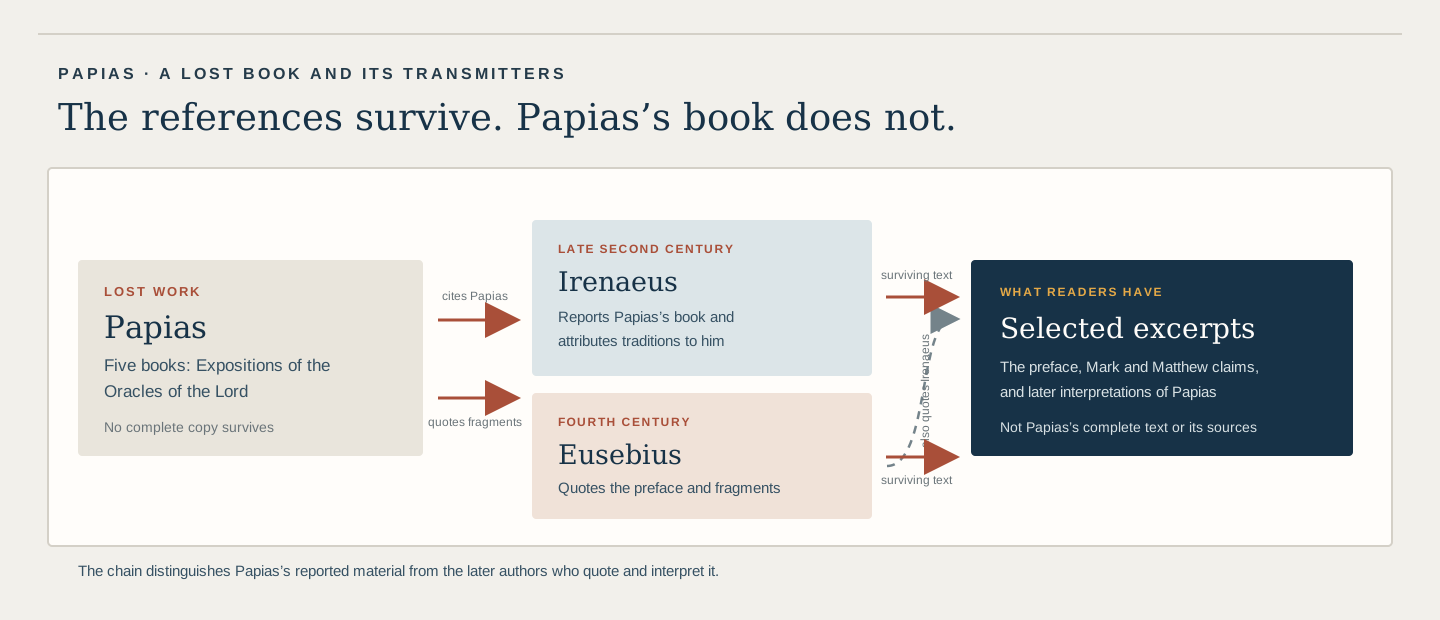
Eusebius says that Papias wrote five books titled Expositions of the Oracles of the Lord. Irenaeus also refers to the five-book work. Papias’s text is not extant as a complete book: the passages available to readers are quotations and summaries in later Christian writers.
Irenaeus, writing in the late second century, cites Papias for a teaching about the material kingdom. Eusebius, writing in the fourth century, quotes Papias’s preface and preserves statements about Mark and Matthew. In the site’s chronology, those surviving documentary references are later than Marcion; proposed earlier dates for Papias’s activity are reconstructions, not dates recorded on a surviving copy.
Papias describes questioning followers of elders
In the preface excerpt preserved by Eusebius, Papias says he asked visitors who followed elders what Andrew, Peter, Philip, Thomas, James, John, Matthew, Aristion, and John the elder had said or were saying. He says he valued the ‘living voice’ over what could be obtained from books. The account presents a method of collecting reports, not a transcript of conversations that can now be checked.
Papias does not say that he met Jesus. Eusebius reads the preface as Papias acknowledging that he had not been a hearer or eyewitness of the apostles and had received teaching through their associates. That reading fits the passage’s stated chain of informants; the surviving words do not name a source for each individual report.
The John link is disputed by the transmitters
Irenaeus calls Papias a hearer of John and a companion of Polycarp. Eusebius reads Papias’s preface differently: he notes that John appears twice, once with the apostles and again as ‘the presbyter,’ and concludes that Papias heard Aristion and the presbyter John rather than the apostle John. Those are later claims by Irenaeus and Eusebius, not statements preserved in a surviving Papias manuscript.
The fragments leave the identification contested. Eusebius’s two-John reading is an interpretation of the wording; Irenaeus’s assertion of a connection is also a later report. Neither establishes a direct link from Papias to an eyewitness of Jesus.
Mark: Papias quotes an unnamed presbyter
Eusebius introduces a tradition Papias gave about Mark, then begins the quoted material with ‘the presbyter used to say.’ In that report, Mark is described as Peter’s interpreter, writing accurately what he remembered about things said or done by the Lord, but not in order. The statement adds that Mark had neither heard nor followed the Lord and later followed Peter.
This is a nested attribution: Eusebius transmits Papias, who transmits an unnamed presbyter. The fragment does not say Papias interviewed Peter or Mark, and it supplies no independent record for the claimed relationship. The source itself presents Mark as someone who did not hear Jesus directly.
The Mark attribution does not identify a manuscript
Eusebius frames the passage as a tradition about Mark, ‘the author of the Gospel.’ The quoted report does not name a manuscript, provide a title page, or say that its Mark is the writer of the anonymous Gospel text now transmitted under that name. The Gospel itself names no author. Identifying the figure in this report with the author of the canonical Gospel is a later attribution, not something demonstrated by a Papias copy.
Even if the identification is accepted, the report is not an independent account of Jesus’s life: it is a later author’s report of what an unnamed elder said about Mark and Peter. Its claim of accurate recollection cannot be checked against the lost conversations it invokes.
Matthew: a Hebrew collection of ‘oracles’
Eusebius preserves a short statement attributed to Papias: Matthew arranged the oracles in the Hebrew language, and each person interpreted them as best they could. Papias does not quote this work, describe its contents, name a translator, or connect it to a surviving manuscript.
The identification with the Greek Gospel of Matthew is an inference. The line does not explain how the supposed Hebrew text relates to the Greek work or establish that the surviving Gospel is a translation of it. Without Papias’s book or the Hebrew work he mentions, those steps cannot be verified from this fragment.
Other fragments preserve stories and interpretation
Eusebius says Papias also reported a resurrection story he had heard from Philip’s daughters, the survival of Justus Barsabbas after drinking poison, and teachings received through unwritten tradition. He links Papias with a literal expectation of a thousand-year kingdom and abundant harvests. These are reports preserved by later authors, not surviving passages in Papias’s own book.
Irenaeus uses Papias’s material about the earthly kingdom as support for his own interpretation. Eusebius rejects Papias’s reading and criticizes his judgment. Their disagreement shows how later Christian writers selected, used, and evaluated Papias; it does not turn the traditions he reports into contemporary evidence for Jesus.
What Papias can establish
The fragments establish that later Christian writers attributed a five-book work to Papias and preserved claims about elders, Mark, Matthew, and other traditions. They do not provide Papias’s complete argument, an inspectable copy of his sources, or a contemporary account of Jesus.
On this site’s documentary chronology, the surviving references are post-Marcion. Papias’s conventional placement earlier in the second century depends on later testimony and reconstruction. His reported chains of oral authority therefore cannot be treated as first-century documents or independent confirmation of the Gospel biography.
Chronology check
Evidence by date
| Date or period | Source | What it says or does | What it cannot establish |
|---|---|---|---|
| Composition date reconstructed; the work is lost | Papias, Expositions of the Oracles of the Lord | Irenaeus and Eusebius describe a five-book work and preserve selected reports attributed to it. | No complete Papias text or dated copy survives; the proposed early-second-century date comes from later chronology. |
| Late second century | Irenaeus, Against Heresies 5.33.3–4 | Irenaeus attributes a material kingdom tradition to Papias and calls him a hearer of John and companion of Polycarp. | Irenaeus is a later transmitter; his statement does not document Papias’s contact with Jesus or verify the oral chain. |
| Fourth century | Eusebius, Church History 3.36.2 | Eusebius places Papias as bishop of Hierapolis in his succession narrative. | This is Eusebius’s later chronology, not a date supplied by Papias or a contemporary document. |
| Fourth century | Eusebius, Church History 3.39.1–8 | Eusebius quotes the preface, discusses Papias’s sources, and argues that the two mentions of John refer to two people. | The surviving preface is excerpted by Eusebius; his distinction between the two Johns is an interpretation. |
| Fourth century | Eusebius, Church History 3.39.14–15 | Eusebius presents Papias’s account of Mark, which quotes an unnamed presbyter describing Mark and Peter. | This is a three-stage report, not a surviving statement by Mark, Peter, or a direct eyewitness to Jesus. |
| Fourth century | Eusebius, Church History 3.39.16 | Eusebius attributes to Papias a claim that Matthew arranged Hebrew ‘oracles’ and reports a story associated with the Gospel according to the Hebrews. | The Hebrew work is unidentified and unavailable; the fragment does not establish that it was the Greek canonical Matthew. |
| Late second- and fourth-century citations | Irenaeus, Against Heresies 5.33; Eusebius, Church History 3.39.9–13 | The later writers transmit Papias’s material kingdom interpretation and stories about miraculous events. | Their citations establish what these later authors report, not the events or teachings as contemporary facts. |
The case
Papias is evidence for later Christian claims about oral teaching and the origins of texts. His Mark passage is reported through Eusebius as Papias quoting an unnamed presbyter; his Matthew line names no surviving work. Neither fragment independently verifies Gospel authorship, an eyewitness chain, or the events narrated in the Gospels.
Conclusion
Papias’s surviving fragments are later reports about claimed sources and texts. They do not establish that Papias met Jesus, that the Gospel attributions are correct, or that the Gospel Jesus existed.