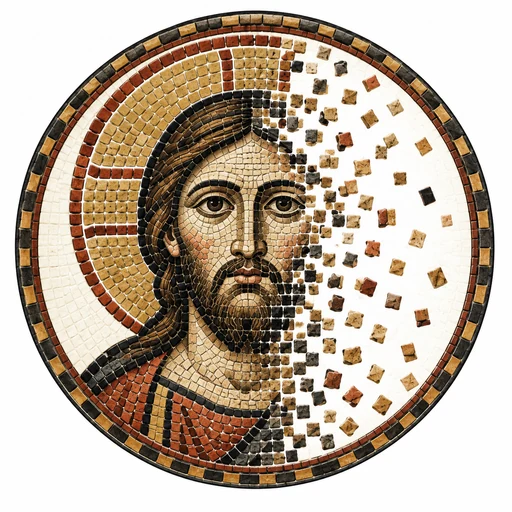
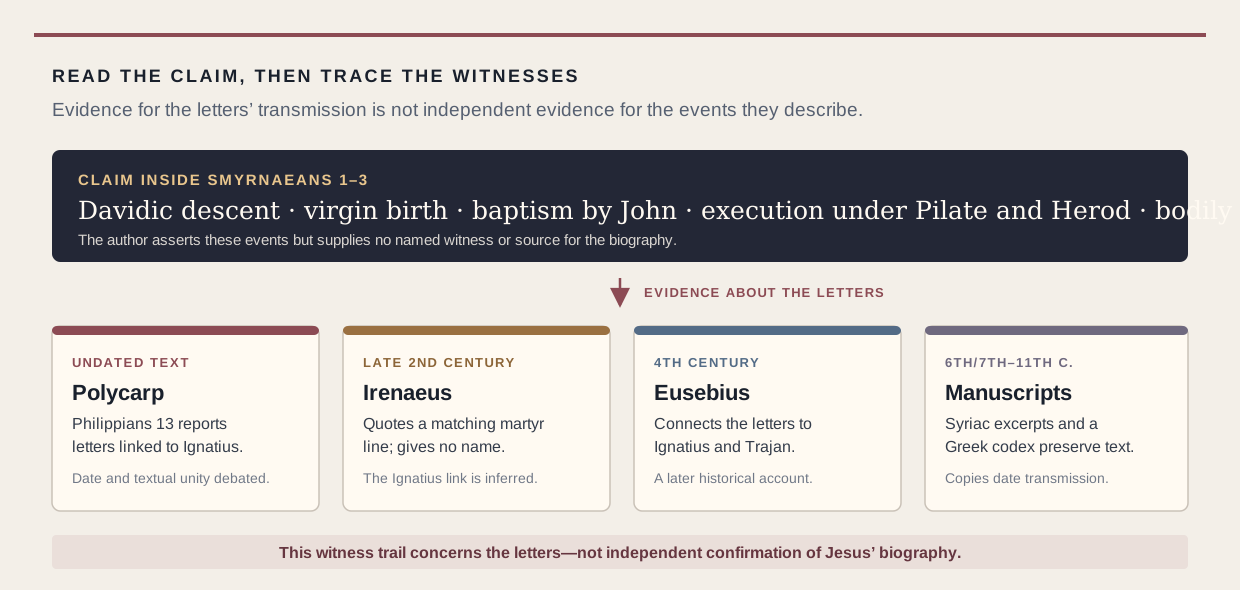
The seven-letter Middle Recension says Jesus descended from David, was born of a virgin, baptized by John, and executed under Pontius Pilate and Herod. It gives no named witness or source for those claims.
Three recensions, not one fixed text
The corpus survives in three principal forms. The Middle Recension contains seven letters: Ephesians, Magnesians, Trallians, Romans, Philadelphians, Smyrnaeans, and Polycarp. A shorter Syriac form preserves three letters; the Long Recension expands the seven and adds six more. The seven-letter Middle Recension is the form used in modern critical editions, but acceptance of that text does not settle who wrote it or when.
The Long Recension is a later expansion, and its additions cannot be treated as evidence from the author of the Middle Recension. Debate also continues over the date and authenticity of the seven-letter collection. Those are separate questions: a text can preserve an early source and still contain later editing, or be a later composition in an earlier author’s name.
Smyrnaeans states the biography
Smyrnaeans 1 says Jesus was descended from David, born of a virgin, baptized by John, and crucified under Pontius Pilate and Herod. The wording combines scriptural language: the Davidic descent echoes Romans 1:3, and the baptism clause echoes Matthew 3:15. The letter presents these points as things to affirm; it does not identify who first reported them.
Smyrnaeans 2–3 insists that Jesus suffered and rose in the flesh. The author gives no first-person memory of Jesus and names no eyewitness, document, or independent source behind the biography. The passage establishes what this Christian text asserts, not that each narrated event occurred.
The ‘only seemed to suffer’ dispute
In Smyrnaeans 2, the author attacks people described as saying that Jesus only appeared to suffer. He repeats ‘truly’ to emphasize physical suffering and resurrection. The passage is a polemic: it preserves the author’s portrayal of his opponents, not their own account of what they believed.
That argument tells us that the author considered bodily suffering important to his theology. It does not independently verify a crucifixion. Nor does a hostile label tell us that every person he calls an opponent belonged to one organized group or held the same position.
Bishops and the community the letters address
The letters repeatedly urge communities to obey a single bishop alongside presbyters and deacons. Magnesians 6–7 compares obedience to the bishop with obedience to God and tells the community to act together under that authority. These are forceful prescriptions, not neutral descriptions of every Christian community.
The passages document the leadership model promoted by the author of these letters. They do not establish that all earlier communities had this structure, or date Jesus’ life. Using them to reconstruct church development requires dating the letters independently of the institutional model they advocate.
Polycarp does not date Ignatius before Marcion
The letter attributed to Polycarp says that Ignatius was remembered among people who had suffered (chapter 9) and that letters sent by Ignatius were forwarded to Philippi (chapter 13). Those statements occur inside an undated text; they do not independently date Polycarp’s letter or the letters it mentions.
The conventional early-second-century setting depends on attribution, reconstruction of the letter’s unity, and later historical identifications. Chapters 13–14 are preserved in Latin in the manuscript tradition; Eusebius later quotes chapter 13 in Greek. These facts document later transmission. They do not establish that the Polycarp text or Ignatius’ letters existed before Marcion. There is no evidence that this passage predates Marcion; the proposed early date is a reconstruction, not a date in the text.
Irenaeus quotes a matching line without naming Ignatius
In Against Heresies 5.28.4, conventionally dated to the late second century, Irenaeus quotes an unnamed Christian condemned to beasts: ‘I am the wheat of Christ, and am ground by the teeth of the wild beasts.’ The wording closely matches Romans 4.1 in the Ignatian corpus.
Irenaeus does not name Ignatius, Antioch, or a letter. Identifying his unnamed speaker with the author of Romans is a strong textual comparison, but it remains an identification by later readers. If accepted, the passage establishes that this saying circulated by Irenaeus’ time; it does not establish the seven-letter collection’s author, its early date, or an independent source for Jesus’ life.
Eusebius supplies the Trajan setting
Writing in the fourth century, Eusebius places Ignatius in a succession of Antiochene bishops and says that ‘report’ has him sent from Syria to Rome and killed by beasts. He identifies letters associated with Ignatius and cites both Polycarp and Irenaeus in support. Those citations are a transmission chain inside Eusebius’ account, not two additional contemporary reports of the journey.
Eusebius also quotes a passage from Smyrnaeans about Jesus after the resurrection and says it was ‘taken I know not whence’ (Church History 3.36.11). That is Eusebius’ comment on the quotation’s source; it does not prove the passage was fabricated, but he supplies no source for it. The letters themselves do not name Trajan or give a year. Eusebius’ account explains the conventional Trajanic date; it does not turn that date into a contemporary record. Later narratives about Ignatius’ death must be assessed separately, not silently folded into the letters.
The manuscript witnesses are centuries later
A sixth- or seventh-century Syriac manuscript, Deir al-Surian Sir. 28A, preserves excerpts from Ephesians, Trallians, Romans, and Smyrnaeans. It is an important physical witness to the later transmission of these letters. It is not a first-century or early-second-century copy.
The Greek codex Biblioteca Medicea Laurenziana Plut.57.7 is catalogued to 1001–1100 CE and includes letters attributed to Ignatius. Folio 242r is part of that Ignatian section. The page shown here is a medieval copy: it documents the text’s transmission, not the date when the letters were composed or the existence of their author. Manuscript dates and proposed composition dates answer different questions.

Stylometry raises a composition question
Christ Before Jesus reports several stylistic groupings within the Ignatian letters. Such groupings can help identify differences across a corpus, but they do not return a date or name an author. Results depend on the Greek edition, passage divisions, sample size, and comparison texts. A cluster is evidence to examine alongside textual and historical evidence, not proof of forgery by itself.
The separate [stylometry analysis](/evidence/stylometry/) explains the book’s method and the limits of its authorship claims. The presence of stylistic variation matters to the question of layers; it does not independently establish that the letters were written before or after 144 CE.
What these letters establish
Taken at face value, the letters establish that their author presents Jesus as a fleshly, Davidic figure who was baptized and executed under named rulers, and that the author argues against Christians said to deny his bodily suffering. The letters do not supply an eyewitness statement, identify a source for the biography, or independently corroborate the events they assert.
Polycarp chapter 13 is sometimes used to date Ignatian letters before Marcion. That conclusion depends on assigning an early date and an integral form to another undated text. The passage itself supplies neither date. No evidence establishes that Polycarp’s letter or the Ignatian letters it mentions predate Marcion, and these texts do not furnish an independent record of Jesus’ life. The manuscript witnesses are later still.
Attestation audit
What the Ignatius evidence dates—and what it says
| Date or proposal | Source | What it says or does | What it cannot establish |
|---|---|---|---|
| Early second century · traditional composition proposal | Eusebius, Church History 3.36; later dating scholarship | Eusebius places Ignatius under Trajan; the letters themselves name no emperor or year. | A fourth-century chronology is not a contemporary date. Early composition is a reconstruction, and modern discussion separates date from authenticity. |
| Undated text · date and unity disputed | Polycarp, Philippians 9 and 13 | The text names Ignatius and reports that letters associated with him were sent to Philippi. | This is a serious early-circulation argument if the relevant chapters are early and integral. The letter gives no year; its date and the unity/transmission of chapters 13–14 are disputed. |
| Late second century · conventional dating | Irenaeus, Against Heresies 5.28.4 | Quotes an unnamed Christian condemned to beasts using wording that matches Ignatius, Romans 4.1. | Irenaeus does not name Ignatius or the letter. The identification is an inference; the passage does not date the complete corpus or corroborate Jesus’ life. |
| Fourth century | Eusebius, Church History 3.36 | Reports the Trajanic setting, Ignatius’ journey and death, and the letters associated with him. | This records Eusebius’ later account and the corpus known in his time, not a contemporary account of the journey or execution. |
| Sixth–seventh century manuscript | Deir al-Surian Sir. 28A · Syriac excerpts | Preserves excerpts from four Ignatian letters in a Syriac witness to the corpus. | The copy shows the letters’ later transmission. It does not establish when the underlying compositions were written. |
| 1001–1100 CE · Greek codex | Biblioteca Medicea Laurenziana, Plut.57.7, fol. 242r | A Greek manuscript catalogued as containing letters of Ignatius; the digitized folio shown above belongs to that section. | A medieval manuscript is evidence for the text at the date of copying, not an autograph or a contemporary witness to Jesus. |
The case
The letters document a Christian author insisting on a fleshly Jesus while arguing against people said to deny his physical suffering. That is evidence for the author’s theology and dispute. It is not an independent biography or a source chain to Jesus. The early date and attribution are reconstructions contested in current scholarship.
Conclusion
Ignatius’ letters show how a Christian writer framed Jesus’ birth and death. They do not independently verify those events, and the proposed early date depends on disputed textual and historical links.