The anonymous text presents Jesus as God’s servant in its meal prayers and refers to a ‘Gospel’; it gives no continuous account of his life, death, or resurrection.
Read the book’s actual contents
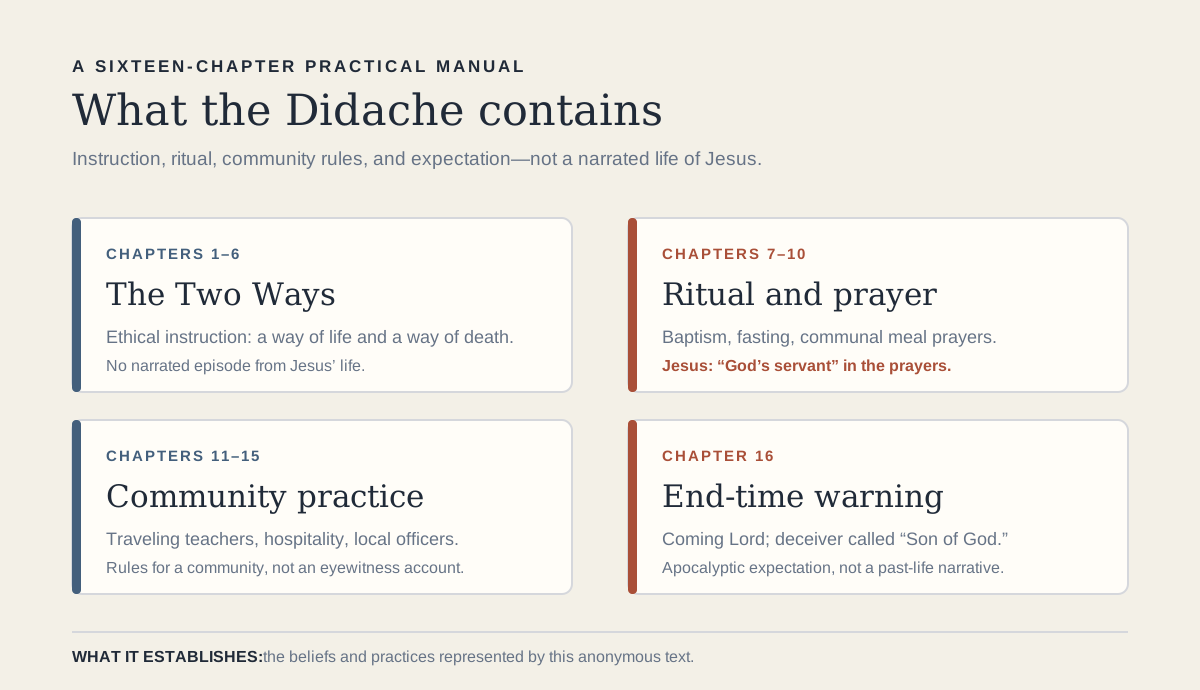
The sixteen chapters form a practical manual, not a letter or a life of Jesus. Chapters 1–6 give the ‘Two Ways’ moral teaching; 7–10 prescribe baptism, fasting, prayer, and thanksgiving at meals; 11–15 regulate itinerant teachers, prophets, hospitality, offerings, and local leaders; chapter 16 closes with an end-time warning.
Those topics matter because the text’s primary evidence is about instruction and community practice. The manual never narrates a birth, hometown, ministry, trial, execution, or resurrection, and it names no person who witnessed such events.
The Jesus the prayers describe
In Didache 9–10, Jesus appears as God’s servant through whom the ‘holy vine of David,’ life, and knowledge were made known. The community asks God to gather the Church into the coming kingdom; the prayers do not retell a Last Supper scene or describe Jesus’ body, blood, death, or resurrection. Chapter 16 calls an end-time deceiver the ‘Son of God’ and expects the Lord to appear; it is apocalyptic teaching, not a report of a past public career.
These lines are direct evidence for the text’s theology and ritual language. They do not supply a first-person observer, location, named source, or independently checkable event. Calling Jesus ‘servant’ and invoking David are theological claims within the manual, not a biography.
‘The Gospel’ and the Matthew parallels
Didache 8.2 says to pray as the Lord commanded ‘in his Gospel’; 11.3 says to handle apostles and prophets ‘according to the decree of the Gospel’; 15.3 refers to the Gospel of the Lord. None names Matthew, Mark, Luke, or John. The opening chapters contain sayings with close parallels in Matthew and Luke, including material resembling the Sermon on the Mount and Sermon on the Plain.
A post-Matthew date for a section follows only if two premises are accepted: a first-century date for Matthew and direct literary dependence by the Didache. Similar wording can instead reflect a shared sayings collection or a different direction of borrowing. The text gives no independent date that settles those choices. On this site’s chronology, conventional first-century Gospel dates are reconstructions, so they cannot be used as proof that the Didache attests a first-century Jesus.
The Didache does not name Paul or quote a letter attributed to him. That silence cannot independently date the manual: its instructions address ethics, rites, hospitality, and local governance, not a survey of Christian authors or writings.
What the early-date case is built from
Arguments for a first-century or early-second-century date commonly read the text's itinerant apostles and prophets alongside its local bishops and deacons as evidence of a particular stage in community organization. They also point to the meal prayers’ form, the urgency of chapter 16, and the sayings shared with Matthew. These clues are real features of the text; the date assigned to them is an inference.
The text does not say when itinerant teachers or local officers first appeared, and neither a prayer's form nor an urgent end-time warning carries a calendar date on its own. The Matthew argument additionally requires both a date for Matthew and a direction of literary dependence. Claims that the work accumulated in identifiable stages are reconstructions: no surviving manuscript preserves earlier drafts or marks the proposed layers.
At best, these clues suggest a relative arrangement if the proposed literary relationships hold. They supply no independently dated external anchor and do not establish composition before 144 CE. On this site's chronology, the first documentary anchor remains the Marcion-era record around 144 CE.
Irenaeus does not date the Didache
A proposed Irenaeus-to-Didache relationship sometimes rests on broad similarities in Eucharistic language, church order, and Two Ways imagery. No exact Two Ways quotation from Irenaeus is identified. The specific offering parallel is narrower: Didache 14 calls the community’s offering ‘pure’ and quotes Malachi 1:11; Irenaeus, Against Heresies 4.18, also interprets the Church’s offering through Malachi. Both use the same biblical source; Irenaeus does not quote or name the Didache.
These parallels do not establish direction. Similar community roles or meal language are not distinctive enough to show that Irenaeus wrote material later inserted into the Didache. Dating the Didache by a thematic resemblance to Irenaeus would repeat the conventional date assigned to Irenaeus rather than supply independent evidence. Without a specific verbal parallel or external date, Irenaeus supplies no date for the manual.
The Stromata parallel and its attribution
The work transmitted as Stromata 1.20.100.4 has a close match to Didache 3.5: ‘My child, be not a liar, since a lie leads the way to theft.’ The passage does not name the Didache or identify a source. It may reflect a shared instruction, one text’s use of the other, or a source both used.
The surviving Greek Stromata is transmitted in a medieval manuscript, not an author’s autograph. Eusebius, writing centuries later, identifies Clement as its author and says Book I’s chronology runs through Commodus’ death. That date is grounded in the chronology printed in the text, which ends its count at Commodus; if the received text and attribution are accepted, Book I was written after 192. Neither Eusebius nor the Stromata passage says Clement copied the Didache.
At most, the parallel attests the saying in a later textual record under the received attribution. It cannot date all sixteen Didache chapters, prove the heading’s apostolic claim, or turn the meal prayers into eyewitness testimony.
Fragments, versions, and the complete Greek copy
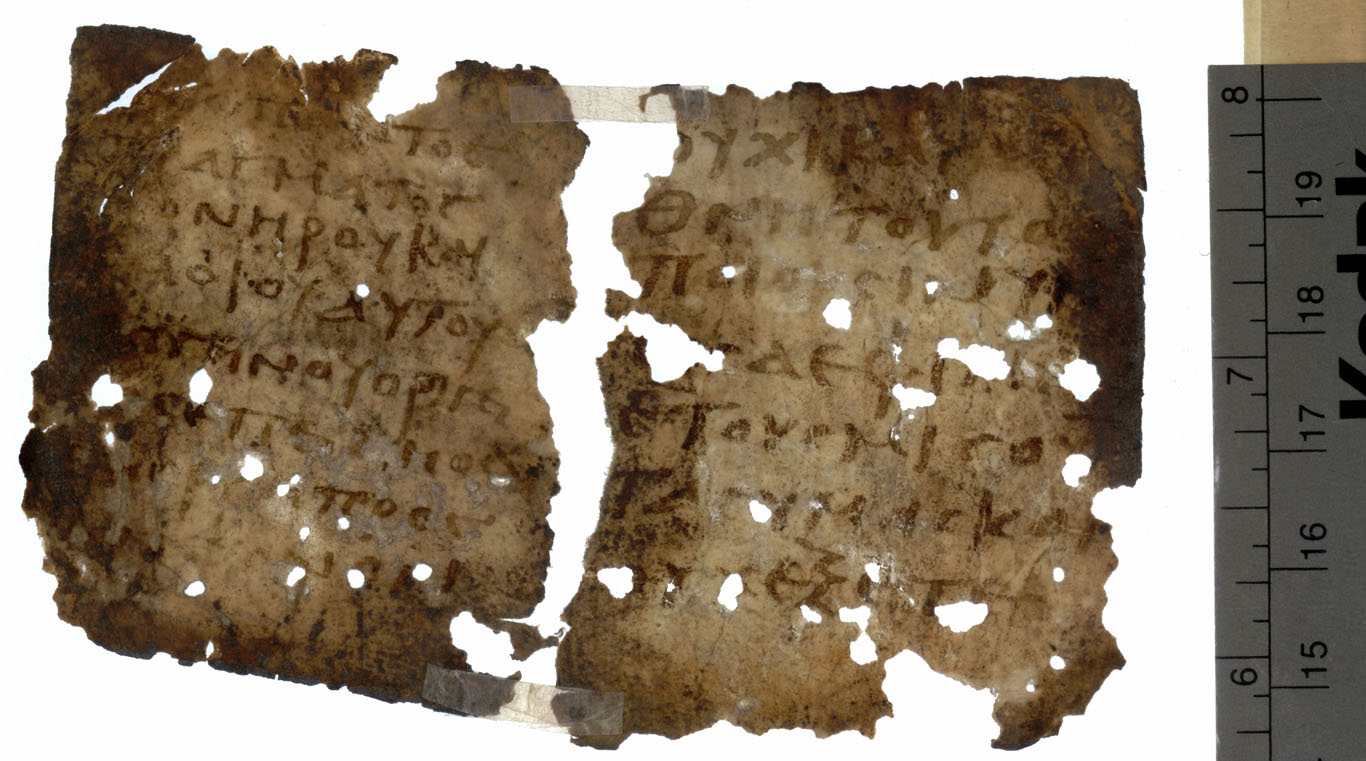
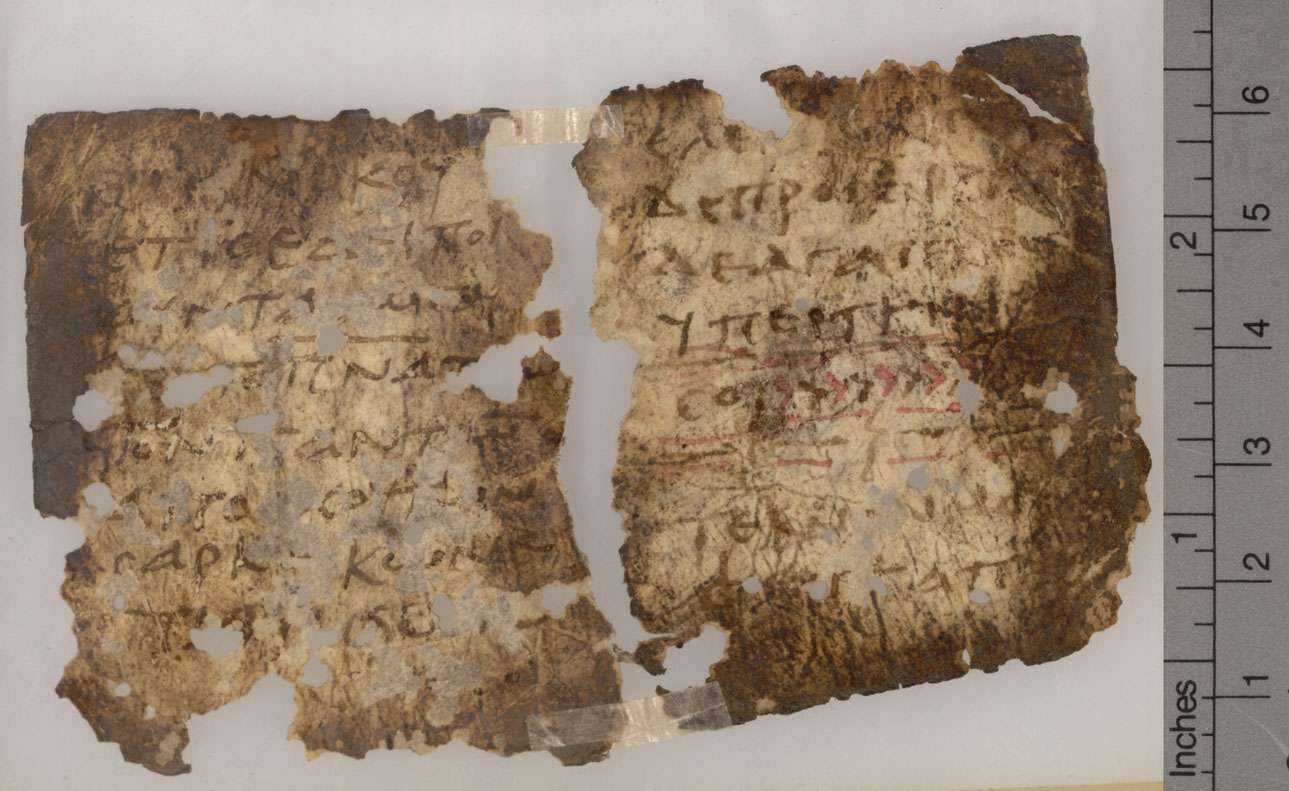
The manuscript story is larger than ‘two copies.’ P.Oxy. XV 1782 preserves two short Greek fragments from the Two Ways section and is assigned to the late fourth century by handwriting. A Coptic papyrus, British Library Or. 9271, preserves Didache 10.3b–12.2a and is usually placed around the late fourth or early fifth century. Both are fragments, not complete copies.
The complete continuous Greek text survives in Codex Hierosolymitanus 54, copied in 1056. Bryennios rediscovered the codex in 1873 and published the Didache in 1883. A Latin Doctrina Apostolorum preserves a related form of the Two Ways material; it is not a second full translation of all sixteen chapters. Book VII of the Apostolic Constitutions reuses and adapts Didache material. An Ethiopic church-order text also preserves related material, but the translation and extent of that witness are uncertain.
These witnesses are not two equivalent ‘copies’: they preserve different portions, languages, and textual forms. Paleography dates a copy; it does not date first composition. No first-century Didache manuscript has been identified.
Eusebius and Athanasius: reception, not origin
In Church History 3.25.4, Eusebius lists the ‘Teachings of the Apostles’ among writings he classifies as rejected, then groups such works with disputed books. That plural title is usually linked to the Didache, but Eusebius gives no chapter count or description that identifies it with certainty as the sixteen-chapter text now preserved.
Athanasius’ Festal Letter 39, dated to Easter 367, places the Teaching of the Apostles outside the canon but recommends it for instruction of new converts. ‘Rejected’ and ‘not canonical’ are not the same as ‘dismissed as nonsense’ or ‘unknown everywhere.’ These lists show how later church authorities ranked a text; they do not establish when it was composed or whether its apostolic title is true.
What the Didache contributes to the case
The Didache records the beliefs and practices represented by its compiler: ethical instruction, baptism, fasting, communal thanksgiving, itinerant prophecy, local officers, and expectation of the Lord’s return. Its prayers name Jesus and attach him to Davidic and servant language. That is evidence about a Christian text and the tradition it presents.
It is not independent evidence for a first-century Jesus biography. The central chronology claims depend on uncertain literary direction, reconstruction of layers, and conventional dates assigned to related texts. The known physical copies date from later centuries; nothing in the Didache itself names a first-century author or witness.
Text and witness audit
What each Didache source can establish
| Evidence | Source | What it says or does | What it cannot establish |
|---|---|---|---|
| The heading | Title preserved in Codex Hierosolymitanus | Attributes the teaching to the Lord and the Twelve Apostles. | A title states the authority claimed by the text; it names no human author, witness, or date. |
| The Two Ways | Didache 1–6; Barnabas 18–20; Doctrina Apostolorum | Related moral instruction survives in several forms, with verbal overlap and differences. | Parallel material establishes a shared textual tradition. It does not, by itself, identify which form came first or when. |
| The Jesus references | Didache 9–10; compare 7, 8, 11, and 14–16 | The meal prayers name Jesus as God’s servant; other passages contain baptism, Gospel, community-meal, and end-time instructions. | The manual names no witness to an event and narrates no continuous life of Jesus. |
| Sayings and ‘the Gospel’ | Didache 1.3–2.1; 8.2; 11.3; 15.3 | The manual contains sayings parallel to Synoptic material and refers to ‘the Gospel’ without naming a book or author. | Similarity alone cannot decide direct dependence, a common source, or composition date. Dating the sayings is not dating every section of the manual. |
| Arguments for an early composition | Didache 7–16; parallels with Matthew and Barnabas | Proposed dates draw on Gospel parallels, itinerant teachers alongside local officers, and readings of the meal prayers and final chapter as early forms. | These are interpretations of the text, not external dates. Each depends on assumptions about literary direction, social chronology, or reconstructed layers. |
| The Stromata parallel | Stromata 1.20.100.4; Didache 3.5; Eusebius, Church History 5.11 and 6.6 | Both texts use the saying that a child should not lie because lying leads to theft. Eusebius later attributes the Stromata to Clement and says its chronology reaches Commodus’ death. | The Didache is not named. Clement’s authorship is an external attribution, not a signed autograph; even accepting the received attribution and post-192 date does not date the whole Didache. |
| The Irenaeus comparison | Didache 14.1–3; Irenaeus, Against Heresies 4.18 | Both describe a pure offering and draw on Malachi; the Didache also gives a community meal instruction. | The shared scriptural source explains the wording. Irenaeus does not identify or quote the Didache, so the thematic comparison does not date the manual. |
| P.Oxy. XV 1782 | Two short fragments; recto 1.3d–4a and verso 2.7b–3.2b | An estimated late-fourth-century witness preserves small portions of the Two Ways section. | The date belongs to this fragment, not the composition of the work; it contains neither a full copy nor the Jesus meal prayers. |
| Coptic fragment Or. 9271 | Didache 10.3b–12.2a | A Coptic witness, commonly dated around the late fourth or fifth century, preserves part of the meal and itinerant-teacher sections. | It is fragmentary. Its surviving endpoint does not show that the original work ended at 12.2. |
| Apostolic Constitutions VII | A later church-order compilation reworks Didache material | Preserves adapted material and additional text beyond the end of the complete Greek witness. | An adaptation is evidence for later reuse, not a second independent copy of the Didache in its original form. |
| Codex Hierosolymitanus 54 | The only complete continuous Greek witness; copied in 1056 | Preserves the sixteen-chapter Greek text; Bryennios rediscovered the codex in 1873. | A medieval copy transmits the text but does not establish when its composition began. |
| Later reception | Eusebius, Church History 3.25.4; Athanasius, Festal Letter 39 | Eusebius lists the ‘Teachings of the Apostles’ among rejected/disputed writings; Athanasius places the Teaching outside the canon but recommends it for instruction. | These are later classifications. They do not authenticate apostolic authorship or fix the text’s date. |
The case
The Didache records Jesus-centered teaching and ritual in an anonymous manual. Its title is not an author’s signature, and its prayers are not a biography. Proposed composition dates depend on literary comparisons and reconstructions; no first-century manuscript has been identified. On this site’s chronology, the Didache does not establish a historical Jesus or a first-century Gospel before the Marcion-era record.
Conclusion
The Didache attests to Christian instruction and worship in the text’s recoverable transmission. It does not independently attest events in a first-century Jesus biography.