Justin's writings describe a second-century Christian Jesus narrative and appeal to Gospel memoirs, scripture, and unproduced Roman records. Dialogue with Trypho stages a Jewish character challenging whether the expected Christ exists and has appeared.
The manuscript trail is later than the proposed composition
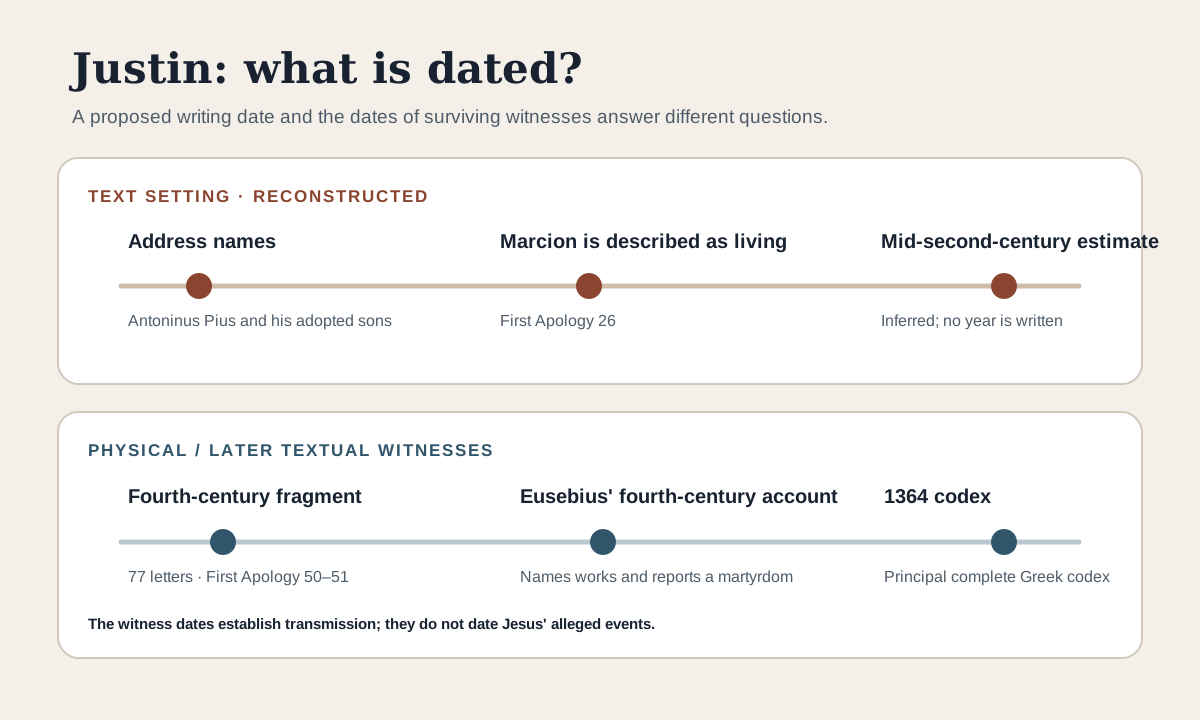
The earliest physical witness now known is P.Oxy. LXXVIII 5129, a fourth-century parchment fragment preserving about 77 letters from First Apology 50.12 and 51.4–5. It demonstrates that a small part of the text circulated by the fourth century. It does not preserve the chapters about Jesus' birth, Pilate, the Gospels, or Justin's own date clues.
Most of the Greek text depends on Parisinus graecus 450, a BnF codex completed on 11 September 1364. A later London manuscript has traditionally been treated as a copy of the Paris codex; Bobichon examines that proposed dependence. Neither codex is a contemporary copy of Justin's proposed lifetime. Eusebius, writing in the fourth century, identifies works under Justin's name and quotes related material. His account is a fourth-century attribution witness, not an author's external signature.
The two Apologies' arrangement and relationship are debated: the principal codex places what modern editions call the Second Apology before the First, and scholars dispute whether the material was composed as one work or two. This textual history calls for precision about which wording is being cited; neither arrangement supplies a first-century source.
‘Memoirs of the apostles’ and the Gospels
First Apology 66 calls written material ‘memoirs’ composed by apostles and says these are called Gospels. Justin uses one of them to support his account of the bread and cup; chapter 67 says memoirs of the apostles or prophetic writings are read at the weekly gathering. In Dialogue 103 and 106 he again appeals to apostolic memoirs for details of Jesus' birth, sayings, death, and resurrection.
The strongest counterargument is textual: many of Justin's quotations and story details closely parallel material in the Gospels now attributed to Matthew, Mark, Luke, and John. That overlap is real evidence that Justin drew on Gospel-like writings. It establishes their use within the setting of Justin's text; it does not establish that the named apostles wrote the later canonical books or date those books to Jesus' lifetime. Justin does not name the four books or assign them the familiar four author-names. Scholarship also notes that his quotations sometimes differ from the later Greek Gospel text, and debates whether those differences reflect adaptation, a harmonized source, or other textual forms.
Justin's statement that apostles composed the memoirs is his authorship claim, not independent verification of it. Even if his citations are identified with the canonical Gospels, a second-century citation establishes that the material was available by Justin's writing horizon; it does not move its first documentary setting into the first century.
Scripture is Justin's proof, not an independent witness
Justin builds his case by reading Jewish scripture as predictions of Jesus. In the Apology and Dialogue he interprets passages from Psalms, Isaiah, Micah, and other books as forecasts of the birth, ministry, crucifixion, and resurrection. The argument shows how Justin connected scripture to a Christian narrative. A later author's interpretation of an older passage is not a contemporary account of the event being interpreted.
In Dialogue 71–73, Justin alleges that Jewish teachers removed passages that supported the crucifixion, including the words ‘from the wood’ in Psalm 96. He offers the allegation inside the polemic, but provides no earlier manuscript containing the disputed wording. The accusation cannot authenticate itself: without an independent witness to the alleged earlier text, it is Justin's claim about scripture, not proof that a first-century event fulfilled it.
The census and Acts of Pilate are assertions, not produced records
In First Apology 34, Justin says Jesus was born in Bethlehem and points readers to registers of the census under Quirinius. He does not quote an entry, identify a surviving archive, or provide a document that can be checked. The passage records Justin's appeal to a register; it does not place the register itself before the reader.
In chapters 35 and 48 he says details of Jesus' crucifixion and deeds can be learned from the Acts of Pontius Pilate. Justin supplies no copy, archival location, date, or chain of custody for such a report. The appeal documents a second-century Christian claim that Pilate records confirmed the story; it is not an independently examined Roman record. The site treats the alleged Pilate document in its dedicated [Pontius Pilate analysis](/evidence/pontius-pilate/).
Marcion appears; Paul and a Pauline collection do not
First Apology 26 names Marcion as a living teacher and attacks his view of God. Justin does not identify a Gospel used by Marcion in this passage, and his extant works do not name Paul or cite a letter as Paul's. Justin's text therefore supplies no evidence for a Pauline collection before the Marcion-era record.
The distinction matters for the chronology argued here. Justin's mention of Marcion places his own authorial setting in the second-century disputes around the Marcion-era horizon. Irenaeus and Tertullian later supply the explicit descriptions of Marcion's Gospel and letters attributed to Paul; their reports are not documents from 144 listing the texts. See the site's [Marcion analysis](/evidence/marcion/) for that source chain.
Read the exchange in sequence
The opening chapters present Justin's account of searching for wisdom and meeting an old man who directs him to the Jewish prophets. In chapter 8 that story ends. Justin then urges Trypho and his companions to become acquainted with Christ; after the group laughs, Trypho answers with the disputed line. Chapter 9 has Justin promise to defend the Christian claim rather than leave the challenge unanswered.
The wording is part of a crafted Christian dialogue with shifts in speaker, scene, and argument. The book presents an extended encounter, but its literary form does not make the speeches a stenographic transcript.
Christ and Jesus are not interchangeable in this sentence
Trypho's line begins conditionally: Christ, if he has been born and exists anywhere, remains unknown. It continues that he has no power until Elijah comes to anoint and reveal him. In this context, “Christ” means the expected anointed figure; Trypho is challenging Justin's claim that Jesus fulfills that role and that the Messiah has already appeared.
The sentence explicitly questions Christ's existence, so it should not be softened into a mere disagreement about doctrine. But it does not name Jesus, describe a first-century person, or give a source for biographical claims. It is a line in a second-century messianic argument, not evidence about Jesus' life.
Trypho as a character in a Christian dialogue
Justin presents Trypho as a Jewish interlocutor in a Christian literary dialogue. No independent Jewish text identifies this Trypho or records the conversation. The passage documents what the Christian author chose to put into the character’s speech; it is not an independent Jewish testimony or a transcript of a first-century exchange.
Composition date and manuscript witness
The Dialogue is commonly placed around 160 CE, based on historical and literary reconstruction. That proposed composition date is not a date printed in the text or a contemporary report documenting the conversation. Under this site's chronology, the Dialogue belongs to the second-century record, after the proposed Marcion-era horizon around 144 CE.
The principal surviving Greek witness is Codex Parisinus graecus 450, completed in 1364. Modern editions note gaps in the manuscript, including part of the introduction. The date of this medieval copy establishes when that codex was made; it does not establish when the Dialogue was composed or when the narrated conversation took place.
What the passage establishes
On the conventional composition date, the passage shows that a Christian author by about 160 CE represented an argument over whether Jesus was the promised Messiah and whether the Messiah had appeared. It does not show that Jews generally denied Jesus' existence, that Trypho's words are verbatim, or that a first-century person stood behind the Christian claim.
Read as this site's chronology requires, the passage is a later Christian literary witness. Its value is evidence for second-century Christian argument and the way a Jewish objection was framed—not independent evidence for a first-century Jesus.
John and the thousand-year prophecy
Dialogue 81 attributes a prophecy about a thousand-year residence in Jerusalem to ‘a man named John, one of the apostles of Christ.’ The content is commonly connected with Revelation 20. Justin's text does not give the book the title Revelation or supply an independent record of who wrote it; it shows that this dialogue attributes an apocalyptic teaching to an apostle named John.
Eusebius later discusses the possibility of two Johns when interpreting Papias (Church History 3.39). That passage is not a direct refutation of Justin's sentence. It shows later Christian uncertainty about identifying the apostle and the elder mentioned in Papias; neither writer provides an external authorial signature for Revelation.
Worship, leadership, Mithras, and the Chrestian pun
First Apology 61–67 describes baptism, a shared meal, a ‘president,’ deacons, charitable distributions, Sunday readings, and prayer. This is useful evidence for the Christian community Justin presents. The passage neither mentions a pope nor says that no bishop existed. Its short ritual outline cannot establish the absence of a wider hierarchy, and it cannot establish later claims about papal authority.
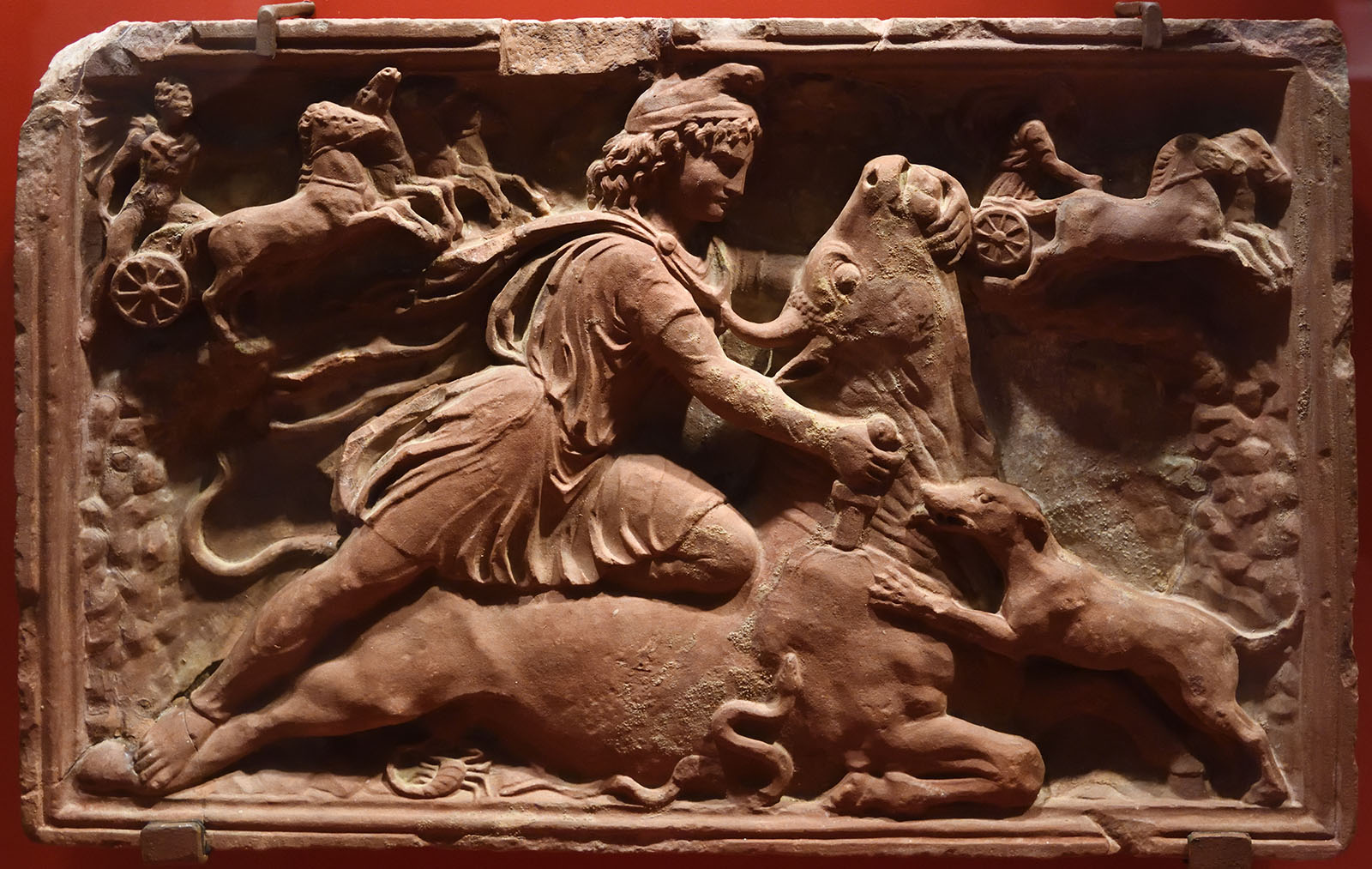
In First Apology 66 and Dialogue 70, Justin says demons copied Christian rites in Mithras worship and connects Mithras' cave and rock birth with scriptural prophecy. Those chapters give Justin's polemical explanation for the similarities he claims. He supplies no chronology showing which ritual came first. The Roman Mithras relief pictured here illustrates the cult's visual record; it does not confirm Justin's account of bread, a cup, or borrowing.
The current English translation of First Apology 4 plays on ‘Christian’ and Greek chrēstos, meaning good or excellent: Justin argues that it is unjust to hate what is good. He does not say that Christians were called ‘Chrestians.’ The passage is wordplay, not evidence that Justin records an alternative group name or a pre-Christian community.
‘Martyr’ and the date 165 come from later biography
The First Apology does not state Justin's birth year or his death year (often given as 165 CE). In Second Apology 3, the speaker says he expects to be plotted against and possibly attacked by Crescens; this is a prediction, not a report of an execution. Eusebius, writing in the fourth century, says Justin was executed after Crescens' plot and attributes the death report to Tatian, whose work Eusebius quotes. Eusebius then presents Justin's earlier warning as a forecast. The Acts of Justin present a trial narrative in later recensions. These sources document the later biographical tradition and the use of the honorific ‘Martyr’; they do not make 165 a date supplied by Justin himself.
Source and transmission audit
What Justin and the Trypho dialogue can date
| Date or period | Source | What it says or does | What it cannot establish |
|---|---|---|---|
| Second-century setting (inferred) | First Apology 1, 26, 31 | The speaker addresses Antoninus Pius and calls Marcion alive; he describes the Bar Kokhba revolt as recent. | The text gives no year of composition or proof that an emperor received the petition. |
| First Apology 34–35, 48 | Justin's references to records | Justin invokes Quirinius' census registers and Acts of Pontius Pilate as support for Jesus claims. | Neither document is quoted, produced, or identified by an independently checkable archive reference. |
| First Apology 66–67; Dialogue 103, 106 | Apostolic memoirs / Gospels | Justin says Gospel memoirs are read and appeals to them for Jesus stories and sayings. | The passages establish Justin's text-use and beliefs, not apostolic authorship or a first-century composition date. |
| Dialogue 71–73 | Alleged scriptural deletions | Justin claims Jewish teachers removed phrases that would prove Christian readings of prophecy. | He supplies no earlier manuscript witness to the alleged readings in this argument. |
| Fourth century | P.Oxy. LXXVIII 5129 | A parchment fragment preserves about 77 letters from First Apology 50.12 and 51.4–5. | It witnesses a small portion of the text by the fourth century; it does not preserve the Jesus-birth or Pilate-record claims. |
| Fourth century | Eusebius, Church History 4.16–18 | Eusebius attributes works and a martyrdom account to Justin and quotes related material. | Eusebius is a later transmitter, not a contemporary witness to Justin or Jesus. |
| Second Apology 3; later account in Eusebius 4.16 | Crescens and Justin's death | The text attributed to Justin predicts a possible attack by Crescens; Eusebius later says Crescens plotted against Justin and that Justin was executed. | A prediction does not verify its fulfillment; the execution narrative reaches us through later Christian testimony, not a contemporary court record. |
| 11 September 1364 | Parisinus graecus 450 | The principal complete Greek codex for the extant Justin corpus was completed on this date. | A medieval copy dates this manuscript, not the composition of every work it transmits. |
| c. 160 CE (proposed composition) | Dialogue with Trypho, attributed to Justin | A Christian dialogue stages an argument with a Jewish interlocutor about Christ and scripture. | The date is reconstructed; the literary text does not independently verify the speakers, exact words, or a first-century Jesus. |
| 11 September 1364 | Codex Parisinus graecus 450 | The principal surviving Greek manuscript witness to the Dialogue; it has lacunae. | This date belongs to the physical copy, not to the work's composition or the encounter it narrates. |
The case
The writings document second-century Christian claims and a Christian author's literary argument. Trypho's line directly questions Christ's existence, but Justin's dialogue does not independently record Jewish speech or a first-century Jesus.
Conclusion
Justin and the dialogue document second-century Christian claims and debate. They do not provide a contemporary record or independent evidence for Jesus' life.