The received text says that people accused of being Christians worshipped Christ, described a fixed-day meeting and an oath against wrongdoing, and faced a loyalty test. Pliny supplies no biography, date, place, or source for the figure called Christ.
The governor asks for a procedure
The first letter begins with Pliny addressing Trajan as ‘my lord.’ Pliny says that people were being reported to him as Christians and that he had never taken part in such hearings. He asks whether age matters, whether someone who recants should be pardoned, and whether the name itself is punishable or only crimes associated with it.
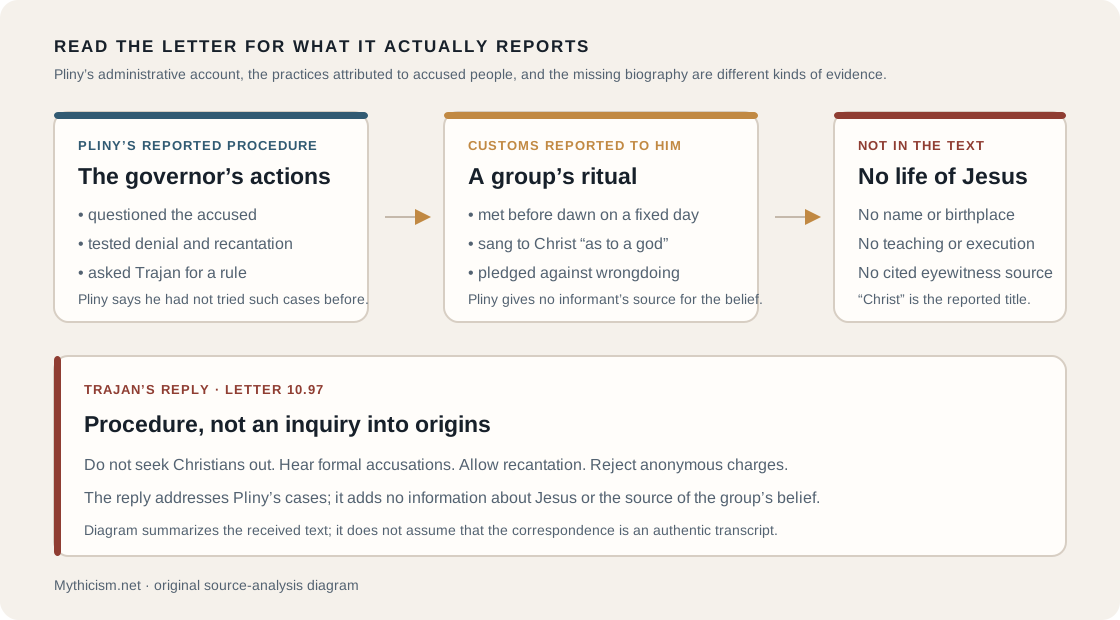
Pliny describes his own procedure: he asks whether each accused person is Christian, questions confessors again and a third time under threat of punishment, and orders persistent confessors led away for execution. People who deny the label are released after performing a test Pliny dictates: invoke Roman gods, offer incense and wine before Trajan’s image and the gods, and curse Christ. Roman citizens are sent to Rome. These are claims made by the letter about the governor’s actions; they are not observations of Jesus or of events in Judaea.
What Pliny says he learned
Pliny says that people who had once been Christians described their former practice. They met on a fixed day before dawn, recited or sang a response to Christ ‘as to a god,’ and bound themselves by an oath not to commit theft, robbery, adultery, fraud, or breach of trust. They later met for an ordinary meal, but stopped holding it after Pliny issued an edict against private associations. He says he tortured two enslaved women described as ministrae and found only what he called an excessive superstition.
Pliny’s word is ministrae, meaning female attendants or servants. Some translations render it ‘deaconesses,’ but that is an interpretation of their role, not the title Pliny gives them. The passage itself does not establish a formal church office.
This is not a report of Pliny interviewing a witness to Jesus. It is the governor’s summary of what accused or former adherents told him about their own customs. The letter gives no names for the informants, no account of how they learned the tradition, and no chain reaching back to a person in Galilee. Its description of worship is evidence about the text’s Christian group; it does not establish the life of the being worshipped.
The phrase ‘to Christ as to a god’
The Latin reads carmenque Christō quasi deō dicere sēcum invicem: the group ‘recited a song to Christ as to a god’ or ‘sang responsively to Christ as to a god.’ The wording identifies the object of the reported ritual with the title Christus. It does not supply the personal name Jesus, a location, a life story, an execution, or a source for the group’s belief.
The distinction matters. Evidence that people worship a figure or title is not automatically evidence that a person matching a later narrative existed. Pliny says nothing about whether the title refers to a recent human, a heavenly figure, or a literary character. The identification with the Gospel Jesus is an interpretation added by readers, not a detail Pliny provides.
The biography Pliny does not give
The letter never names Jesus, Judaea, Galilee, Nazareth, disciples, a messiah, Pontius Pilate, an execution, a resurrection, or a Gospel. It does not say what ‘Christ’ means, when the group began, or whether its object of worship had lived as a human. The phrase ‘Christ as to a god’ is the only description of the worshipped figure.
That absence is not a claim that Pliny had to write a biography in an administrative letter. It identifies the limit of what this text can prove: the passage cannot independently corroborate any event or person in the Gospel biography because it reports none of them.
‘Superstition’ does not settle the origin
One argument says Pliny’s label prava et immodica superstitio (‘depraved and excessive superstition’) would be strange if he understood Christ as a Jewish messianic title. That inference goes too far. Roman writers used superstitio as a polemical label for religious practices they regarded as excessive, foreign, or socially disruptive; its use does not show that Pliny had investigated the group’s Jewish background—or that he had not.
The term supplies Pliny’s hostile evaluation of the practice, not an etymology or origin story for Christ. The text never explains the group’s relation to Judaism, so neither the word superstitio nor the title Christ identifies a historical founder.
Pliny’s career and the trial wording
Comparing Pliny’s long Roman career with later church lists of early Roman bishops raises the question why a well-connected official had not encountered Christian trials before Bithynia. Pliny’s career also overlaps the alleged Domitian-era persecution. Those comparisons raise a question about how visible a Roman Christian group was supposed to be, but Pliny’s own passage says only that he had never taken part in hearings concerning Christians. He does not say he had never heard of them or that Trajan knew nothing about them. His earlier offices did not give him jurisdiction over every provincial case, and this letter says nothing about trials under Domitian.
The bishop names and dates in later succession lists are retrospective church testimony, not contemporary Roman records. They cannot independently establish the scale or public visibility of a Roman congregation during Pliny’s earlier offices. Conversely, Pliny’s lack of prior trial experience does not by itself prove that no Christians existed in Rome. The sound conclusion is limited: this letter records Pliny asking for a procedure in Bithynia, not an empire-wide survey of Christian communities.
The claimed age and spread of the group
Pliny says that some people named as Christians had left the group three years earlier and others ‘many years’ earlier, with the Latin giving a maximum of twenty years. One English translation gives ‘twenty-five years’; that number is not in the Latin text. On the conventional date of c. 111–113, the claim would place some former adherents in the 90s. It remains a statement inside the received letter, not a separately dated record from that earlier period.
Pliny says the group had spread through cities, villages, and farms and that temples, rites, and sacrificial-meat sales were recovering after his intervention. He calls the movement a contagion but says it could be ‘stopped and corrected.’ These are his claims about the administrative situation and its effects; the text does not name the places, count the group, or independently verify the reported scale. Nor does a claim about a group’s reach supply a biography of its object of worship.
Trajan’s answer is a local ruling
Trajan replies that Christians are not to be hunted out; if formally accused and convicted, they are to be punished. Anyone who denies being Christian and demonstrates this by worshipping the Roman gods may receive pardon. Anonymous written accusations are not to be accepted. Trajan also says no single rule can be laid down for every case.
The reply addresses the administration of accusations. It neither identifies Christ nor comments on Jesus’ existence. It does not say that Trajan investigated the origin of the group, checked Pliny’s account against records, or confirmed a biography. The exchange gives a policy response to Pliny’s described cases, not an imperial inquiry into a first-century life.
How the conventional date is constructed
The letters themselves give no year. Their conventional placement around 111–113 CE comes from the reconstruction of Pliny’s provincial governorship under Trajan and from the arrangement of the correspondence in Book 10. The letters are attributed to Pliny and Trajan; no contemporaneous copy or dated dispatch for 10.96–97 is extant.
Tertullian’s Apology, conventionally dated to the late second century, is the earliest surviving author to describe Pliny consulting Trajan about Christians. Tertullian’s summary resembles the received letters but differs in wording and emphasis: for example, it says ‘Christ and God’ where Pliny’s received Latin says ‘Christ as a god.’ That establishes a later version of the story in Christian literature; by itself it does not authenticate the exact wording, date, or documentary status of the letters now printed as 10.96–97.
Eusebius later repeats the account in Church History 3.33, presents it as part of a broad persecution, and explicitly says he took it from Tertullian’s Latin Apology. Eusebius therefore does not supply an independent Roman witness to the correspondence; his chapter shows how the Pliny story was reused and expanded in later Christian history-writing.
A literary exchange or an official record?
Scholars disagree about what Book 10 represents. The conventional reading treats 10.96–97 as genuine official correspondence, even though the surviving manuscript copies are much later than the events the letters describe. Tony Keddie argues that the exchange is shaped as epistolary fiction within Book 10: its presentation of Pliny as a careful governor and Trajan as a measured ruler serves the collection’s literary and political design. This proposal does not mean that a Christian scribe forged the text; it questions whether the letters are transcripts of an actual exchange.
Other scholars retain a historical reading while narrowing what the letters can show. James Corke-Webster interprets them as a local response to an escalating administrative situation, not evidence for a uniform empire-wide persecution. Enrico Tuccinardi’s stylometric study argues that the Christian letter’s style differs from the rest of Book 10 and proposes substantial interpolation. These are distinct arguments—literary composition, limited historical scope, and textual interpolation—and none should be collapsed into a single claim that the whole passage is a proven forgery.
Pliny, Tacitus, and the later Roman story
Pliny and Tacitus corresponded, and Pliny’s letters show that he supplied Tacitus with an account of the Vesuvius eruption. No surviving letter says Pliny supplied Tacitus with information about Christians. The two writers’ acquaintance cannot authenticate Tacitus’ separate passage about Christus; that passage has its own textual and source questions, treated on the Tacitus page.
Claims that Tacitus relied on Pliny or that Annals 15.44 is interpolated require separate evidence; neither conclusion follows from Pliny’s letter. The useful point here is narrower: the Pliny–Tacitus relationship supplies no missing source for Pliny’s Christ-title or for Tacitus’ account. Those passages must be assessed independently.
What Pliny can and cannot establish
Read on its own terms, the passage’s subject is how a Roman governor should handle accusations against a group called Christians. Even if the conventional date and attribution are accepted in full, Pliny reports a community’s worship and the state’s response; he provides no independent testimony to Jesus’ birth, teaching, location, execution, or existence as a human being.
On this site’s chronology, the c. 112 composition date is a reconstruction, not a date stated in the letter or recorded in a contemporary manuscript. The first external literary witness to a Pliny–Trajan story about Christians is later, in Tertullian. Either way, the passage does not move the evidence for a biographical Jesus earlier: it contains no biography to authenticate and no source connecting its Christ-title to the Gospel narrative.
Source audit: from the received letters to later readers
The records below separate what the texts say from the dates and historical conclusions later readers assign to them. A conventional date for a work is not the same thing as the date of its surviving manuscript witness.
Chronology check
Evidence by date
| Date or period | Source | What it says or does | What it cannot establish |
|---|---|---|---|
| c. 111–113 CE in conventional chronology | Pliny, Letters 10.96 | The text presents Pliny asking Trajan how to handle people reported as Christians and summarizes their reported practices. | The letter gives no year, no biography of Jesus, no named informant, and no independent source for the worshippers’ Christ-title. Its date and documentary status are reconstructed. |
| c. 111–113 CE in conventional chronology | Trajan, Letters 10.97 | The text presents Trajan approving a limited procedure: do not seek Christians out, accept formal accusations, allow recantation, and reject anonymous libelli. | It is a reply to the question as framed in the preceding letter, not a separate investigation of Jesus or the origin of Christianity. |
| Late second century by conventional dating | Tertullian, Apology 2.6–7 | Tertullian says Pliny consulted Trajan and summarizes the Christians’ early-morning meeting, song, and moral pledge. | Tertullian is a later Christian author, not a contemporary copy of Pliny’s dispatch. His summary has wording differences and proves reception of a Pliny–Trajan story, not the exact received text or its c. 112 date. |
| Fourth century by conventional dating | Eusebius, Church History 3.33 | Eusebius presents the correspondence within a broad persecution narrative and explicitly says he took his account from Tertullian’s Latin Apology. | Eusebius is a later Christian transmitter who expands Tertullian’s account; he is not an independent Roman archive witness. |
| Dating debated; modern stylometric study | Enrico Tuccinardi, authorship study | The study finds distinctive stylistic behavior in Letter 10.96 compared with the rest of Book 10 and proposes that substantial parts may be interpolated. | Stylometric results are an argument about composition, not a manuscript discovery; the proposal remains disputed. |
| Modern literary interpretation | Tony Keddie, ‘The Pliny-Trajan Correspondence about Christians as Epistolary Fiction’ | Keddie reads 10.96–97 as a crafted exchange serving the literary and political design of Book 10. | This is a modern literary interpretation of the correspondence, not a claim made by Pliny in the letters. |
| Modern historical interpretation | James Corke-Webster, ‘Trouble in Pontus’ | Corke-Webster argues that the letters represent a local, limited administrative response to a developing situation. | Even this historical reading does not turn Pliny or Trajan into witnesses to Jesus’ life; the letters concern accusations, ritual, and policy. |
The case
Pliny’s account describes people called Christians and reports their devotion to Christ. It does not connect that title to a person in the Gospel narratives. The c. 112 date is a conventional reconstruction from the text’s placement under Pliny and Trajan; the letters give no year and no contemporaneous copy establishes that date.
Conclusion
Pliny’s text is about the Roman handling of a group and the group’s reported ritual. It gives no independent biographical evidence for Jesus.