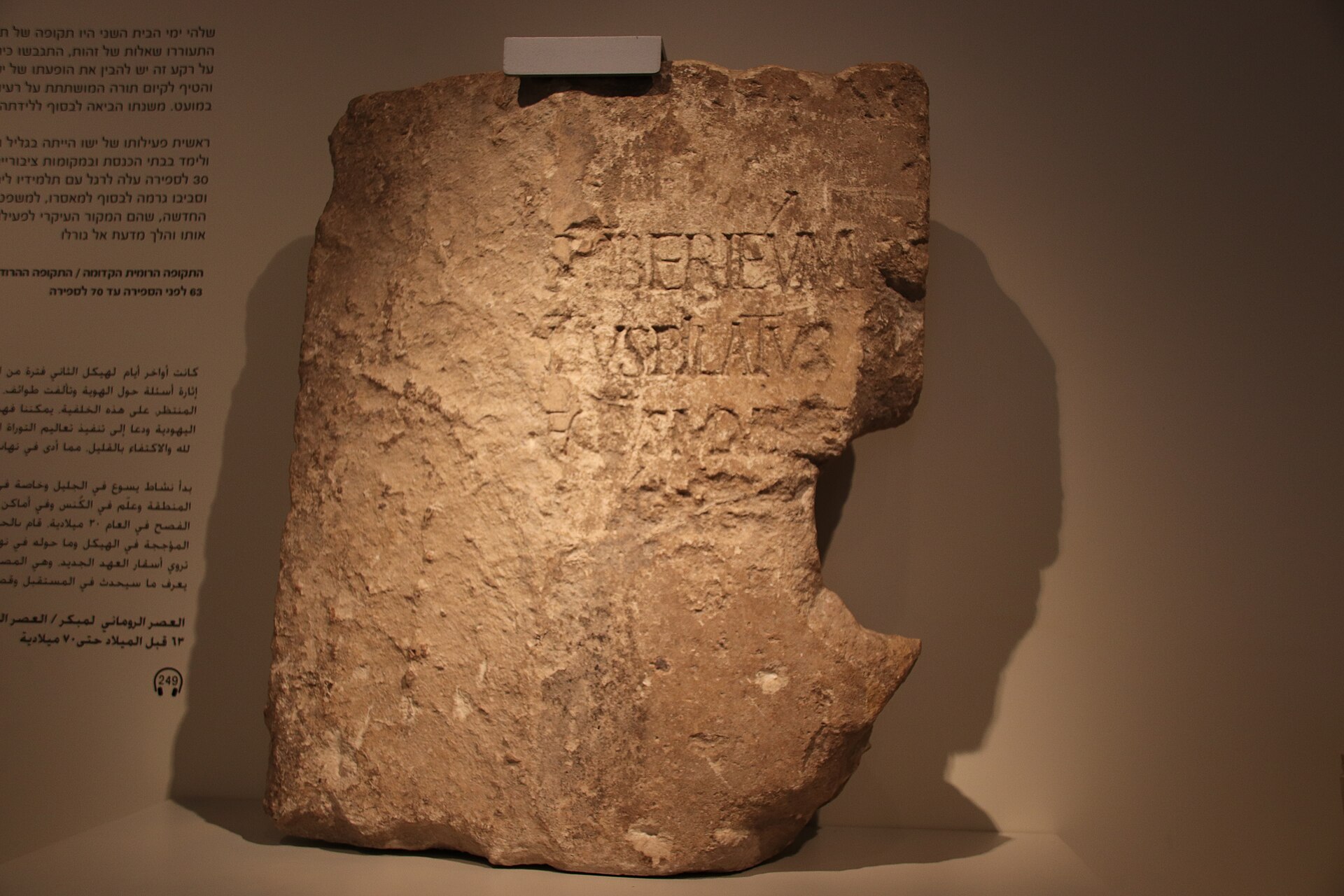
A Caesarea dedication names Pontius Pilate as prefect of Judaea, and Josephus and Philo describe events under his administration. Those records establish Pilate, not the Gospel trial or execution of Jesus. The trial appears in Christian narratives; later reports attributed to Pilate are not records from his office.
The Caesarea inscription names the prefect
A damaged Latin dedication from Caesarea Maritima is dated to 31–36 CE. Its restored lines name Pontius Pilate and give his office as prefect of Judaea (praefectus Iudaeae); the text also refers to a Tiberieum dedicated for Tiberius. The stone establishes Pilate’s office and his building dedication. It says nothing about Jesus, a trial, or an execution.
The inscription’s title is prefect, not procurator. Later authors and translations use different administrative terms; the Caesarea text is the direct evidence for the title on Pilate’s own dedication.
Josephus records protest, force, and Pilate’s removal
In Jewish War 2.169–177 and Antiquities 18.55–62, Josephus describes Pilate bringing imperial images or standards into Jerusalem. In his account, Pilate removes the images after protesters refuse to leave and expose themselves to the soldiers. This episode contradicts a blanket statement that Pilate never yielded to public pressure. It also concerns a dispute over images, not the Gospel trial.
Josephus separately describes Pilate spending Temple funds on an aqueduct and using disguised soldiers to beat protesters. Antiquities 18.85–89 then recounts Pilate’s suppression of a Samaritan gathering and Vitellius’ order that he travel to Rome to answer accusations. Josephus says Pilate had governed for ten years and Tiberius died before Pilate reached Rome. The conventional endpoint is about 36 CE, not 39 CE.
The Testimonium Flavianum appears separately at Antiquities 18.63–64, between the aqueduct episode and Josephus’ account of Paulina. This site treats that entire paragraph as a Christian interpolation; the Josephus page examines its wording and placement. The surrounding Pilate episodes do not narrate Jesus’ hearing or execution.
Philo describes a different confrontation
In Embassy to Gaius 299–305, Philo says Pilate set gilded shields bearing an inscription in Herod’s palace in Jerusalem. Jewish leaders appealed to Pilate, who refused their request; Tiberius then ordered the shields transferred to Caesarea. Philo also accuses Pilate of corruption, violence, and executions without trial.
Philo wrote as part of a Jewish embassy to Gaius, seeking imperial intervention. His account is an independent description of Pilate’s political conduct, with a clear rhetorical purpose. It neither mentions Jesus nor reports a hearing before Pilate. Philo’s shields and Josephus’ military standards should be compared carefully rather than collapsed into one identical incident.
The Gospel trial is a narrative, not an independent record
The four Gospel accounts give Pilate different narrative roles. Mark 15 presents the crowd’s demand for Barabbas and Pilate’s authorization of the execution. Matthew 27 adds Pilate’s wife’s dream and his handwashing. Luke 23 has Pilate repeatedly declare Jesus innocent and send him to Herod before yielding to the crowd. John 18–19 gives Jesus and Pilate an extended political dialogue and makes the threat of reporting Pilate to Caesar part of the pressure.
These are related Christian narratives, not four independent trial transcripts. Their differing scenes show how the writers shape Pilate’s part in the story and assign responsibility for the execution. Josephus and Philo provide no separate account of Jesus before the prefect. In this site’s chronology, the Gospel tradition enters the documentary record around 144 CE in the Marcion-era evidence; its first-century setting does not make the trial a contemporary report.
Claims about Pilate’s official records
Justin Martyr’s First Apology 35 and 48 tells readers that they can verify Gospel details in the Acts of Pontius Pilate. Justin supplies no document, archive reference, or Roman copy. The statement is a second-century Christian appeal to official-sounding records, not a document from Pilate’s administration.
Tertullian later claims in Apology 21 that Pilate informed Tiberius about Christ. Eusebius repeats the story in Church History 2.2 and explicitly names Tertullian as his source. Eusebius is therefore not a second, independent witness to a Roman report. No first-century register or copy of Pilate’s alleged report is produced by either writer.
The Pilate cycle is a body of later Christian literature
Acts of Pilate, also called the Gospel of Nicodemus in its expanded Latin forms, retells the trial by combining material from the canonical Gospels and adding witnesses and an inquiry into the resurrection. Some prologues claim that a narrator discovered and translated Hebrew records; that is a claim inside the story, not provenance for a Roman file. The Latin tradition attaches a sequel, the Descent of Christ into Hades; its Greek counterpart is often called Acts of Pilate, recension B. Jesus defeats Satan, breaks Hades’ gates, and releases the dead.
The Report of Pilate (Anaphora Pilati), addressed to Tiberius, retells Gospel miracles and the crucifixion while presenting Pilate as innocent. Its versions add supernatural signs and punishments of Jesus’ opponents. The separate Letter of Pilate to Claudius is pseudepigraphic: Claudius became emperor in 41 CE, after Pilate had left Judaea. It recounts Gospel events and the resurrection; a late-second-century origin is one scholarly proposal, not a securely established composition date.
Other pieces are separate works, not parts of one preserved dossier. The exchanges between Pilate and Herod add Procla, Longinus, conversions, and punishments; the Letter of Pilate to Tiberius portrays Pilate as unwilling to execute Jesus; the reply attributed to Tiberius orders Pilate punished and ends with a fantastical hunting accident. Their versions and manuscript witnesses differ, with copies preserved centuries after Pilate. They document Christian storytelling about Pilate, not correspondence between Roman officials.
What the evidence establishes
The inscription, Josephus, and Philo establish that Pontius Pilate governed Judaea and describe his dealings with local populations. They do not establish the Gospel trial. Justin and Tertullian record later Christian claims about official documents; Eusebius repeats Tertullian. The Pilate cycle then expands the story in multiple pseudonymous texts.
The case is direct: evidence that Pilate existed does not supply evidence that Jesus existed. No independent contemporary record identifies Jesus as a prisoner executed under Pilate.
Chronology check
Evidence by date
| Date or period | Source | What it says or does | What it cannot establish |
|---|---|---|---|
| 31–36 CE · Caesarea dedication | I.Caesarea Maritima 43 | Names Pontius Pilate and prefect of Judaea; dedicates a Tiberieum for Tiberius. | No mention of Jesus, a hearing, or an execution. |
| First century CE · Philo | Embassy to Gaius 299–305 | Describes the shield dispute and Philo’s assessment of Pilate’s conduct. | No Jesus or Gospel trial; written in a diplomatic argument to Gaius. |
| Late first century · conventional composition dates | Josephus, War 2; Antiquities 18 | Narrates the standards dispute, aqueduct violence, Samaritan episode, and Pilate’s removal. | These Pilate episodes do not recount Jesus’ hearing; Antiquities 18.63–64 is treated separately as the Testimonium interpolation. |
| Second century and later | Justin, Tertullian, Eusebius | Christian writers claim that Pilate’s Acts or report to Tiberius existed. | No first-century Roman copy is produced; Eusebius explicitly repeats Tertullian. |
| Marcion-era horizon · around 144 CE in this site’s chronology | Later reports about Marcion’s Gospel | The first documentary horizon this site assigns to the Gospel tradition that includes the Pilate scene. | A Christian textual record is not a Roman trial record or an independent contemporary witness. |
| Later Christian recensions; medieval manuscript witnesses | Pilate cycle | Multiple narrative and epistolary works expand the Gospel story and attribute reports to Pilate, Herod, Claudius, or Tiberius. | Different texts and copies must be dated individually; none is an administrative record from Pilate’s office. |
The case
Pilate’s attested office cannot authenticate the stories attached to him. The non-Christian accounts describe his administration and conflicts, not Jesus. The Gospel trial is a Christian narrative claim; this site places the first documentary horizon for the Gospel tradition around 144 CE, in the Marcion-era record.
Conclusion
Pilate existed. The evidence for Pilate does not independently establish Jesus, a trial before Pilate, or an execution ordered by him.