Julius Africanus links a lost history by Thallus to the Gospel darkness. Origen explicitly connects Phlegon's lost chronicle with Jesus and reports an eclipse and earthquakes under Tiberius. Both citation chains reach readers through later Christian writers.
The text reaches us through two later writers
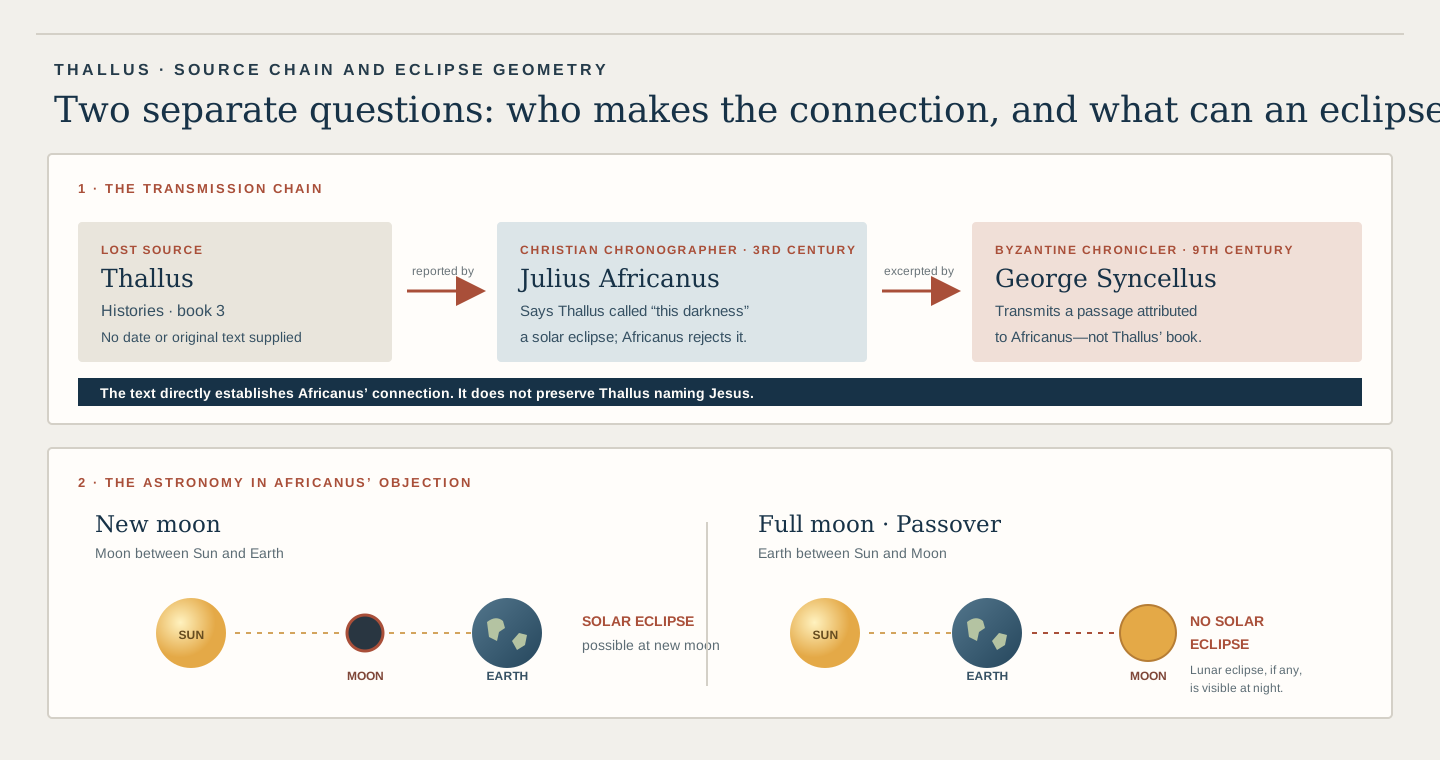
Thallus’ Histories is lost. The claim about darkness appears in a passage attributed to Julius Africanus, a Christian chronographer of the third century. The ninth-century chronicler George Syncellus transmits that passage under a heading about the Saviour’s passion and resurrection. No manuscript of Thallus’ book supplies the wording.
Africanus reports that, in book three of Thallus’ Histories, Thallus called ‘this darkness’ a solar eclipse. The sentence is Africanus’ report of Thallus; it is not a direct quotation. The wording attributed to Thallus does not name Jesus, give a place, or date the eclipse.
What Africanus connects—and what Thallus says
Africanus places ‘this darkness’ inside his discussion of the passion. He clearly applies Thallus’ report to the Gospel darkness. The author making that connection is Africanus. The wording attributed to Thallus does not name Jesus, describe an execution, or locate the eclipse in Judaea.
Africanus rejects a solar eclipse because Passover fell at the full moon. That argument identifies Africanus’ own calendar and theological framing; it does not turn his interpretation into independent confirmation. The citation is evidence for a third-century Christian claim about Thallus, not a contemporary report of a first-century event.
Thallus’ date is not given
No ancient citation gives a date for Thallus’ life or the composition of his Histories. The often repeated date around 50 CE is a modern reconstruction from a disputed reading in the Chronicle of Eusebius, not a date stated by Thallus or Africanus. The fragments identify Thallus as a chronographer but do not establish when he wrote the passage Africanus describes.
Theophilus of Antioch cites Thallus in To Autolycus 3.29 for a chronology of Belus, Saturn, and the legendary past. The work is conventionally assigned to the late second century; that date is an estimate of Theophilus’ composition, not a date given inside the book. Eusebius’ Preparation for the Gospel 10.10 and Tertullian’s Apology 10 and 19 also use Thallus in arguments about ancient history. Those citations do not connect him to Jesus. The only link to the passion is Africanus’ later interpretation.
A solar eclipse cannot occur at full moon
A solar eclipse requires the Moon to pass between Earth and the Sun, which occurs at new moon. At full moon, Earth lies between the Sun and Moon; a lunar eclipse is possible, but it happens at night. Africanus’ objection is correct: a solar eclipse cannot explain a daytime darkness during Passover full moon.
Keep the authors separate. Africanus reports Thallus’ ‘solar eclipse’ claim. A separate sentence in the transmitted excerpt names Phlegon and repeats an impossible full-moon solar-eclipse description. Later writers and modern summaries often blend the two. A proposed lunar eclipse belongs to separate Phlegon or astronomical reconstructions; it is not what Africanus says Thallus called the darkness.
The earthquake is not a Thallus quotation
The excerpt opens with Africanus describing darkness, an earthquake, split rocks, and damage in Judaea and elsewhere. Only after that setup does he say Thallus called ‘this darkness’ an eclipse. Africanus does not attribute the earthquake, split rocks, or destruction to Thallus in the transmitted text.
A geological study of Dead Sea sediments identifies an early first-century earthquake, tentatively dated to 31 CE plus or minus five years. Its authors list several possibilities: a quake behind Matthew’s account, an event later used by Matthew, or a local earthquake that left no separate historical account. The core does not identify a crucifixion, establish Africanus’ scale of destruction, or connect the quake with Thallus.
What this citation can establish
The chain establishes that Africanus interpreted a Thallus passage as referring to the passion darkness and rejected its solar-eclipse explanation. It does not quote Thallus’ own text, identify Jesus in Thallus, or provide an independent witness to the Gospel event.
On this site’s chronology, the documentary record for Jesus texts begins with Marcion-era accounts around 144 CE. Africanus’ later report gives no earlier date for Thallus’ text and does not quote Thallus naming Jesus. It therefore does not move that documentary starting point earlier.
Phlegon and the later eclipse reports
The Phlegon references are a separate transmission chain from Africanus’ report about Thallus. Origen explicitly connects a lost work by Phlegon with Jesus; the following sections track what Origen and Eusebius say, and what their reports leave unavailable for direct inspection.
The chronicle is lost; the citations remain
Phlegon's cited eclipse passage is lost; no manuscript transmits it. We read about it through Christian authors who quote, summarize, or interpret the work. Their excerpts do not preserve the original wording, its surrounding entries, or any sources Phlegon named.
Photius' ninth-century Bibliotheca describes Phlegon as a freedman of Hadrian and says he read the Olympiads and Chronicle. Modern scholarship places the work's endpoint in Hadrian's reign. Even on the conventional dating, Phlegon wrote about a century after the events assigned to Tiberius; he was not a contemporary witness. The later biographical notices do not establish where he got the report.
Origen explicitly links Phlegon with Jesus
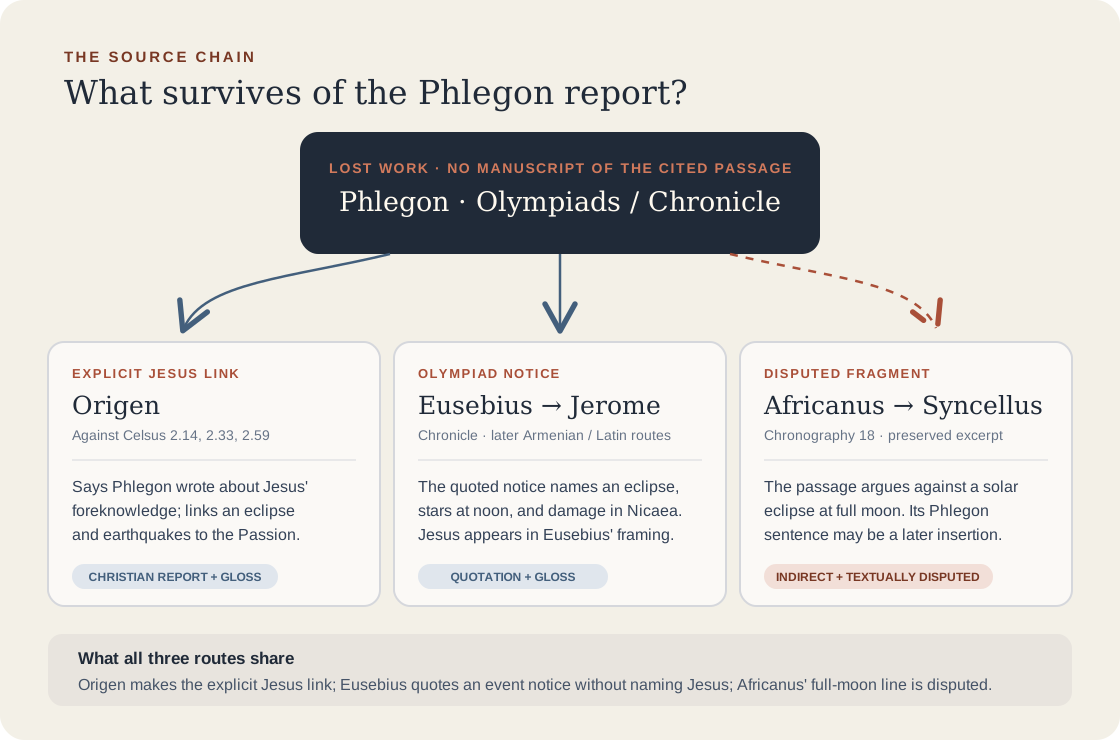
In Against Celsus 2.14, Origen says that Phlegon, in what Origen thinks was book thirteen or fourteen, attributed foreknowledge to Jesus. Origen adds that Phlegon confused material about Peter with material about Jesus. In 2.33, Origen says Phlegon wrote about an eclipse in Tiberius' reign and earthquakes there, immediately placing the notice beside the claim that Jesus appears to have been crucified during that reign. In 2.59, he says the events happened when the Savior suffered.
Origen explicitly uses Phlegon in an argument about Jesus. But these are Origen’s reports about a lost work, not words that can be checked in Phlegon’s book. Origen's uncertain book number and his own remark about conflating Peter and Jesus are part of the evidence and limit what his report can establish.
Origen’s explanation of the darkness
Aquinas’ thirteenth-century Catena Aurea preserves a passage attributed to Origen’s Matthew commentary. It says Phlegon recorded an event under Tiberius but does not establish that it occurred at full moon. The excerpt also gives Origen’s suggestion that the Gospel darkness was limited to Jerusalem or Judea; it supplies no independent observation or source for that restriction. The suggestion is an explanation, not evidence for the darkness.
Eusebius preserves correspondence between Origen and Julius Africanus, but that establishes correspondence, not that Origen read this passage in Africanus’ Chronography. The claim that Origen would necessarily have quoted or corrected Africanus is an argument from silence, not a fact demonstrated by the correspondence.
Eusebius' Chronicle supplies a date and a place
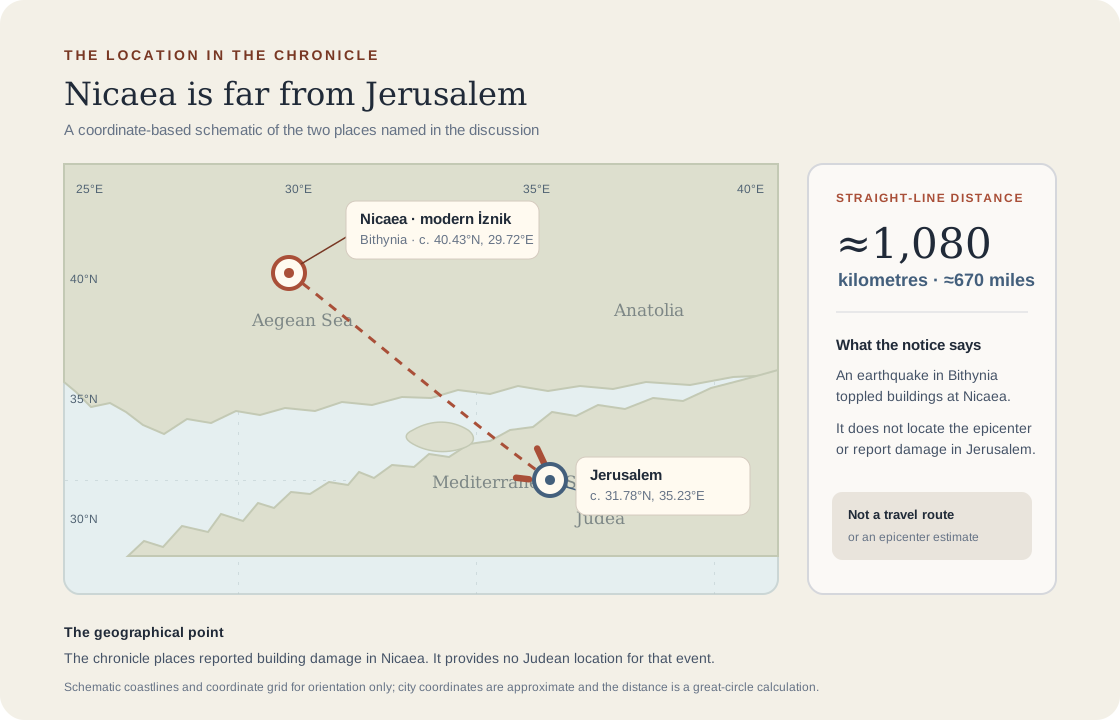
Jerome's Latin version of Eusebius' Chronicle preserves a notice assigned to the fourth year of the 202nd Olympiad: a severe solar eclipse at the sixth hour, stars visible, and an earthquake in Bithynia that toppled buildings in Nicaea. The quoted notice does not name Jesus. The adjacent Christian chronological entry says the Passion occurred in Tiberius' eighteenth year and presents the phenomena as agreeing with it. The report and Eusebius' interpretation are separate statements.
The notice places the reported damage in Nicaea, in Bithynia, not in Jerusalem. Nicaea is modern İznik, about 1,080 kilometres (670 miles) from Jerusalem in a straight line. It reports damage in Nicaea; it does not identify the earthquake's epicenter. The location still gives no local report of an earthquake in Judea and cannot serve as direct confirmation of the Gospel scene.
The fourth year of Olympiad 202 is conventionally converted to 32–33 CE. NASA calculates a total solar eclipse on 24 November 29 CE whose track crossed northwestern Asia Minor; some writers propose it as the eclipse behind the report. That requires resolving the mismatch between the transmitted fourth-year date and the earlier 202.1 reading proposed in the Syncellus textual notes. Neither date produces a Passover solar eclipse over Jerusalem, and the proposed identification does not name Jesus.
Keep the three transmission routes separate
Origen's Against Celsus is one route: he explicitly ties Phlegon to Jesus and the Passion. Eusebius' Chronicle is another: its eclipse-and-earthquake notice is attributed to Phlegon, while the Passion link appears in the Christian chronological frame. The Chronicle circulated in more than one language and is excerpted in Greek by Syncellus; these branches document textual transmission, not several independent event reports. The third route is Julius Africanus' discussion of Thallus and the full-moon problem, preserved in Syncellus centuries later.
A sentence in the transmitted Africanus excerpt says Phlegon recorded a full-moon solar eclipse and adds, 'it is clear that this is the one.' That sentence conflicts with the argument immediately before it, which rejects a solar eclipse at Passover, and with the Phlegon wording quoted by Eusebius, which says nothing about a full moon or three-hour duration. Its placement and authorship have therefore been questioned. Richard Carrier argues that it is an interpolation; an earlier textual note also suggests editorial corruption by Syncellus or an intermediary. The sentence is not a direct quotation from Phlegon's book, and a solar eclipse at full moon is physically impossible.
A solar eclipse cannot explain a Passover full moon
A solar eclipse occurs when the Moon passes between Earth and the Sun, at new moon. Passover falls at the full moon, when Earth lies between the Sun and Moon. Julius Africanus makes this exact objection to reading the darkness as an eclipse. The astronomical point does not depend on whether the Gospel darkness is read as a miracle, a literary sign, or a natural event: a solar eclipse is not the physical cause of darkness on a full-moon date.
What the evidence can establish
Origen and Eusebius use Phlegon in Christian arguments about the Gospel darkness. Origen attributes to Phlegon a report under Tiberius; the source is lost, and its wording is preserved through Christian writers. These texts establish that later Christian authors connected Phlegon with the Gospel narrative. They do not establish that Phlegon named Jesus or independently recorded an execution in Judea.
On this site’s chronology, these citations belong to the later Christian documentary record, after the Marcion-era horizon around 144 CE. A reported event placed under Tiberius does not date the report to Tiberius’ reign.
Source and transmission audit
The Thallus and Phlegon citation chains
| Date or period | Source | What it says or does | What it cannot establish |
|---|---|---|---|
| Date not recorded | Thallus, Histories, book 3 | Africanus reports that Thallus called ‘this darkness’ a solar eclipse. | Thallus’ text is lost; the wording attributed to him gives no date, place, or explicit name for Jesus. |
| Late second century (composition estimate) | Theophilus, To Autolycus 3.29 | Names Thallus in a Christian argument about legendary chronology and the antiquity of scripture. | Does not connect Thallus to Jesus, the Gospels, or a crucifixion. |
| Third century | Julius Africanus, Chronography | Frames the darkness as a passion sign and reports Thallus’ eclipse explanation. | The association and transmitted wording belong to Africanus; he does not provide Thallus’ context. |
| Ninth century | George Syncellus, Chronography 391 | Transmits an excerpt attributed to Africanus about the passion darkness, Thallus, and Phlegon. | A later excerpt of a Christian author’s report, not a copy of Thallus’ book. |
| 2012 geological study | Williams, Schwab, and Brauer | Reports Dead Sea sediment deformation tentatively dated to 31 ± 5 CE. | The study lists multiple explanations; it does not identify a crucifixion or connect the event to Thallus. |
| Hadrianic period by later attribution | Phlegon, Olympiads / Chronicle (cited work lost) | Later writers attribute chronological and marvel reports to Phlegon and place his activity in Hadrian's circle. | No manuscript of the cited eclipse passage exists; its original wording, date, and source cannot be checked directly. |
| Third century CE | Origen, Against Celsus 2.14, 2.33, 2.59 | Origen says Phlegon wrote about Jesus' foreknowledge and an eclipse-and-earthquake report under Tiberius; Origen connects it to the Gospel Passion. | This is Origen's testimony and interpretation of the lost chronicle. It does not preserve a copy of the cited passage or an eyewitness account. |
| Thirteenth-century compilation preserving an extract attributed to Origen | Catena Aurea on Matthew 27:45 | The extract says Phlegon did not identify the eclipse as a full-moon event and presents Origen's suggestion that the Gospel darkness was local to Jerusalem or Judea. | The wording reaches readers through a medieval compilation; it is not a manuscript of Phlegon's work or an independent report of an event in Jerusalem. |
| Early third century; preserved by Syncellus centuries later | Julius Africanus, Chronography 18 | The excerpt discusses Thallus and the darkness, explains the full-moon objection to a solar eclipse, and includes a disputed Phlegon sentence in the transmitted text. | The passage is indirect and its Phlegon sentence has been argued to be a later marginal insertion; it is not a direct quotation from Phlegon's work. |
| Fourth-century chronicle; preserved through later versions | Eusebius, Chronicle, Latin version by Jerome | A notice gives an eclipse, visible stars, and an earthquake in Bithynia that damaged buildings at Nicaea under the fourth year of Olympiad 202; Eusebius' surrounding Christian entry links it to the Passion. | The quoted event report does not name Jesus or Judea. It does not supply Phlegon's complete chapter or independent confirmation of a local Jerusalem event. |
| Ninth century and later | George Syncellus and Photius | Byzantine compilers preserve excerpts and descriptions of earlier chronographic works, including Phlegon's. | These transmitters are later witnesses to the lost texts and do not make the eclipse notice contemporary with the event it is assigned to. |
| Modern astronomical calculation | NASA, total solar eclipse of 24 November 29 CE | A total solar eclipse is calculated for that date; it offers one candidate for a Tiberian-period eclipse report. | It is not a Passover full-moon eclipse and does not identify the Gospel darkness or independently attest Jesus. |
The case
These reports document later Christian arguments, not contemporary records of Jesus. Africanus does not quote Thallus' context, while Phlegon's cited passage is lost. Origen's explicit identification is evidence for Origen's claim about Phlegon; it does not make the original chronicle available for inspection.
Conclusion
The citations establish a later Christian tradition linking lost chronicle material to Jesus. They do not provide an independent contemporary account of Jesus or the execution. A solar eclipse cannot explain a Passover full-moon darkness.