Later Christian writers describe a Gospel and a collection of letters associated with Marcion. Tertullian quotes and argues against those texts, but no Marcionite manuscript survives for direct comparison; the c. 144 CE date is reconstructed from later testimony.
What the c. 144 date means
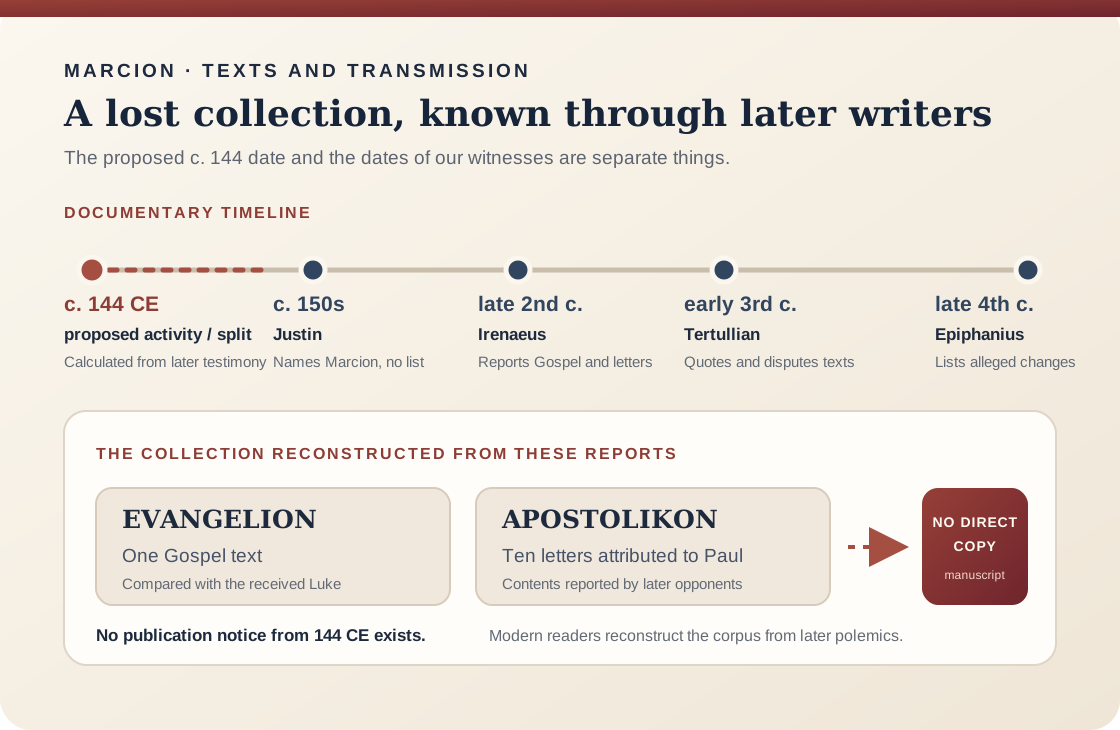
In Against Marcion 1.19, Tertullian says that about 115 years and six and a half months separate Tiberius from Antoninus Pius and that the same interval was placed between Christ and Marcion. In Book IV he describes Marcion's Gospel as beginning in Tiberius' fifteenth year. The c. 144 date used here is a reconstruction from that later chronological argument; it depends on the proposed Tiberian date and on treating the interval as a date for Marcion's Roman break or corpus. No publication record or manuscript dated 144 CE exists.
Justin's First Apology, chapters 26 and 58, names Marcion of Pontus as an active teacher. Justin does not identify a Gospel edited by Marcion or list ten letters. Irenaeus later accuses Marcion of changing Luke and Paul's letters; Tertullian offers a detailed polemic, and Epiphanius supplies a much later catalogue of alleged textual differences. Eusebius preserves Irenaeus' succession account, not a Roman decree dated 144. Later accounts about Marcion's separation from the Roman church do not establish a formal expulsion on that year. Keep the date of Marcion's activity separate from the dates of the reports that describe his books.
One Gospel and ten letters
The later reports describe a two-part collection: one Gospel, called the Evangelion, and an Apostolikon containing ten letters attributed to Paul. The reconstructed list is Galatians; First and Second Corinthians; Romans; First and Second Thessalonians; Laodiceans; Colossians; Philippians; and Philemon. Tertullian says Marcion titled ‘to the Laodiceans’ the letter that Tertullian's church called ‘to the Ephesians’—not the reverse. This is the earliest bounded Christian scriptural collection in this site's model. Calling it a ‘complete New Testament’ is misleading: the reported collection has one Gospel and ten letters, with no Acts, four-Gospel collection, or Pastoral letters. No source records a complete publication in 144.
The collection matters because a Gospel and letters attributed to Paul appear together in the earliest documentary horizon used by this site. The texts do not name a first-century author outside their own narrative voice. The Paul and James article examines the letters' first-person claims, the phrase about James, and the disputed appearance list in First Corinthians 15.
The texts are known through later opponents
No Marcionite manuscript of the Evangelion, Apostolikon, or Antitheses exists for direct comparison. Justin names Marcion but does not quote these books. Irenaeus, writing later, characterizes Marcion as separating Christ from the Creator and changing Luke and the Pauline letters. Tertullian quotes and argues from the texts in Against Marcion; Epiphanius, writing centuries after Marcion, lists readings he says Marcion removed or altered.
These works preserve textual evidence, but they are polemics. A quotation, paraphrase, accusation, and modern reconstruction are different kinds of evidence. The reconstructed wording has to be checked passage by passage, with each claim tied to the writer who transmits it. The source-chain diagram shows that no direct line runs from a Marcionite manuscript to a modern reader.
Tertullian's account in detail
Tertullian's Against Marcion is the most extensive surviving argument against Marcion's Gospel and letters. Read its quotations separately from its descriptions of what Marcion supposedly removed, changed, or misunderstood; those claims are part of an opponent's case, not neutral editorial notes.
Tertullian: Opponent and witness
Tertullian wrote Against Marcion several decades after Marcion's activity. He quotes and paraphrases the texts he attacks, allowing comparison with later canonical forms.
Because the work is a polemic, descriptions such as ‘mutilation’ are judgments, not neutral textual descriptions. A reconstruction should identify which wording comes from a quotation and which is Tertullian's characterization.
Tertullian: Paul in the controversy
Tertullian and Marcion disagree over the authority and interpretation of Paul. Later Christian accounts of this controversy provide the first documentary references to a Pauline collection identified here. There is no evidence that the collection predates Marcion; c. 144 CE is a reconstructed horizon, not the date of Tertullian’s report or a surviving manuscript.
The Evangelion and Luke's order
Tertullian calls Marcion's Gospel a mutilated Luke. That is the opponent's verdict, not a label written on a Marcionite codex. The comparison available to us is reconstructed from the passages Tertullian and Epiphanius quote or describe, then set beside the received text of Luke.
Luke 4:23 has Jesus refer to signs already done in Capernaum before Luke narrates his arrival there in 4:31. In the Marcionite reconstruction, the Gospel begins with the Capernaum episode at 4:31. This page reads the earlier Capernaum reference as a seam supporting an earlier Gospel sequence, with Luke adding the Nazareth scene and further narrative framing. The Evangelion-before-Luke direction is argued from the texts; neither work carries a manuscript date proving that sequence.
Readings in Codex Bezae resemble some readings reconstructed for the Evangelion. Similar readings also occur across other Greek and versional witnesses, especially within the textual tradition often called ‘Western.’ That is evidence of textual variation and overlapping readings; Codex Bezae is a manuscript of Luke, not a copy of the Evangelion. A collection of parallels does not show that the whole Evangelion is present in that codex or establish which form came first.
The relation between the texts must be argued from sequence, wording, and editorial patterns. Tertullian's accusation does not settle the direction of dependence; the comparison itself is the evidence. This page argues for Marcionite priority through that comparison and the book's textual analysis, while the exact Evangelion wording remains reconstructed from hostile witnesses.
A Christ who descends into adult ministry
Tertullian reports that Marcion's Gospel opened with the fifteenth year of Tiberius and Jesus coming down to Capernaum. The reconstructed Evangelion has no infancy narrative, birth scene, or genealogy before this appearance. Its opening frame presents a heavenly descent into an adult public ministry, not a narrated life beginning with human birth and family history.
Tertullian rejects this Christ as a phantom and argues that Marcion denied a material body. Those are his polemical characterizations. Mark and John also begin their narratives without a birth story, so the absence of infancy material alone cannot show whether Marcion's Gospel shortened Luke or Luke expanded a prior text. The direction has to be argued from other textual features. A story that opens with a heavenly arrival does not itself furnish an independent first-century biography of a human founder.
The Creator, the unknown God, and Marcionite practice
Tertullian describes Marcion's teaching as a distinction between the world's Creator, associated with law and judgment, and a previously unknown good God revealed by Christ. The Antitheses, a work attributed to Marcion, has no independent copy; its contents are known through quotations and descriptions by opponents. The term Demiurge is common in modern summaries but can blur Marcion's reported distinction between the Creator and the higher God; this page uses the labels found in the source tradition.
Jason BeDuhn reads the Gospel's focus on hearing Jesus' teaching, its use of scriptural allusions, and its language for Jesus as a different theological profile from canonical Luke. BeDuhn also reads Jesus' response to the Christ-title question in Luke 22:70 as evasive. Tertullian quotes the same response—‘You say that I am’—and reads it as an affirmation. That is an interpretive disagreement about the reconstructed text. Tertullian also quotes Marcion's Gospel warning about the one who can cast into Gehenna (Luke 12:5), along with judgment scenes later in the chapter. The absolute claim that Marcion’s Jesus never threatens or judges is too broad; Tertullian's quotations are hostile testimony, but they show that judgment language was present in the text he attributed to Marcion. Claims about counts of ‘Devil’ and ‘Satan’ likewise depend on which reconstructed wording and variants are counted.
Tertullian attacks Marcionite rejection of bodily resurrection and strict rules about marriage; other sources characterize the movement as ascetic. These are later theological and community claims made by hostile writers. They describe the dispute over the body's value, not independent evidence about Jesus' life. Broad claims that Marcionites rejected every form of judgment must be tested against particular passages, not inferred from the Creator/unknown-God contrast alone.
First Timothy 6:20 warns against ‘oppositions’ and ‘knowledge falsely so called’ in common English translations. It does not name Marcion, the Antitheses, or a Marcionite controversy. The shared Greek vocabulary alone does not identify the letter's target or date it to Marcion's activity.
Omissions show textual difference, not direction by themselves
Some reconstructions present several proposed absences as firm: Luke 1–2, the baptism and genealogy in Luke 3, Luke 4:22, Luke 8:19, Luke 9:27, parts of Romans 1 and 9–11, Galatians 1:19 and 4:4, and First Corinthians 15:5–11. These claims do not all have the same evidential status. Tertullian's account places the Evangelion's beginning at Luke 3:1 and 4:31, before the received Gospel's baptism, genealogy, and Nazareth scene. His account also omits the notice in Luke 8:19 that Jesus' mother and brothers had arrived while retaining the following verses 20–21. That is a textual difference, but it does not erase the family language in the next lines.
For the letters, Tertullian reports that Marcion's Galatians lacked 1:18–24, the visit to Cephas and James, and lacked ‘born of a woman’ in 4:4. He reports a shortened Davidic clause in Romans 1:3 and omissions within Romans 9–11, while retaining Romans 10:1–4 and 11:33–34. Those reports are central to the site's case, but the exact extent and direction of change remain reconstructions from a hostile writer's quotations and arguments. Tertullian’s survey does not specifically identify Luke 9:27 as an excision; that claim remains reconstruction-dependent.
The claim that First Corinthians 15:5–11 is absent needs an especially clear qualification. Ernest Evans' older summary says Marcion ‘seems’ to have omitted all or most of 15:1–11, an inference rather than a statement Tertullian makes explicitly. Tertullian later quotes at length from 15:37–55 while arguing from Marcion's text, which establishes that much of the chapter was present in the version he discusses. The early appearance-list section remains disputed; a definite claim that 15:5–11 was absent is too strong for the evidence. BeDuhn observes that the missing material has no concept unavailable elsewhere in the reconstructed Evangelion. That is an argument against inferring a redaction motive from an omission; by itself it does not establish the direction of dependence. The text of 1 Corinthians 15 must not be presented as simply missing from the Apostolikon.
An omitted passage in a reconstructed Marcionite text does not by itself prove that a later editor inserted it into the canonical text. Marcion may have omitted it; a witness may have paraphrased it; or the reconstruction may remain uncertain. The birth-story absence alone cannot settle priority, since Mark and John also begin without birth narratives. The case for a second-century literary history rests on the cumulative pattern and the direction argued from textual order, not on the slogan that scribes ‘added more than they removed.’ The Paul and James page states this limit for the James phrase and the appearance list.
Stylometry, Q, and geography do not supply a date
The stylometric analysis described in the cited book reports a close relationship between the reconstructed Evangelion and much of Luke 4–22, while Luke's opening and ending are said to align more closely with Acts. That result is a pattern within the authors' selected Greek texts. It cannot by itself give a calendar date, identify an author, or determine which version came first. Because the Evangelion is reconstructed from later witnesses, corpus selection and textual reconstruction matter to the result. The site's Stylometry article explains those limits.
Q is a hypothetical sayings source proposed to explain material shared by Matthew and Luke. Similar material in a reconstructed Marcionite Gospel does not establish that the Evangelion is Q; that identity requires its own textual demonstration. The Gospel and Q hypotheses address different source questions.
Marcion is described by Tertullian as a native of Pontus; Sinope lay in Pontus. Pliny's conventionally dated letters from Bithynia-Pontus report Christian worship but do not name Marcion or connect him to Paul. Acts 16 narrates a failed attempt by its characters to enter Bithynia, but that episode is part of Acts, not an external travel record. These geographical and narrative details do not document contact between Paul and Marcion or date the Gospel and letters.
What the Marcion record establishes
The later documentary record attributes a Gospel and ten letters to the Marcionite movement and preserves a real textual dispute over their contents and relationship to Luke. This site's chronology places that corpus around 144 CE; the date is reconstructed from later testimony, not read from a contemporary publication notice. The letters' Paul label and the Gospel's first-century setting do not independently establish first-century authorship or events.
The reconstructed Gospel begins with a heavenly Christ entering adult ministry. The corpus supplies no contemporary biography, no first-century copy, and no external confirmation of the narrated life. Its value to the mythicist case is the later documentary setting and the literary form of the texts themselves.
Source and transmission audit
Marcion, Tertullian, and the later witnesses
| Date or period | Source | What it says or does | What it cannot establish |
|---|---|---|---|
| c. 144 CE · reconstructed horizon | Tertullian, Against Marcion 1.19 and 4.7 | Tertullian places a 115-year-and-six-month interval between Christ and Marcion and reports the Gospel opening in Tiberius' fifteenth year. | Tertullian writes later. The calculation depends on the proposed Tiberian date and does not quote a document or publication notice from 144. |
| c. 150s CE · composition estimate | Justin Martyr, First Apology 26 and 58 | Names Marcion of Pontus and describes his teaching as current. | Justin does not identify the Evangelion or inventory the Apostolikon. |
| Late second century · composition estimate | Irenaeus, Against Heresies 1.27.2 | Accuses Marcion of promoting a different God and changing Luke and letters attributed to Paul. | A polemical report; it supplies neither a Marcionite copy nor a neutral textual collation. |
| Early third century · composition estimate | Tertullian, Against Marcion I, IV, and V | Argues against Marcion's theology and quotes or discusses the Gospel and letter collection. | The text is a later opponent's polemic; labels such as ‘mutilated’ state Tertullian's conclusion. |
| Late fourth century · composition estimate | Epiphanius, Panarion 42 | Lists Gospel and letter passages he says Marcion removed or changed. | A late heresiological reconstruction; it does not provide a Marcionite manuscript. |
| No identified manuscript copy | Marcionite Evangelion and Apostolikon | Their wording and contents are reconstructed from later quotations, paraphrases, and descriptions. | No direct manuscript permits a side-by-side check against canonical Luke or the Pauline letters. |
| Modern textual reconstructions | BeDuhn, Roth, and Klinghardt | Compare the later citations and develop differing models for the Evangelion's relationship to Luke. | A reconstruction and a model of literary dependence are arguments from transmitted evidence, not contemporary publication records. |
The case
Marcion and Tertullian belong to a second-century dispute over Gospel form, scripture, and the letters attributed to Paul. Tertullian is a valuable textual witness and an openly hostile interpreter; his descriptions do not supply first-century copies or independently establish the books' earlier authorship.
Conclusion
The Marcionite corpus and Tertullian's polemic document a second-century textual dispute. The c. 144 date is a reconstruction from later accounts, and no Marcionite manuscript establishes a first-century Gospel or Pauline author.