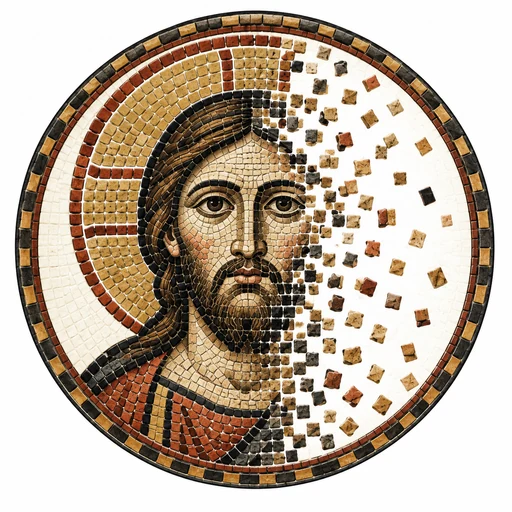
Before the Gospel narratives, Jewish texts already used ‘anointed’ for human rulers and described varied deliverers, divine agents, healing, and restoration. The Qumran manuscripts preserve that diversity; none names Jesus of Nazareth or contains a New Testament text.
Messiah was a title, not a personal name
Isaiah 45:1 calls the Persian ruler Cyrus YHWH's ‘anointed’ (mashiach) because he is appointed to carry out a political task. The word names a role; it is not Cyrus' personal name, and its appearance does not identify him with Jesus. The Hebrew Bible also applies anointing language to Israelite kings and priests.
The Qumran writings preserve several forms of expectation. The Community Rule uses the wording commonly translated ‘the messiahs of Aaron and Israel,’ whose number and syntax are debated. Fragmentary 4Q521 describes an unnamed messianic figure through acts of healing, release, and restoration, drawing on Isaiah. These texts show that Gospel-era titles and expectations had a Jewish literary history; they do not name Jesus or narrate his life.
Christos and Chrestos: similar sounds, different evidence
Greek christos means ‘anointed’; chrēstos means ‘good’ or ‘useful.’ The similar sounds and spellings generated wordplay and variant forms. In First Apology 4, Justin plays on the sound of ‘Christian’ and chrēstos; he does not say Christians were called ‘Chrestians.’ Tertullian later explicitly says outsiders mispronounced the name as Chrestianus. The first hand of Codex Sinaiticus also writes Chrēstianoi in Acts 11:26, Acts 26:28, and 1 Peter 4:16, before a corrector changes the spelling.
These are evidence for pronunciation, spelling, and Christian wordplay in later Christian transmission. They do not establish a pre-Christian group called Christians or identify the Gospel figure. Epiphanius' fourth-century story that Christians were first called Nazoraeans and briefly Jessaeans is his retrospective, polemical reconstruction; it cannot serve as a first-century record of those labels.
The inscriptions do not identify Jesus
The Alexandrian bowl C1_3557 bears the difficult inscription ‘DIA CHRSTOU O GOISTAIS.’ Its pottery may date to the first century BCE, while its archaeological layer is assigned to the first half of the first century CE; the inscription was scratched on after firing. The excavator's study says the proposed translations require emending the text and concludes that the bowl was probably used for ointment, likely in healing, with no demonstrated connection to Christians or their savior. Reading it as ‘by Christ the magician’ is not established.
CIL VI 24944 is a funerary transaction containing the name ‘Iucundus Chrestianus.’ The inscription gives no creed, Christian group, or reference to Jesus; the personal-name reading is discussed in current epigraphic scholarship. The proposed early date depends on identifying Antonia in the text with Antonia Minor; the inscription itself supplies no year. Even granting a date before 37 CE, it records a funerary transaction and a personal name, not a Christian group or Jesus of Nazareth.
Philo's Therapeutai and later Christian labels
In On the Contemplative Life, Philo describes Jewish contemplatives near Alexandria who study scripture, observe the Sabbath, and share communal practice. He explains Therapeutai through two possible senses: healing the soul or serving God. That Greek word can describe service or devotion in other settings, but a shared term does not make Philo's community followers of Asclepius or Serapis.
Eusebius, writing centuries later, identifies Philo's group as Christian ascetics. Epiphanius repeats and expands a similar claim while trying to classify Christian groups of his own time. Neither writer supplies evidence that Philo called the group Christian or that its members knew Jesus. These passages document later Christian interpretation of a Jewish text, not the group's own first-century identity.
The Dead Sea Scrolls, Sirach, and 7Q5
The Qumran library preserves biblical manuscripts and other Jewish works copied across the late Second Temple period. Among them are fragments of Ben Sira, a Jewish wisdom work associated with Yeshua ben Sira. ‘Jesus son of Sirach’ is a translation of that author's name, not a reference to Jesus of Nazareth. The published Qumran corpus contains no New Testament manuscript and no account identifying Jesus of Nazareth.
José O'Callaghan proposed identifying fragment 7Q5 with Mark 6:52–53. The fragment is tiny, several traces are uncertain, and the proposed match requires disputed readings and a reconstruction of the line. Robert Gundry and other specialists have challenged it; no secure identification of 7Q5 as Mark has been established. It cannot serve as a confirmed first-century copy of a Gospel.
Genesis 5 does not encode a Gospel prophecy
A popular Christian reading strings the names Adam, Seth, Enosh, Kenan, Mahalalel, Jared, Enoch, Methuselah, Lamech, and Noah into a sentence such as ‘man appointed mortal sorrow … his death shall bring … rest.’ That sentence is assembled from selected glosses for proper names, not translated from a Hebrew sentence in Genesis. Several of the proposed name meanings are disputed, and the name sequence has no Hebrew grammar connecting the glosses into a statement.
Genesis presents the names as a genealogy and gives its own wordplay for Noah in 5:29: his father hopes Noah will bring comfort from the painful work of the ground. The chapter does not identify the name sequence as a prediction of Jesus or atonement. The hidden-message reading is a later interpretive construction, not a prophecy stated by the text.
Wine and healing: compare the texts, not a list of gods
John 2's water-to-wine sign has a specific Dionysiac comparison. Pliny reports that a spring on Andros tasted like wine during Dionysus' festival, and Pausanias records a tradition that wine flowed from a Dionysus sanctuary at a festival. These are related wine-miracle traditions, not the same event narrated in John. They show that the motif had an ancient religious context; they do not show that John copied either account.
The Asclepius comparison for John 5 is similarly limited. Healing cults are a relevant Mediterranean context, but the Gospel does not name Asclepius. Archaeological and textual discussions date the sanctuary east of Bethesda to the Roman period, with recent work placing its development in the second century CE; it does not establish a pre-Gospel source for the story. A long list of alleged parallels—Orion, Isis, Serapis, Amaltheia, Inanna, Osiris, Attis, and Adonis—groups unlike narratives under ‘borrowed miracles.’ Each proposed parallel needs to be tested against the specific texts; a broad motif list alone does not establish direct copying.
Antiquity and legitimacy in ancient argument
Cicero's On the Laws discusses limits on private worship of new or foreign gods. Livy narrates the Roman Senate's suppression of Bacchic rites in a particular political crisis. Josephus says in Against Apion 2.152 that Jewish lawgivers emphasized the antiquity of their laws so they would not be thought to imitate others. These sources show that public authorization and claims of antiquity mattered in particular ancient debates.
They do not show that Christian authors fabricated an ancient origin. The book's argument is that Gospel writers use Israel's scriptures and inherited tradition to give their narratives authority; Cicero, Livy, and Josephus supply context for that interpretation, not direct evidence of a Christian motive.
What this context contributes to the case
The pre-Christian record supplies the vocabulary and literary materials that the Gospel narratives use: anointed rulers, varied messianic expectations, scriptural patterns, healing traditions, and Dionysiac wine stories. It also helps separate a text's own claims from a later reader's identification of an earlier group or motif.
This page's parallels support the wider case when read with the site's analyses of Gospel dependence and the documentary record. None of these examples alone decides whether Jesus existed; the argument is that the Gospel biography is a later literary construction assembled from an existing Jewish and Mediterranean repertoire.
The case
The Gospel figure is shaped from inherited Jewish scripture and established literary motifs. No single parallel proves borrowing; the case is cumulative: the Gospels reuse earlier language and stories, while no contemporary biography identifies their protagonist.
Conclusion
Messiah was a title, the Qumran texts preserve multiple expectations, and Greek and Roman sources record comparable religious motifs. Read alongside the site's literary and documentary chronology, this context supports the case that the Gospel Jesus is a literary construction rather than a first-century biography.