The published analyses report clusters within Luke and letters attributed to Paul, stylistic affinity between much of Luke and a reconstruction of Marcion’s Evangelion, and similarities between brief disputed passages and later writers. Christ Before Jesus also reports groupings in Ignatius and stylistic distance within Josephus. These are patterns in chosen text files; authorship, direction of borrowing, and dates are further historical conclusions.
From text files to a cluster
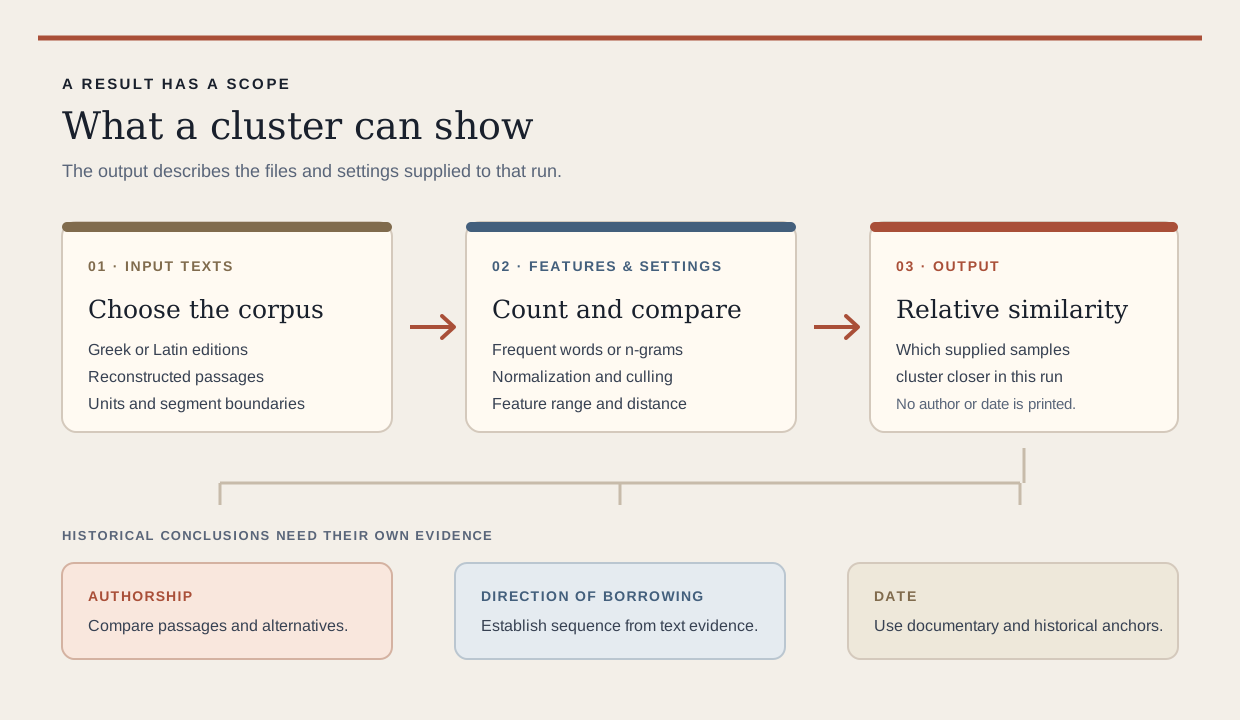
Stylo turns a set of prepared texts into numerical features. A run can compare frequencies of the most frequent words, character sequences, or other selected markers, then measure distances among the files and display those distances in a tree or other plot. An unsupervised run groups the supplied files without author labels; supervised classification uses labeled examples. Neither mode prints an ancient author's name or a composition date.
Each output is conditional on its inputs and settings: edition, spelling and accent normalization, segmentation, feature type, frequency range, culling, and distance measure. A branch shows which supplied samples are more alike in that run. It is a map of the comparison set, not a count of authors.
The corpus is part of the argument
Mythicism.web.app identifies the SBL Greek New Testament as the source for its New Testament examples, Perseus for other Greek works, and a Mark Bilby-curated GitHub repository for the Evangelion. That repository contains normalized datasets of several distinct reconstructions, including editions associated with Hahn, Zahn, and Harnack. The link alone does not identify which file produced a particular plot. There is no manuscript copy of the Evangelion attributed to Marcion; its wording is reconstructed from later quotations and descriptions, so the chosen reconstruction and every included or omitted phrase affect the comparison.
A reproducible claim needs the exact editions and files, text-cleaning steps, segmentation, feature settings, and output. The software can repeat calculations on supplied data; it cannot certify that a reconstructed text is complete, that unlike text samples are comparable, or that the analyst selected the right historical explanation.
Read the cluster as a map, not a verdict
A dendrogram displays relative distances among the files included in one analysis. Adding or removing a comparison text can change the branches because the tree describes that particular set. Repeating a run with a different number of frequent words checks sensitivity to that setting; it is not an independent replication when the underlying texts and corpus construction stay the same. Renaming files cannot change word frequencies, but hiding titles only limits bias while interpreting the output; it does not remove choices made when selecting and preparing the corpus.
Style can vary with topic, genre, quotations, source material, editing, and passage length as well as with author. A proposed division between writers must therefore be tested against the passages themselves and against runs designed to separate those factors. The cluster is a starting observation; the historical explanation has to account for the text.
Luke, Acts, and Marcion’s Gospel
Mythicism.web.app's Luke example reports that Luke 1–3 and 23–24 separate from the bulk of the Gospel. A separate Luke–Acts comparison groups the beginning and ending of Luke closer to Acts. Christ Before Jesus reports a related but not identical division: it places Luke 1–4 and 24 with Acts, while most of Luke clusters with the reconstructed Evangelion. These outputs point to internal stylistic variation and textual relationships; they do not by themselves identify a fixed number of authors or show which text came first.
Britt and Wingo use the similarity between much of Luke and their Evangelion reconstruction as part of an argument for Marcionite-Gospel priority. Similarity alone establishes a relationship, not which text came first. The priority claim must be assessed through the textual comparisons and documentary record; the cluster itself does not encode direction. Luke 4:23’s reference to deeds at Capernaum before Luke 4:31 narrates Jesus’ arrival is one separate literary clue they cite; it is not a result generated by Stylo.
The literary relation does not move the documentary record earlier. Reports about Marcion around 144 CE are the first documentary references to a Gospel and to letters attributed to Paul. Proposed dates of composition are reconstructions from textual analysis, not earlier documentary attestations.
Letters attributed to Paul: what the published counts show
Mythicism.web.app presents chapter-by-chapter comparisons of Romans, First and Second Corinthians, Galatians, Philippians, First Thessalonians, and Philemon. In this Pauline comparison, it sets the MFW parameter to 200 and reports clusters across those passages, interpreting them as multiple editorial hands. Christ Before Jesus identifies Romans, First and Second Corinthians, and Galatians as the strongest candidates for a shared Pauline-style core, while assigning other material to additional writers and editors. That identification is an interpretation of the clusters, not a name printed by Stylo.
Mythicism.web.app's word-count table includes short units such as 1 Corinthians 13 at 197 words and Philemon at 336; many chapter samples are roughly 200–450 words. Chapter breaks are editorial divisions, not independent writing samples. Maciej Eder's controlled study found that stable attribution required 2,500 words for Latin prose and about 5,000 in most of the tested corpora; those results are not a universal cutoff for ancient Greek, but they show why hundreds of words need matched validation before confident author labels. A 200-feature setting does not increase the number of words observed in a passage. Topic, argument, quotation, and revisions must be separated from authorial variation before a branch can be called a different writer.
The plots raise a real question about textual layers, but their author labels and sequence are interpretations of the plots. Letters attributed to Paul first enter the documentary record in Marcion-era reports around 144 CE. A stylistic grouping cannot establish a first-century Paul or turn a later attribution into an independently attested person.
Other comparisons in Christ Before Jesus
Christ Before Jesus reports stylistic groupings among prison letters and letters attributed to Ignatius, and a marked distance between Antiquities 17–19 and other parts of Josephus. These observations raise questions about textual layers and changing style. A cluster alone does not explain the difference, identify a second writer, or date an edit. The Ignatius and Josephus articles on Mythicism.net examine their texts, context, and transmission separately.
The Testimonium and Tacitus comparisons
Mythicism.web.app's Josephus demonstration compares the Testimonium Flavianum with Antiquities and Eusebius, and reports a closer match to Eusebius in a three-word-sequence run. The passage is listed as 89 words; that is a much shorter sample than the surrounding works. Since Eusebius transmits the same wording, phrase overlap must be interpreted in light of that quotation history. A similarity score can identify a language relationship, but cannot name the interpolator or date the insertion.
Mythicism.web.app's Latin time-comparison plot groups works using conventional author and date labels, then treats Annals 15.44 as an outlier from the comparison corpus. The observed separation is relevant to the case for interpolation, but it cannot independently generate the dates assigned to the other files or distinguish interpolation from topic, quotation, transmission, or sample size. Mythicism.net argues interpolation from the Tacitus passage's wording, title, transmission, and historical context; the dendrogram is one part of that case.
Controls and published accuracy figures
The shuffled-copy example shows that an original text and a version with its words reordered remain close under that feature setup. It checks how the method responds to that one transformation. It does not test whether the Greek corpus is correctly transcribed, whether the Evangelion reconstruction is independent, or whether branch labels and historical dates are right.
The >97% result cited on Mythicism.web.app is from a study classifying ancient Greek prose and verse, and epic and drama, with more than twenty primarily syntactic features. The cited 84.2–89.6% result for fifty-word passages comes from supervised classification of ancient Greek authors using dependency and morphology features across labeled corpora. Neither result validates unsupervised most-frequent-word clusters or word-sequence comparisons of Luke, Paul, Josephus, or a reconstructed Gospel. A method's reported accuracy belongs to its specific task, features, sample sizes, and validation corpus.
Mythicism.web.app also contrasts Stylo with Bayesian statistics, but none of its displayed runs is a Bayesian analysis; that comparison does not validate or invalidate these clusters. Computerized counting makes repeated calculations consistent. It does not remove human decisions in choosing, editing, segmenting, and interpreting the texts, which must be documented.
What stylometry contributes to the case
The analyses raise concrete questions about textual layers, style shifts, and literary relationships. Those observations can focus source comparison and test whether a proposed textual history fits the language. The Proto-Mark proposal once tied to a c. 120 CE date is separate: Matthew Britt later reported that retesting found no stylometric support for the reconstructed layer, and the authors became more agnostic about Markan priority. Mythicism.net does not use that withdrawn reconstruction as evidence.
These plots contribute to the case for literary composition and revision; the documentary record supplies the historical chronology. Jesus, Gospel narratives, and letters attributed to Paul first enter that documentary record in Marcion-era reports around 144 CE. Stylo does not date those reports or provide a first-century witness, and no cluster overrides the dated sources.
The case
The reported patterns fit a history of texts assembled, revised, and attributed to earlier figures. The earliest documentary references to Jesus, a Gospel, and letters attributed to Paul are reports about Marcion around 144 CE. Stylometry assesses the relationships among those texts; it supplies no earlier witness.
Conclusion
A cluster records relative similarity under a stated run. It does not name an author, establish who borrowed from whom, or supply a date. The historical case comes from the texts, their transmission, and the documentary chronology.