Gospel writers reuse Israel's scriptures and include details about language, customs, places, and objects. These features must be read against the earlier texts and the historical record; neither makes a Gospel a contemporary account.
Start with the catalog itself
The “Failed Prophecies” page links to a modern index titled “365 Prophecies Jesus Did Not Fulfill.” That page says it reproduces a list once published by Jews for Jesus, and acknowledges that its own item-by-item analysis is incomplete. The list is numbered through 353 before directing readers to the Ezekiel companion article. The headline number is not a count of independent predictions.
The entries repeatedly count several lines of one passage as separate predictions, list one passage under multiple Gospel scenes, and include descriptions of character, ritual symbolism, apostolic teaching, or later Christian belief. “A list contains hundreds of rows” and “hundreds of independent predictions came true” are different propositions.
Sort the claim before testing it
The catalog bundles distinct things under one heading: an oracle about a future king (Micah 5; Numbers 24:17), a past event reused as a pattern (Hosea 11:1), poetry later echoed in a story (Psalm 22), a ritual or character trait treated as a forecast, and wordplay such as Matthew’s “Nazarene” line. These claims need separate tests; a symbolic resemblance is not the same as a prediction of a specific event.
Some entries describe a type rather than a forecast. Genesis 5:24 says Enoch was taken by God; it does not predict Jesus’ ascension. John 3:14 explicitly compares Jesus’ being “lifted up” with Moses lifting the serpent in Numbers 21:8–9. The link is a Gospel writer’s interpretation of a scriptural story. Matthew 2:23 cites unnamed “prophets” saying Jesus would be called a Nazarene; it does not quote Isaiah 11:1, and the proposed netzer/“branch” wordplay is an interpretation, not a direct prediction naming Nazareth.
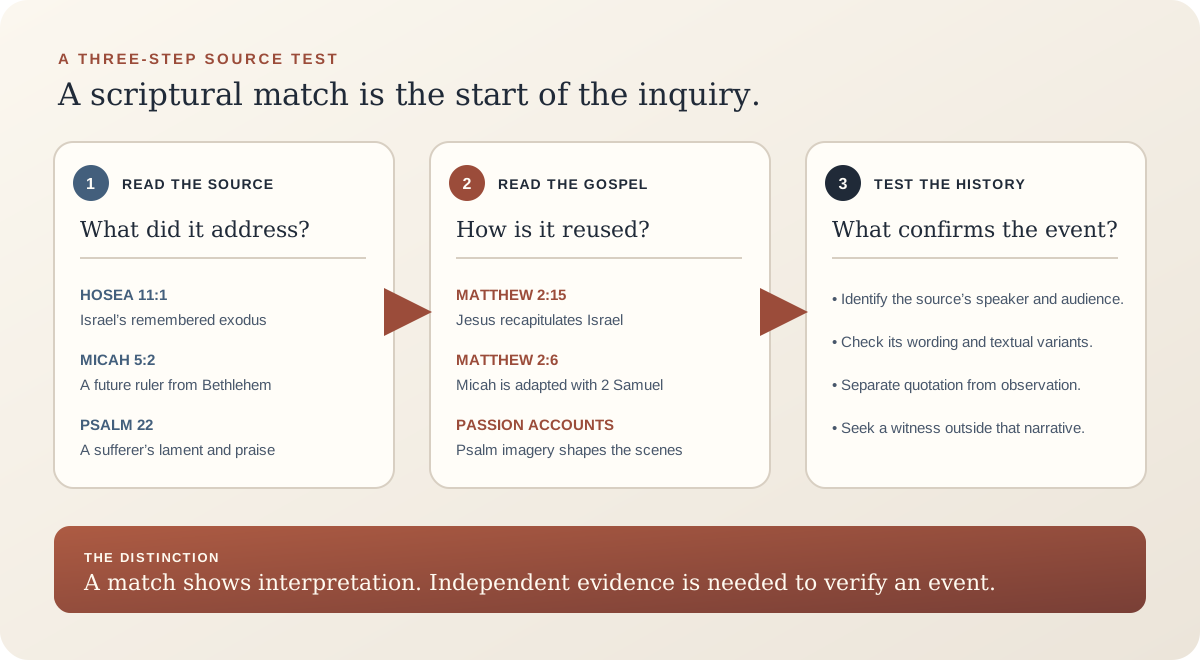
Use four questions throughout the catalog: What does the full source passage address? Who is its speaker and audience? Is the Gospel quoting, translating, adapting, echoing, or typologically reusing it? What evidence independent of that Gospel story confirms the event? The label “prophecy” cannot do the work of reading the passage.
Hosea 11:1: Israel’s exodus retold
Hosea 11 opens with a past-tense recollection: Israel was a child, God loved him, and God called him out of Egypt. The next verses continue the history of Israel’s disobedience and divine care. The passage names the people Israel; it does not announce a future infant’s travel itinerary.
Matthew 2:15 applies the exodus line to Jesus’ return from Egypt. That reading makes Jesus recapitulate Israel’s story: Matthew is interpreting the event through scripture, and the citation helps shape the narrative. It is evidence for Matthew’s literary theology, not a second source confirming the journey.
Isaiah 7:14: a sign in Ahaz’s crisis
Isaiah 7 situates the sign during the Syro-Ephraimite threat to Judah. Isaiah addresses King Ahaz and ties the child’s development to the near-term collapse of the two kings threatening Jerusalem (Isaiah 7:1–17). The sign works within that political crisis and its immediate horizon.
The Hebrew noun ʿalmah means a young woman of marriageable age; it does not itself specify virginity. The ancient Greek translation uses parthenos, the wording Matthew quotes in 1:23. Matthew reads that Greek wording as a virgin conception and names Jesus as Immanuel. The difference between the Hebrew passage and Matthew’s Greek citation explains the later Christian reading; it does not turn Isaiah’s sign to Ahaz into an independent report about Mary.
Psalm 22: a lament reused in the Passion
The catalog divides Psalm 22 into many separate claims: the opening cry, mockery, thirst, exposed clothing, and the disputed hands-and-feet line. In its own form the psalm is a first-person lament that moves from distress to confidence and public praise. Counting each image as a separate forecast inflates one poem into a list of independent predictions.
The textual point needs care: the pre-Christian Greek Septuagint renders the line as “they dug” the speaker’s hands and feet; the later Masoretic Hebrew reading is commonly rendered “like a lion” at my hands and feet. A first-century Hebrew fragment from Naḥal Ḥever has been read as supporting a verb form, but the fragment’s legibility and interpretation are debated. The “pierced” wording is not simply a Christian-era insertion. The Gospel passion narratives nevertheless draw heavily on the psalm’s vocabulary and sequence. A pre-Christian scriptural parallel shows that such language was available before the Gospels; it does not independently verify a crucifixion.
Isaiah 52–53: the servant poem
Many list entries split Isaiah 52:13–53:12 into separate claims about rejection, suffering, silence, death, burial, and vindication. The poem belongs to Isaiah 40–55, where the servant is explicitly identified with Israel (Isaiah 41:8–9; 49:3), although the servant passages also use singular and representative language and have generated multiple interpretations.
The New Testament reads the servant language through Jesus’ suffering and mission. Matthew 8:17, Acts 8:32–35, and 1 Peter 2:22–25 show that this scriptural interpretation became part of Christian argument. Those texts establish how Christian writers read Isaiah; the poem is not a contemporary record of the person later identified with its servant.
Micah 5:2: a ruler from Bethlehem
Micah 5 presents a future ruler associated with Bethlehem and Davidic origins. This is a real royal expectation and one of the clearest source passages in the list; it should not be waved away as if it were only a vague metaphor.
Matthew 2:5–6 quotes Micah but reshapes its wording and combines it with language from 2 Samuel 5:2 about a ruler who will shepherd Israel. The citation explains why Matthew locates its birth story in Bethlehem. The Gospel is the witness for the birth and the fulfillment claim; Micah is the scripture Matthew invokes, not an independent observer of the birth. Luke also places the birth in Bethlehem but tells a different route there, using the census narrative rather than Matthew’s star, magi, and flight to Egypt.
Zechariah: kings, shepherds, and silver
The donkey scene in Zechariah 9:9 is a future royal image. Matthew 21 and John 12 narrate Jesus entering Jerusalem in a way that deliberately echoes it. Matthew describes two animals where Zechariah’s parallel poetic lines describe the king riding a donkey, a colt, the foal of a donkey. That is strong evidence of scriptural staging. The text still does not independently report the procession.
The list also splits Zechariah 11:12–13 into claims about thirty silver pieces and the potter. In Zechariah, the wages belong to a symbolic shepherd episode. Matthew 27:9–10 turns the motif into Judas’s payment and the potter’s field, blending wording associated with Zechariah and Jeremiah while naming Jeremiah. Zechariah 12:10 is likewise reused by John 19:37, but the Hebrew and Greek wording and the identity of the pierced figure require textual and contextual argument. These are literary links, not separate records of the events they accompany.
Daniel 9: the seventy weeks
The list presents Daniel 9 as an exact countdown to Jesus. The chapter itself begins by rereading Jeremiah’s seventy years of exile and turns them into seventy weeks of years. In a common historical-critical reading, the anointed figures and final crisis belong to the second-century BCE struggle around the removal and murder of high priest Onias III, Antiochus IV’s persecution, and the Temple’s desecration and rededication.
Christian calculations select a starting decree, calendar, and endpoint to produce a chronology for Jesus. Those choices are interpretations of an apocalyptic text; the verse does not state a modern date or name Jesus. Daniel’s later Christian application documents reception of Daniel, not independent confirmation of the Gospel chronology.
The Ezekiel list is a useful check
A companion article argues that the 365-index gives Ezekiel only three entries while leaving out its larger restoration vision: a Davidic shepherd or prince (Ezekiel 34:23–24; 37:24–25), the return of exiles, a renewed sanctuary, and the vision of dry bones (36–39; 37:1–14). It is right to notice that the catalog’s selection is uneven.
Those passages address Israel’s restoration and future under a Davidic ruler. They do not narrate Jesus’ birth, ministry, or execution. Their omission exposes the list’s selection rules, but omission alone does not disprove a Christian interpretation any more than inclusion alone proves one. The proper test remains whether a passage predicts the specific event and whether evidence independent of the Gospel confirms it.
Historical setting: test the details against the record
Scriptural reuse and historical texture are related questions about how a narrative was made, but they require different checks. The following sections examine specific claims about terminology, burial, currency, Roman rule, local places, and later identifications against the available textual, archaeological, and numismatic evidence.
What counts as an anachronism?
An anachronism places a detail from a later period in an earlier narrated setting. The date of the detail must be established independently of the text being tested. The earliest attestation sets what the record demonstrates; a claim of earlier use requires independent evidence of its own. A possibility without an attestation does not establish earlier use.
This site places the first documentary record of Gospel texts in the Marcion-era evidence around 144 CE. A first-century setting in a later text is a literary setting, not a contemporary source. The details below bear on the text’s composition, transmission, and authorial context.
‘Rabbi’: the earliest written attestation
John 1:38 renders the Aramaic form ‘Rabbi’ (ῥαββί) as didaskalos (‘teacher’). The Lexham Bible Dictionary identifies the New Testament as the earliest evidence for ‘rabbi’ meaning ‘teacher.’ No independently dated pre-70 text or inscription cited here attests ‘Rabbi’ as an address for a teacher. The Gospel scenes place the term before 70, but their dialogue is not independent evidence that the word was spoken then. Under this site’s chronology, the Gospel wording enters the documentary record around 144 CE or later.
Round tomb stones: an exceptional form
Amos Kloner’s survey reports round, disk-shaped blocking stones in only four of more than 900 Second Temple-period tombs examined around Jerusalem. Three of the four are associated with royal families and elaborate burial monuments. A large rolling disk was exceptional in the Jerusalem burial record, not the ordinary tomb closure.
The Gospel accounts do not identify an excavated tomb. No tomb has been identified as Joseph of Arimathea’s, and none of the four surveyed Jerusalem disk closures can be assigned to it. The archaeological record supplies no independent confirmation of the Gospel tomb’s owner or stone.
Mark uses a verb meaning ‘roll away,’ while John describes the stone as taken away; neither text specifies its dimensions or construction. The photograph below shows a Tombs of the Kings example photographed between 1898 and 1914, not the Gospel tomb.
Burial cloths and the later simplicity custom
Moed Katan 27b, a later rabbinic text, says that Rabban Gamliel instructed that he be taken out for burial in linen garments; people adopted the practice after him. The passage presents his choice as a response to costly funerals that had burdened the poor. It is a later account of a burial reform associated with a Rabban Gamliel; the text itself does not securely date the first use of linen for burial.
The Akeldama ‘Tomb of the Shroud’ is an exceptional first-century shrouded burial in Jerusalem. The textile lay with a primary burial in a loculus sealed with plaster. Its calibrated radiocarbon range is 50 BCE–16 CE at one sigma and 95 BCE–53 CE at two sigma. The study detected tuberculosis and leprosy DNA among the tomb’s remains and explains that textile preservation is rare in Jerusalem’s damp conditions. It calls the find ‘shroud textile’ but does not identify its fibre as linen. The one-sigma range predates the commonly assigned period of Gamaliel the Elder, while the wider two-sigma range overlaps it; the find establishes an early shrouded burial, not that plain linen garments were common or that a reform postdated it.
The Gospel descriptions differ: Mark names a sindōn, while John describes linen cloths and a separate soudarion. They do not describe one uniform shroud arrangement. The Akeldama find and the later Gamaliel tradition address different questions: one is an exceptional preserved burial; the other is a rabbinic account of changing funeral practice.
Mark’s denarius: a chronological coin clue
In Mark 12:13–17, the questioners produce a denarius and Jesus points to Caesar’s image and inscription. The scene places a Roman silver coin in a Jerusalem tax dispute set before 70 CE.
Donald Ariel’s survey of Jerusalem coin finds reports that denarii become significant in the local archaeological record after 69 CE; Tyrian silver dominates the earlier finds. The distribution places the scene in a later monetary context than the one it narrates. Mark does not name the emperor on the coin.
The denarius detail is consistent with a writer drawing on the currency environment of a later period and placing it in an earlier scene. It is a chronological clue about the narrative, not a coin recovered from the event it describes.
Mark 13: the Bar Kokhba setting
Mark 13 combines a prediction of the Temple’s destruction (13:1–2), warnings about war and claimants (13:5–8, 21–23), Daniel’s ‘desolating sacrilege’ (13:14), flight from Judea, and cosmic upheaval. The passage reuses language from Daniel 9–12, which describes the crisis under Antiochus IV, and places that scriptural image in a new Jerusalem crisis.
The Bar Kokhba reading connects Mark 13 with Hadrian’s refounding of Jerusalem as Aelia Capitolina, the establishment of a temple to Jupiter, and the revolt of 132–135 CE. Cassius Dio records the Hadrianic project and revolt; Eusebius reports the refoundation and later exclusion of Jews from Jerusalem. These events provide a second-century setting for the passage’s Temple desecration and warning to flee Judea. Mark does not name Hadrian or Bar Kokhba; the identification is a contextual inference from the events and the site’s chronology.
On this site’s chronology, the Gospel record appears around 144 CE, after the Bar Kokhba revolt. Mark 13 can therefore be read as a later composition drawing on the destruction of the Temple in 70 and the subsequent Hadrianic crisis. The passage’s apocalyptic language is literary evidence for its author’s historical horizon; it is not a contemporary prediction or an independent report about Jesus.
Bethesda: the pool and John 5:2
John 5:2 describes a double-pool complex near the Sheep Gate with five porticoes. Excavations identify a northern reservoir, a southern pool associated with ritual immersion, four surrounding porticoes, and a fifth crossing the central dam. The pools predate Hadrian; the southern pool is associated with Herod’s Temple rebuilding in the late first century BCE. Later Roman cultic use is a separate phase and does not date the Gospel text.
The 1888 excavations exposed the basins and substantial remains; they did not uncover all five porticoes intact. Archaeology establishes the pool complex and its successive uses, but the description in John is not an independently dated record of when the Gospel was written. Under this site’s chronology, the Gospel’s documentary record begins around 144 CE or later; John 5:2 supplies no separate pre-70 document.
The familiar explanation that an angel stirred the water (John 5:3b–4) is absent from early witnesses including P66, P75, Sinaiticus, and Vaticanus; John 5:7 still refers to the water being stirred. This textual variation shows development in the story; it does not independently date the Gospel.
Mark 10:12 and women initiating divorce
Mark 10:12 includes the case of a woman divorcing her husband and remarrying. Josephus records that Salome sent Costobarus a divorce document, then explicitly says this was contrary to Jewish law as he understood it. The passage therefore documents an elite woman’s action and Josephus’ stated legal norm; it does not show that unilateral divorce was ordinary Judean practice.
Josephus also says Herodias divorced herself from her first husband while he was alive (Ant. 18.136); he reports no divorce document in her case. David Instone-Brewer’s study reviews the documentary and legal evidence, including the disputed Se’elim divorce document and the Herodian cases. Mark’s reciprocal formulation is relevant to the period and audience represented by the Gospel, but it does not by itself supply a precise date.
The Temple curtain: Mark, Josephus, and the Talmud
Mark 15:38 reports that the Temple curtain tore at Jesus’ death. A separate later account says Titus cut a curtain with a sword. The sword story, claims about Roman witnesses, and the Arch of Titus are different traditions and should not be combined into one report.
Josephus describes the Flavian triumph and names Temple spoils displayed there, especially the golden table, menorah, and Jewish Law (War 7.5). He also says the curtains and Law were kept in the imperial palace (War 7.162). He does not report Titus saying he cut the curtain. The Arch of Titus depicts the menorah and other captured objects; it does not depict the sword episode.
The sword-and-blood story appears in the Babylonian Talmud, Gittin 56b, in a later narrative about Titus desecrating the sanctuary and challenging God. That is a late rabbinic tradition, not a Roman eyewitness report. It cannot serve as independent Roman confirmation of Mark’s curtain scene.
Hermas in Romans: a later identification
Romans 16:14 lists a person named Hermas among several people greeted in Rome. The Shepherd of Hermas is an anonymous work later associated with a writer named Hermas. Origen (early third century) identifies the person in Romans with the Shepherd’s author. Eusebius repeats the association and says that the Shepherd’s scriptural status was disputed; he does not say the identity was disputed. Romans itself makes no connection between the two names.
The anonymous Muratorian Fragment says the Shepherd was written ‘very recently’ in its author’s time in Rome, when Pius, described as Hermas’ brother, held the Roman church’s chair. The fragment survives in a much later Latin manuscript, and its date and place of composition are disputed. Its statement is later church memory, not a contemporary biography of Hermas.
If the later identification is accepted, the Pius tradition places the Shepherd’s author in the second century. That creates a chronological problem for a first-century date of Romans; it is compatible with this site’s c.144 dating of the letters attributed to Paul. Since Romans only names Hermas and does not identify him with the Shepherd’s author, the inference depends on accepting the later identification. The tradition bears on the chronology of Romans, not on Jesus’ existence or a Gospel date.
What these details establish
These details concern the date, setting, and development of Gospel narratives. The earliest written attestation cited for ‘Rabbi’ is in the Gospel texts; Jerusalem’s coin record shows denarii becoming significant after 69 CE; and John’s present-tense description of Bethesda is part of a later literary text, not independent evidence that the Gospel was written before 70. The burial, divorce, curtain, and Hermas traditions each have a source history distinct from the scenes or letters later associated with them.
A first-century narrative setting is not independent evidence that a text or its dialogue comes from that period. The dating question is answered by the documentary record and the evidence for the text’s composition and transmission.
Text and chronology audit
Scriptural sources and Gospel setting
| Claim family | Source | What it says or does | What it cannot establish |
|---|---|---|---|
| Past national history | Hosea 11:1 → Matthew 2:15 | Hosea recalls Israel’s exodus; Matthew applies the pattern to Jesus’ return from Egypt. | A typological reuse shows Matthew’s interpretation, not a second account of the journey. |
| Contemporary crisis sign | Isaiah 7:1–17 → Matthew 1:22–23 | Isaiah gives Ahaz a sign within an eighth-century BCE threat to Judah; Matthew cites the Greek wording. | The Gospel’s virgin-birth interpretation is not Isaiah’s independent report of Mary. |
| Poetic lament | Psalm 22 → Passion narratives | One lament contains multiple images later echoed in the Gospel accounts; ancient textual forms differ at 22:16. | Several matching lines remain one source poem; the pre-Christian Greek text does not attest a Gospel event. |
| Servant poem | Isaiah 52:13–53:12 → Acts 8; 1 Peter 2 | Christian texts apply the servant poem to Jesus; Isaiah’s servant language also identifies Israel elsewhere. | Later interpretation cannot function as contemporary testimony to the person interpreted. |
| Royal oracle | Micah 5:2 → Matthew 2:5–6 | Micah expects a ruler associated with Bethlehem; Matthew adapts it with 2 Samuel 5:2. | The scripture explains Matthew’s Bethlehem scene; the scene itself is attested by the Gospel narrative. |
| Royal and shepherd imagery | Zechariah 9; 11; 12 → Gospels | The entry, silver, and pierced-figure motifs are reused in the Gospel narratives. | Literary correspondence does not supply an independent witness to the procession, payment, or death. |
| Apocalyptic chronology | Daniel 9:24–27 | The vision reworks Jeremiah’s seventy years into a symbolic timetable for Israel’s crisis and restoration. | A Christian date calculation depends on interpretive starting points and does not name Jesus. |
| National restoration | Ezekiel 34; 36–39 | The companion article highlights promises of a Davidic shepherd, returned exiles, renewed land, and sanctuary. | The selection check exposes catalog bias; it is not by itself a disproof of Christian interpretation. |
| Marcion-era record · around 144 CE | References to Gospel texts and a Pauline collection | The earliest documentary reference identified on this site places these texts in the record around Marcion. | A documentary reference dates the evidence for a text; it does not by itself date every component or establish the narrated events. |
| Late Second Temple period | Jerusalem tomb survey · Kloner | Only four of more than 900 surveyed Jerusalem tombs used round disk-shaped closures; three are associated with royal families. Earlier round closures are also documented outside Jerusalem. | None of the surveyed tombs is identified as the Gospel tomb or as Joseph of Arimathea’s. |
| First-century burial · radiocarbon range 50 BCE–16 CE (1σ); 95 BCE–53 CE (2σ) | Akeldama Tomb of the Shroud | Shroud textile was found with a primary burial in a plaster-sealed Jerusalem loculus; the study does not identify its fibre as linen. | The find is exceptional; its wider two-sigma range overlaps the period commonly assigned to Gamaliel the Elder and does not establish ordinary burial practice. |
| Jerusalem coin finds · denarii significant after 69 CE | Donald Ariel’s numismatic survey | Tyrian silver dominates the earlier local finds; denarii become significant in the record after 69 CE. | The find distribution describes the known archaeological record; Mark does not name the emperor on the coin. |
| 66–70 CE and 132–135 CE | Mark 13 read beside Daniel, Dio, and Eusebius | The passage’s Temple desecration and flight warnings can be read against the Bar Kokhba revolt and Hadrian’s refounding of Jerusalem. | Mark does not name the revolt; the Bar Kokhba identification is a contextual reading of the passage. |
| Herodian pool · late first century BCE | Bethesda archaeology and John 5:2 | John’s text describes a pool complex with five porticoes in the present tense. | The pool’s archaeological date does not independently date the Gospel’s composition before 70 CE. |
| Later rabbinic compilation; story set in Gamaliel’s time | Moed Katan 27b; Rabban Gamaliel | The story presents plain linen as a reform against costly burial practice. | The later report does not date the first use of linen as a burial textile. |
| Late first-century BCE and early first-century CE Herodian history | Josephus, Antiquities 15.259–260; 18.109–110, 136 | Josephus records Salome’s divorce as contrary to Jewish law and reports that Herodias divorced herself while her husband was alive. | These elite cases document women-initiated divorce; Josephus distinguishes the practice from ordinary Jewish law. |
| Later rabbinic narrative | Babylonian Talmud, Gittin 56b | Titus is said to cut the Temple curtain with a sword. | This later story is not Josephus, a Roman eyewitness report, or the scene shown on the Arch of Titus. |
| Origen · early third century; Eusebius · fourth century; fragment date debated | Origen, Eusebius, and the Muratorian Fragment | Later writers link Romans 16:14’s Hermas to the Shepherd’s author; the fragment places that author in Pius’ time. | The identification is later than Romans and depends on treating two people with the same name as one. |
The case
The prophecy passages show how Gospel writers rework earlier scripture into scenes of fulfillment. The historical details show where narrative settings meet evidence from coins, inscriptions, archaeology, and later traditions. Together they illuminate literary construction and chronology, not independent testimony from Jesus' proposed lifetime.
Conclusion
The Gospel narratives reuse scripture and contain historical details that can be checked against external evidence. Neither scriptural fulfillment nor a first-century setting supplies a contemporary, independent account of Jesus.