In Against Heresies, Irenaeus names Matthew, Mark, Luke, and John as the writers or transmitters of four Gospels. He also says he met Polycarp, who, he claims, spoke with John and with others described as having seen ‘the Lord.’
The work and its proposed date
The five-book work usually called Against Heresies bears the fuller title Detection and Refutation of Falsely Named Knowledge in its transmission. In Book III, Irenaeus names Eleutherius as the current bishop of Rome. That internal present-tense clue places the work in the late second century; about 180 is a conventional estimate, not a year written in the text.
This dates Irenaeus' polemic, not the Gospels or the events they narrate. Its setting is a dispute among second-century Christian groups over scripture, doctrine, authority, and the identity of Jesus. Irenaeus writes to establish which texts and interpretations should count as apostolic. The c. 144 CE Marcion-era documentary reference precedes this proposed date.
Irenaeus assigns four texts to apostolic names
Against Heresies 3.1.1 gives a compact sequence of origin claims. Irenaeus says Matthew wrote among Hebrews in their own dialect while Peter and Paul were preaching at Rome; after their departure, Mark wrote what he had heard Peter preach; Luke, described as Paul's companion, recorded Paul's Gospel; and John published a Gospel while living at Ephesus.
These are Irenaeus' second-century attributions. The Gospel narratives do not identify their writers in their own text, and Irenaeus supplies no title-page, autograph, or first-century copy for the biographies he assigns. His account shows how he connected the books to apostolic figures and their associates; it does not independently verify those identities, the claimed links to Paul and Peter, or a first-century date for the books.
Why he insists on exactly four
In 3.11.7–9, Irenaeus says there can be neither more nor fewer than four Gospels. He links the number to the four regions and winds, the four living creatures in Revelation, and four covenants. Matthew, Mark, Luke, and John are each fitted into this symbolic scheme by their openings and themes.
The four-winds argument is theological reasoning, not evidence that four books were written by the named figures. Irenaeus also says different Christian groups use Matthew, a form of Luke, Mark, or John. That polemical survey is evidence for the textual landscape as he describes it; it is not an independent inventory of those groups or proof that each Gospel came from the apostle or associate he names.
The four-Gospel collection may predate his defense
Irenaeus is the earliest extant writer to make an explicit, developed argument that the Gospel collection must contain exactly four books. That does not establish that he was the first to read four texts together. The Epistula Apostolorum is commonly assigned to the middle of the second century. Some scholars treat its use of material associated with Matthew, Mark, Luke, and John as evidence for an earlier four-Gospel collection.
The classification is debated. Other scholars read the Epistula as a Gospel-like composition that draws on earlier Jesus books, rather than a statement that four separate books form a closed collection. Recent work therefore treats the text as evidence for second-century Gospel writing while leaving its precise relation to a four-book canon open. Its proposed composition date is a reconstruction, not a date on a contemporary copy. Either reading concerns the composition and use of second-century texts; it does not supply a contemporary account of Jesus' life.
Irenaeus' claim about Polycarp
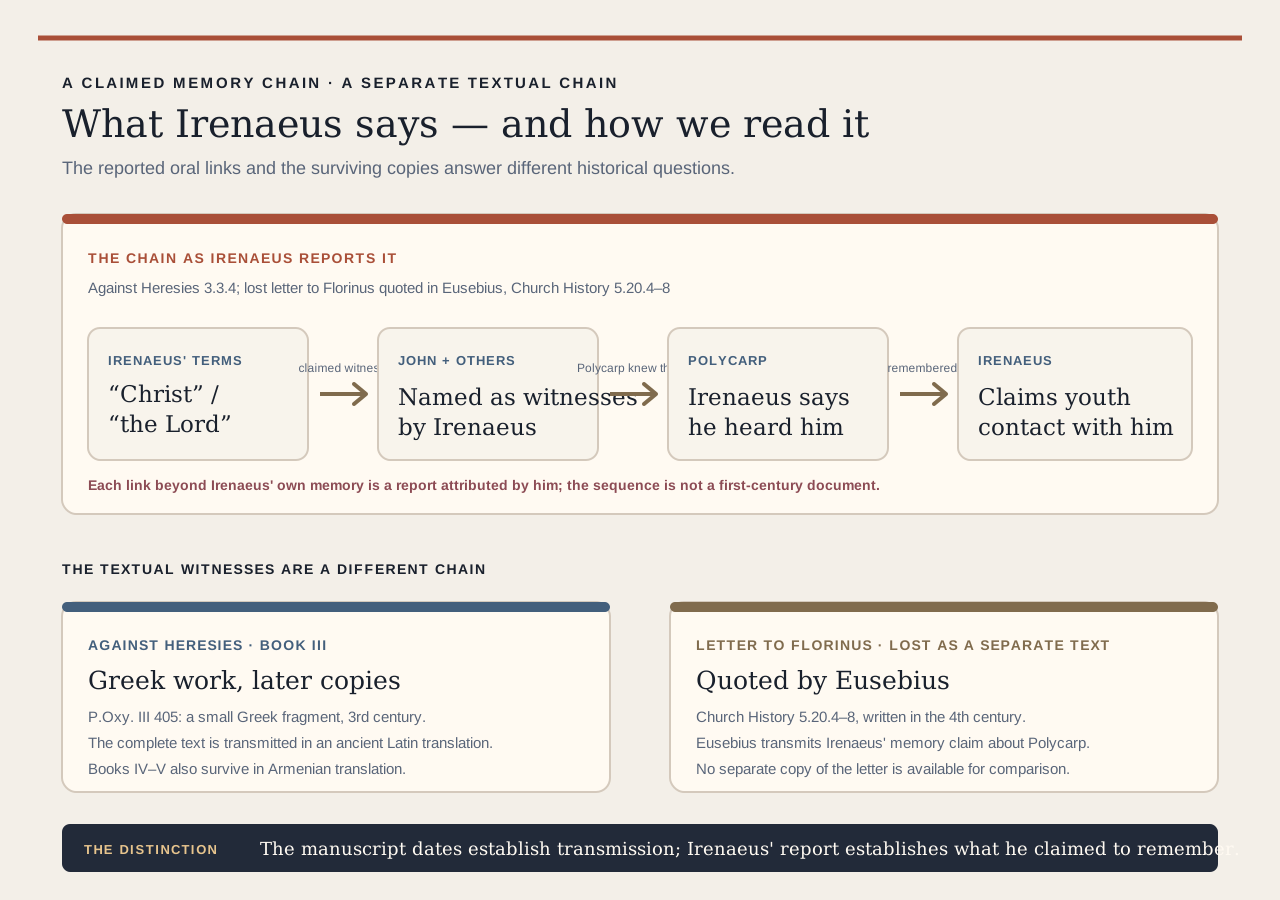
Against Heresies 3.3.4 says Polycarp had been instructed by apostles and had spoken with people who saw Christ. Irenaeus adds that he saw Polycarp in his youth. This is Irenaeus' late-second-century claim about his own memory; it is not a contemporary record from Polycarp or the people he names.
In the passage about Florinus, Irenaeus says that as a boy he saw Florinus with Polycarp and heard Polycarp speak about John and others said to have seen ‘the Lord.’ The letter to Florinus is preserved only through Eusebius, writing in the fourth century. No testimony from Florinus, Polycarp, John, or the alleged eyewitnesses independently documents these conversations.
Irenaeus can attest to what he later wrote and believed about Polycarp. His account does not verify the links from Polycarp to John to Jesus, identify the figure in those reports through a first-century biography, or meet this site's standard of contemporary, independent evidence.
Jesus near fifty: a reading of John, not a dated record
In Against Heresies 2.22.5–6, Irenaeus argues against Christians who said Jesus preached for only one year after baptism. He combines the repeated Passovers in John with John 8:57—‘You are not yet fifty years old’—and reads the remark as putting Jesus above forty and close to fifty during his teaching. He says elders in Asia who knew John reported that John passed on this age information.
Irenaeus offers no public register or dated record for this age. His argument combines a reading of Gospel chronology with an unattributed report about elders; it does not independently authenticate the narrative from which he reasons.
The text has its own transmission history
Against Heresies was composed in Greek, but the complete work is transmitted in an ancient Latin translation. Most of the Greek original is lost; Greek passages are quoted by later writers, including Eusebius and Epiphanius. Books IV and V also survive in an Armenian translation, whose principal manuscript is a thirteenth-century codex.
P.Oxy. III 405 is a small Greek papyrus fragment from Book III, dated to the third century. It is an early physical witness to a short passage of Irenaeus, not a copy of the whole five-book work and not a manuscript from the first century. The Latin and Armenian translations, later codices, and Greek quotations each witness stages in transmission; none dates the Gospel events described by Irenaeus.
What Irenaeus establishes
Irenaeus establishes that, by the late second century, a writer argued for four particular Gospels, attached them to apostolic figures, and used a succession of teachers to defend his reading. He also claimed to remember Polycarp and to have heard Polycarp recount reports associated with John. That is relevant evidence for second-century Christian memory and canon formation.
It does not turn the attributed Gospel authors into eyewitnesses, produce a first-century document, or independently verify the reported chain about the figure called Christ or Lord. The content of Irenaeus' claims must be distinguished from the date of his work and the later manuscripts that transmit it. The conventional date of about 180 CE places the work after the Marcion-era documentary record around 144 CE.
Source and transmission audit
What Irenaeus' testimony dates
| Claim or witness | Source | What it says or does | What it cannot establish |
|---|---|---|---|
| Late second century · commonly about 180 | Against Heresies 3.3.3 | Irenaeus names Eleutherius as current bishop of Rome, a clue used to place the work in the late second century. | The passage gives no calendar year. The date is reconstructed from the succession list and its present-tense wording. |
| Second-century Gospel attributions | Against Heresies 3.1.1 | Irenaeus assigns Matthew, Mark, Luke, and John origins linking them to the apostles and their associates. | These are Irenaeus' claims. The passage is not a first-century colophon, autograph, or independent record of the named writers. |
| Late-second-century four-Gospel argument | Against Heresies 3.11.7–9 | Irenaeus argues that there must be exactly four Gospels and gives theological reasons for the number. | The symbolic argument shows his position; it does not date the composition of the books or prove their attributions. |
| Claimed childhood memory | Against Heresies 3.3.4 | Irenaeus says he saw Polycarp in his youth and reports that Polycarp had spoken with people said to have seen Christ. | This is Irenaeus' own account of his contact and Polycarp's reported teaching; it does not independently identify or document the figure from a first-century source. |
| Lost letter · quoted in the fourth century | Irenaeus to Florinus, in Eusebius, Church History 5.20.4–8 | Irenaeus recalls seeing Florinus with Polycarp and says Polycarp spoke about John and others described as having seen ‘the Lord.’ | The letter is not independently preserved. Eusebius transmits the passage; no corresponding testimony from Florinus or separate record of those conversations is cited. |
| Jesus' age · second-century argument | Against Heresies 2.22.5–6 | Irenaeus reads John 8:57 and the Gospel's Passover sequence to argue that Jesus taught into his forties and approached fifty. | No register is produced. Irenaeus presents the age as a scriptural inference and a report from unnamed elders, not a dated public record. |
| Third century · Greek fragment | P.Oxy. III 405 · Against Heresies 3.9.2–3 | A small Oxyrhynchus papyrus preserves part of Book III in Greek. | The date belongs to this fragment. It is not a copy of all five books or a manuscript of the Gospels. |
| Later translations and copies | Latin and Armenian transmission; Greek quotations | The complete work survives in an ancient Latin translation; Books IV–V also survive in Armenian, and later Greek writers quote portions. | Translation history and surviving manuscript dates document transmission, not the composition date of the Gospels or events narrated in them. |
| Second-century Gospel plurality · disputed relation | Epistula Apostolorum and modern studies | Some scholars read the Epistula as evidence for an earlier four-Gospel collection; others read it as a new composition using multiple Jesus books. | Its date and literary classification are reconstructed. It is evidence for second-century Gospel writing, not a contemporary account of Jesus. |
The case
Irenaeus’ late-second-century writings record his claims about Polycarp, John, and people said to have seen ‘the Lord.’ The letter to Florinus is known only through Eusebius’ fourth-century quotation. No first-century document or independent testimony verifies this chain, and Irenaeus does not identify a contemporary witness whose account can be checked. These passages document second-century Christian claims; they do not document Jesus’ life in his own time.
Conclusion
Irenaeus documents second-century claims about Gospel authorship, apostolic authority, and oral memory. His account names ‘Christ’ and ‘the Lord,’ but supplies no contemporary source, first-century document, or independently checkable witness for the Gospel events.