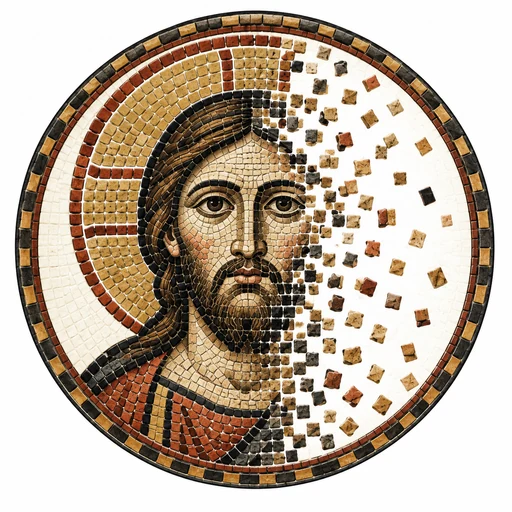
Early Christian manuscripts are physical evidence for copying and textual transmission. P52's proposed 125–175 CE range crosses the c. 144 Marcion-era horizon, while the large catalogue of Greek witnesses consists mostly of later copies and fragments.
Copies, composition, and narrated events
A manuscript is a physical copy. Its date, the date assigned to the work it contains, and the date of events narrated in that work are three separate claims. A later copy can preserve an earlier text, but the copy alone does not tell us when that text was first composed.
No autograph manuscripts of the New Testament books are known. Textual critics compare later copies because their wording differs; a large catalogue counts witnesses to transmission, not independent witnesses to the people or events described in those texts.
What dates establish
Some manuscripts carry explicit dates, but the early New Testament papyri discussed here do not. Their dates are estimates based on handwriting, material, codicology, and archaeological context where that context is available. Palaeography compares a hand with dated documents; it does not provide a year stamped on the papyrus.
P52 is the key case because its often-cited 125–175 CE window straddles the c. 144 documentary horizon used for Marcion. The range gives no exact year, and its early endpoint is not a dated witness. The earliest explicit literary reports about the Gospel corpus remain the Marcion-era accounts.
What the fragment contains
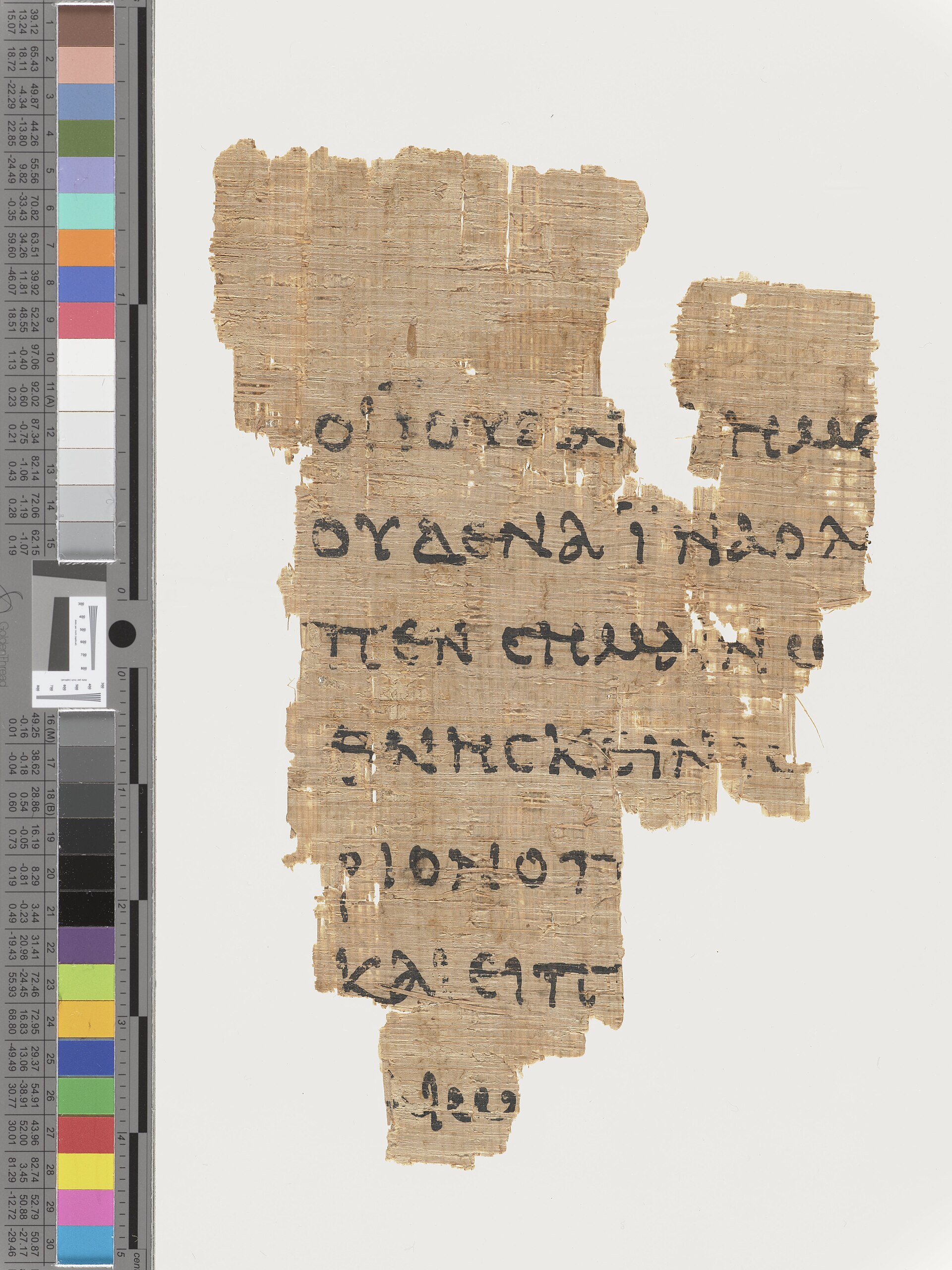
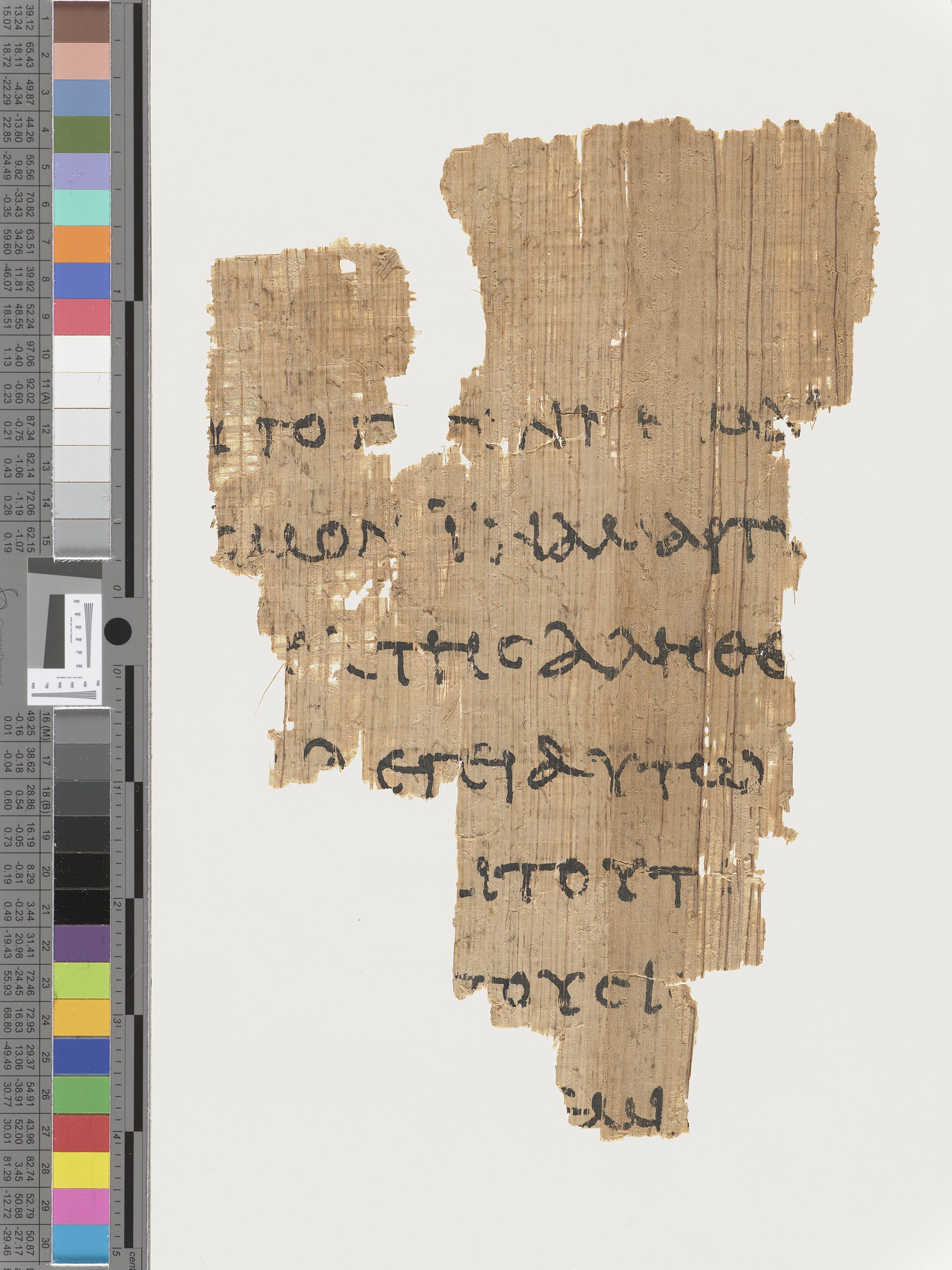
The recto preserves parts of John 18:31–33; the verso preserves parts of 18:37–38. The few lines show part of the exchange between Pilate and the figure the Gospel calls Jesus. P52 is one small fragment, not a complete Gospel or an independent account of that exchange.
The fragment is catalogued as Rylands Greek P 457. Its physical existence is direct evidence that this wording was copied at some point; the year of copying is not written on it.
Copy date versus composition date
A date assigned to P52 applies to the hand that copied this fragment. It does not give the year John was composed, identify its author, or establish the events narrated in John 18.
C. H. Roberts' original catalogue placed the handwriting in the second century. Orsini and Clarysse later proposed a 125–175 CE range. Brent Nongbri argues that the handwriting can be compared with later second- and third-century documents, so the paleographic range may extend into the third century. These are comparative estimates, not dates recorded by the scribe.
Early Gospel fragments and the c. 144 horizon
The commonly cited palaeographic range for P52 is 125–175 CE. It includes years before and after the Marcion-era horizon, but no dated colophon or archaeological context selects its early end. Orsini and Clarysse give that broad range, then conclude that P52, P90, and P104 probably belong to the second half of the second century. Their assessment favors dates after 144; the range itself does not establish a pre-144 copy.
The other two fragments are also small and do not supply an independent biography. P90 preserves a few lines from John 18–19; catalogues place it in the second century, and a study of its text describes it as a second-half-second-century copy. P104 preserves a few lines from Matthew 21 and is catalogued as second-century. Orsini and Clarysse likewise place P90 and P104 among the fragments probably from the century's second half. These witnesses document Gospel wording in small copies, but none supplies a secure pre-144 date.
Nongbri's comparison of P52 with dated papyri shows that palaeographic estimates can extend beyond the narrow popular date, including into the third century. P52 has no dated colophon or securely dated archaeological context that selects a pre-144 year. It therefore does not establish a Gospel copy before the Marcion-era documentary horizon or a first-century composition or event.
P46: letters attributed to Paul
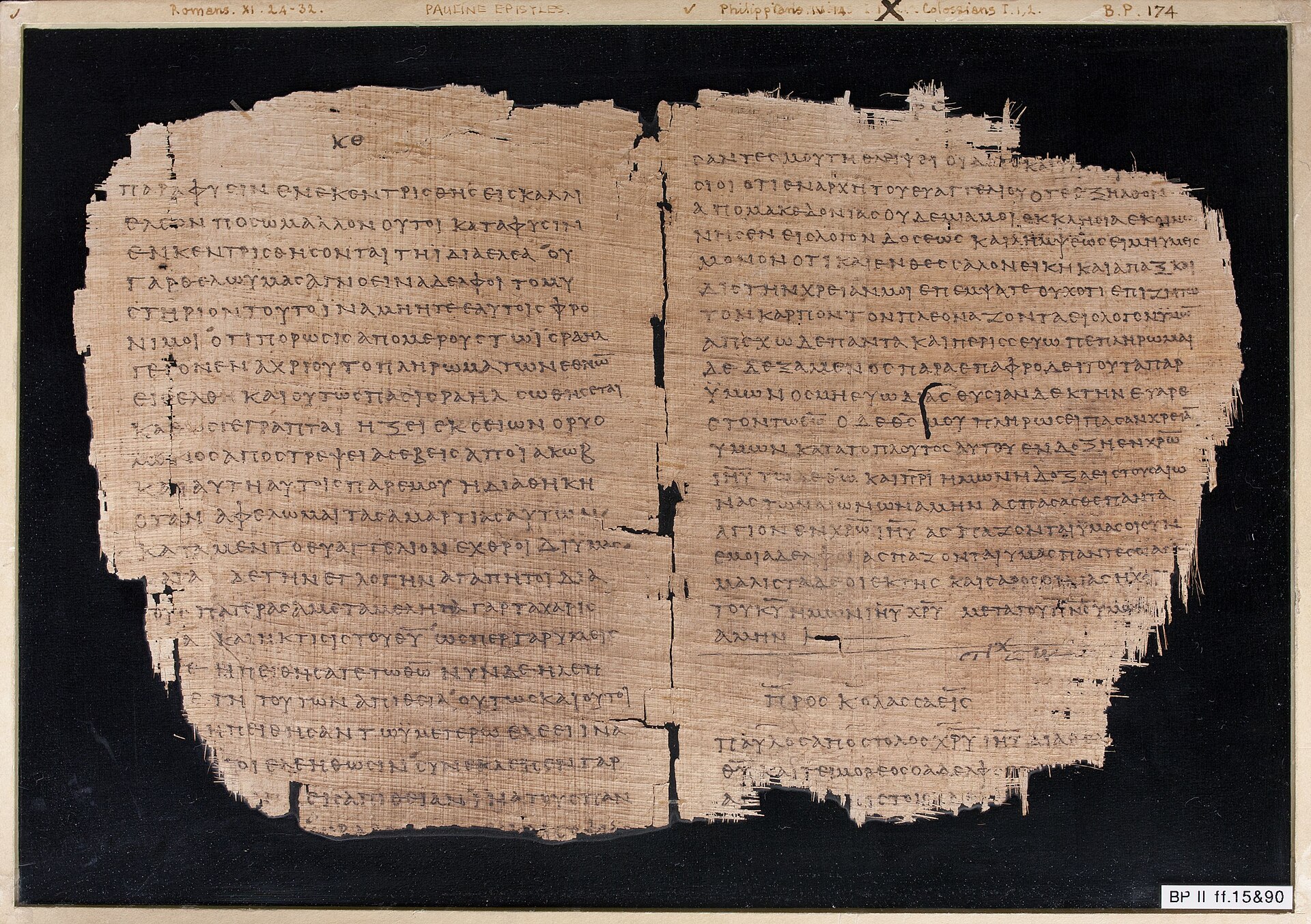
Papyrus 46 is a codex containing a large portion of the collection of letters attributed to Paul, along with Hebrews. Its extant leaves include Romans, both Corinthian letters, Galatians, Ephesians, Philippians, Colossians, and part of First Thessalonians. It is generally placed around 200 CE, with catalogues assigning it to the late second or early third century.
P46 is a physical witness to those letter texts by its estimated copy date. It has no colophon naming a copy year or author. Its contents do not date the letters' first composition, prove that a first-century Paul wrote them, or show that the narratives in them describe events independently of the letters.
P45, P66, and P75: Gospel codices
Papyrus 45 is a fragmentary third-century codex with portions of the four Gospels and Acts. It shows that those writings were copied together by the date assigned to the codex; it does not provide a first-century manuscript or a complete set of the narratives.
Papyrus 66 is a substantial but incomplete copy of John, usually dated to the late second or early third century. Papyrus 75 originally contained Luke and John in sequence; the Vatican Library dates it to the early third century, and about half of each Gospel remains. Neither papyrus carries a copyist's year. Their dates are palaeographic estimates for these copies, not dates of composition.
Codex Sinaiticus and Codex Vaticanus
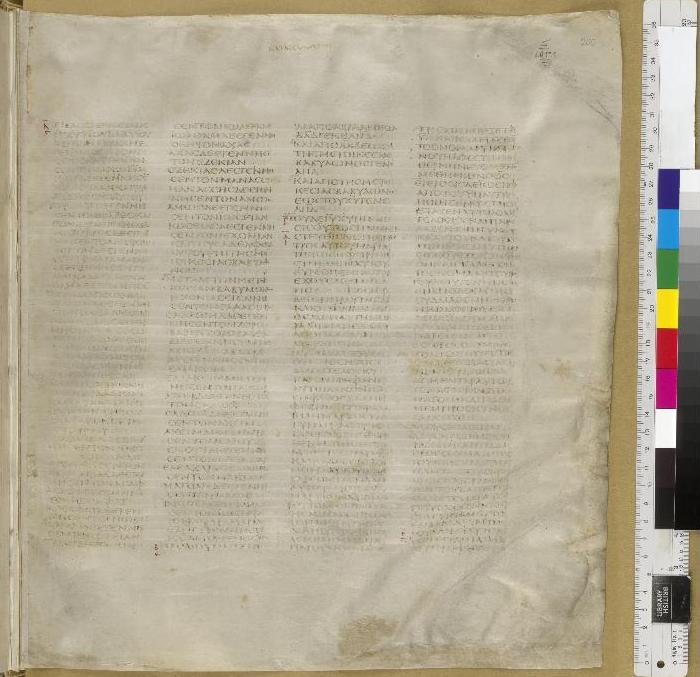
Codex Sinaiticus is generally assigned to the fourth century, often more specifically to its middle. Brent Nongbri's 2022 re-examination argues that the handwriting and other evidence permit a broader range, approximately 300–425 CE; the commonly used fourth-century date is a scholarly judgment, not a date written in the codex. Codex Vaticanus is also generally dated to the fourth century and is one of the other nearly complete Greek Bibles from that period.
These codices preserve extensive Christian biblical collections and are crucial witnesses for textual comparison and canon history. They are not first-century records. Differences between them and earlier papyri show that the wording and arrangement of Christian books must be studied through transmission rather than treated as a single unchanged copy.
What the manuscript totals count
The Institute for New Testament Textual Research reported 5,700 numbered Greek New Testament witness entries in its September 2023 catalogue snapshot. That is a count of registered textual witnesses, not 5,700 complete New Testaments. The register includes items as small as a fragment with a few verses, lectionaries containing selected readings, and large codices. A single artifact can receive more than one number, while one number can cover leaves now held in several places. The INTF reported 5,541 after excluding entries tagged destroyed or presumed missing; the figure depends on what is being counted and when the catalogue is consulted.
The commonly repeated total of more than 10,000 witnesses in other languages is not a Greek-manuscript count and should not be added to it without specifying which version catalogues, fragments, and liturgical books are included. The surviving versions have their own histories. For Latin, the earliest surviving Old Latin Gospel codex is fourth-century Codex Bobiensis; Oxford's account places the likely beginning of the Latin New Testament translation in the early third century and notes earlier Latin Christian writers who translated Greek texts in their own works. A citation in Latin is not itself a surviving Latin manuscript.
Neither a Greek catalogue total nor a combined-language total tells us how many independent reports about Jesus survive. These are copies of Christian writings, many partial and many late. Their total is evidence for the later scale of transmission and preservation; it cannot turn repeated copies of the same narrative into independent eyewitness sources.
The date distribution and its limits
Most catalogued Greek witnesses belong to the medieval copying tradition, and the catalogue becomes much denser in later centuries. A frequently reproduced century-by-century chart was calculated by Peter Gurry from the INTF's Kurzgefasste Liste in 2015. Gurry assigned manuscripts with ranges crossing two centuries to the later century; he noted that just over 300 witnesses fell into that category and explicitly declined to claim that the chart's figures were fully accurate.
That chart illustrates the late concentration of surviving catalogued copies, but its exact percentages are not timeless census results. Catalogue entries and dating judgments change, and broad date ranges are flattened into one century by the chart's method. The distribution says when the surviving copies are assigned; it does not measure the number of copies that existed in each ancient century, nor does it date the first composition of each work.
Handwritten copying did not stop when printing began in Europe. The INTF catalogue includes Greek New Testament witnesses dated as late as the eighteenth century. Printing changed the scale and economics of book reproduction; it did not create a clean cutoff after which no manuscript was made.
Variants record a changing text
Copies differ in wording, order, and included passages. The longer ending of Mark (16:9–20) and the story of the woman accused of adultery (John 7:53–8:11) have distinct manuscript histories; major early codices do not contain those passages in their present locations. These variants show that scribes and communities transmitted texts in more than one form.
No exact total of Greek New Testament variants is established. Eldon Epp called 400,000–750,000 a ‘wild guess’; Peter Gurry's later estimate used a defined sample of collations and excluded spelling differences. A count depends on which manuscripts have been collated, what counts as a variant, and whether each reading is compared with other manuscripts or with a reconstructed text. The headline number is not a count of independent corruptions from a recoverable original, and it does not mean every difference changes the meaning. At the same time, variants are real evidence that the wording is transmitted in multiple forms and critical editions require editorial judgments.
A variant can help reconstruct the history of a passage. It does not by itself date the first composition of a Gospel or verify an event described there. The site's Gospels article examines those passages alongside the wider literary and documentary chronology.
What the manuscript record establishes
P52, P46, P45, P66, P75, Sinaiticus, and Vaticanus are physical evidence for the copying and circulation of Christian writings. Their contents, dates, and textual differences establish a history of transmission; they do not constitute separate reports by independent eyewitnesses.
The dating evidence does not support a confident claim that P52 was copied before 144, and it also does not support the claim that P52 must be later. The site can state that the Marcion-era material forms the earliest explicit literary account of the Gospel-and-letter corpus in its chronology, while acknowledging that the physical date of P52 remains broad and overlaps that horizon.
Manuscript and date audit
What each copy preserves—and what its date means
| Copy or horizon | Source | What it says or does | What it cannot establish |
|---|---|---|---|
| Around 144 CE · reconstructed horizon | Justin on Marcion; later reports by Irenaeus and Tertullian | The site places the first explicit literary reports about Marcion's Gospel and collection of letters in this second-century context. | This is a reconstructed literary chronology, not a dated manuscript or a colophon. |
| P52: 125–175 proposed range; P90 and P104: catalogued second century | Rylands P 457 (P52), P.Oxy. 3523 (P90), P.Oxy. 4404 (P104) | Three fragmentary Gospel copies: P52 and P90 preserve parts of John; P104 preserves parts of Matthew. | The range for P52 permits a pre-144 copy, but Orsini and Clarysse say all three probably date to the century's second half. Nongbri argues that P52 comparanda extend later still. |
| Late second or early third century · often c. 200 | Papyrus 46 (P46), Pauline letters and Hebrews | A substantial codex witness to a collection of letters attributed to Paul, including Hebrews. | The date belongs to the physical copy; it does not identify a first-century author or give the letters' composition year. |
| Third century | Papyrus 45 (P45), Gospels and Acts | A fragmentary papyrus codex with portions of Gospel texts and Acts. | It documents a later copy and collection, not a contemporary account or complete set of books. |
| Late second/early third century; third century | Papyrus 66 (P66) and Papyrus 75 (P75) | P66 preserves much of John; P75 preserves parts of Luke and John, originally in sequence. | The dates are handwriting-based estimates for these copies, not dates written by their scribes. |
| Fourth century | Codex Sinaiticus and Codex Vaticanus | Large, nearly complete witnesses to the Christian biblical collection, copied on parchment. | They document fourth-century texts and book arrangements, not first-century events or authorship. |
| 2023 catalogue snapshot: 5,700 entries; 5,541 after stated exclusions | INTF Kurzgefasste Liste / New Testament Virtual Manuscript Room | A Greek-only catalogue count covering papyri, majuscules, minuscules, and lectionaries, with witnesses ranging from tiny fragments to large codices. | Not a count of complete Bibles or independent accounts. Inclusion of destroyed or missing entries, split artifacts, duplicates, and changing catalog criteria affects the total. |
| Latin version history: likely early third-century translation; surviving Old Latin Gospel codex copied in the fourth century | Oxford, The Latin New Testament: A Guide to its Early History, Texts, and Manuscripts | Oxford distinguishes Latin quotations or translations by early Christian authors from physical Latin biblical manuscripts; it identifies Codex Bobiensis as the oldest surviving Old Latin Gospel manuscript. | Evidence that a writer could translate Greek into Latin does not supply an extant Latin manuscript from that writer's date. |
| Medieval concentration; 2015 distribution chart | Peter Gurry, Distribution of New Testament Manuscripts by Century | A chart based on the INTF Liste groups Greek witnesses by century and places a witness with a multi-century date range in its latest century. | More than 300 entries had ranges handled this way; the author disclaims 100% accuracy. Exact percentages are dataset- and method-dependent. |
| Different readings across copies | Mark 16:9–20; John 7:53–8:11 | The passages have distinct manuscript histories; the major early codices omit them from their current locations. | Textual variation dates stages of transmission; it does not independently date a Gospel's first composition or verify its narrative. |
| Variant totals: estimates, not a census | Eldon Epp (2011/2014); Peter Gurry (2015) | Epp's 400,000–750,000 range is identified as a ‘wild guess’; Gurry estimates from collated data while defining variants as differences among manuscripts and excluding spelling differences. | Counts depend on sample, definition, and comparison baseline. They are not counts of errors against a known original or of equally meaningful changes. |
The case
These manuscripts establish Christian textual transmission within their estimated date ranges, not independent eyewitness testimony. P52's broad 125–175 CE range does not establish a pre-144 copy; no dated colophon or archaeological context selects an earlier year. Catalogue totals and variant counts measure copied textual witnesses and differences, not the date of a work's composition or the truth of its narrative.
Conclusion
The manuscript record is evidence for copying and textual change. It does not establish first-century composition or independent testimony; P52's broad range does not establish a pre-144 copy.