The Tosefta and Babylonian Talmud preserve traditions naming Yeshu or Yeshua ben Pantera, including hostile stories about execution, sorcery, and rival teaching. Some passages explicitly target Jesus of Nazareth; others are linked to him through disputed names or manuscript readings. None is a contemporary account of first-century events.
Two Talmuds, many layers
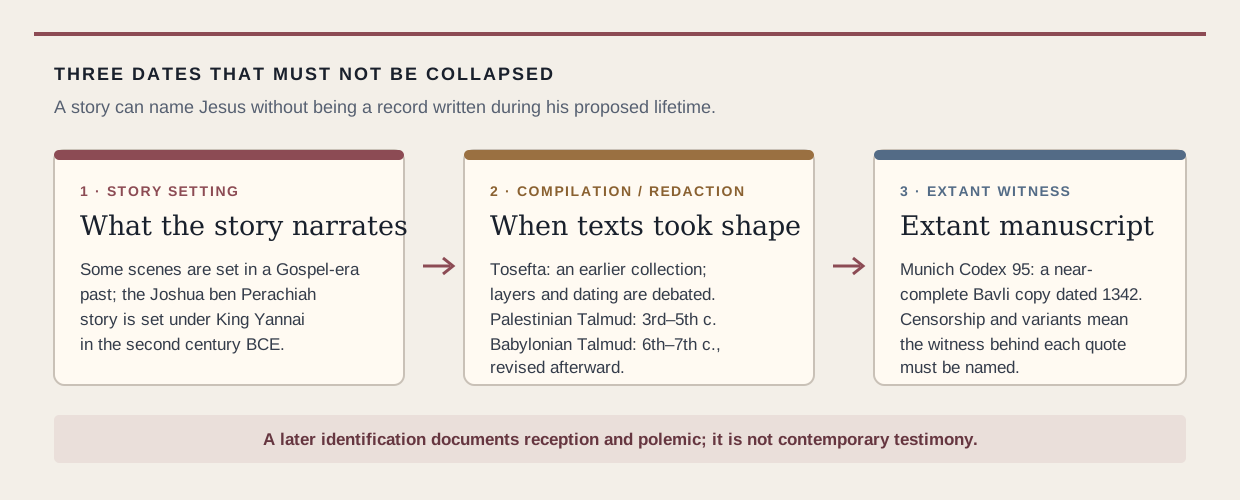
‘The Talmud’ names two related but distinct compilations. The Palestinian Talmud is commonly dated to the third through fifth centuries CE; the Babylonian Talmud to the sixth and seventh centuries, with revision continuing afterward. Both comment on the Mishnah, a text compiled around the beginning of the third century. These ranges describe literary collections, not the date of every saying or story inside them.
The date assigned to a rabbi inside a story is not the date when that story was composed. Traditions may circulate before they are incorporated into a compilation, but that earlier circulation has to be established passage by passage. The Bavli's near-complete Munich Codex 95 was copied in 1342. Manuscript evidence, printed editions, and a story's narrated setting are three separate dates.
Sanhedrin 43a: the execution story
In the received Bavli text, a story says that on Passover eve Yeshu was hanged. A herald is said to have announced for forty days that he would be taken out to be stoned for sorcery and for leading Israel astray, inviting anyone to speak in his defense. The passage then names five disciples—Mattai, Naqqai, Netzer, Buni, and Todah—and gives each a proof-text-based challenge. Some manuscript witnesses identify the figure as Yeshu ha-Notzri; wording and omissions vary among manuscripts and printed editions. The ‘go out to be stoned’ wording appears in the herald's announcement; the story itself then says he was hanged. These lines should not be collapsed into two independent execution accounts.
The story sits in a discussion of legal execution procedure, especially the public search for grounds to acquit. It describes stoning followed by hanging, not the Roman crucifixion in the Gospel narratives. Peter Schäfer reads the passage as a deliberate rabbinic counter-narrative engaging the Gospel account; Michael Cook likewise argues that it responds to Christian claims about an unfair trial. Schäfer and Cook read the episode as a response to Christian claims. Even if that is the intended target, the late legal story documents a later dispute and its rewritten narrative; it is not an eyewitness account or an independent first-century record.
Tosefta Ḥullin and Yeshua ben Pantera
Tosefta Ḥullin 2:22–24 tells of Rabbi Eleazar ben Dama, who is bitten by a snake. Jacob of Kefar Samma offers to heal him in the name of Yeshua ben Pantera; Rabbi Ishmael forbids the treatment, and Eleazar dies before it is carried out. In this legal story, a name linking Jesus with Pantera appears in particular textual forms.
The textual detail matters: in the Sefaria presentation of the Tosefta, the explicit phrase ‘in the name of Yeshua ben Panteira’ is noted as an addition in manuscript Vienna. The Posen Library translates that version and labels the episode as a negative portrayal of followers of Jesus. Those are meaningful clues to how a particular textual tradition was read; they do not erase the witness variation or turn the story into a report about Jesus' own life. The narrative concerns a later healing dispute, not a claimed meeting with Jesus or an independently dated event from his lifetime.
The Palestinian Talmud’s healing stories and name variants
The Palestinian Talmud retells the snakebite story in Shabbat 14:4 and Avodah Zarah 2:2. Like the Tosefta, it describes Eleazar ben Dama, Jacob’s proposed healing, and Rabbi Ishmael’s objection; its expanded discussion asks what proof Ben Dama could have offered. These are literary versions of the same legal story, not separate witnesses to the event.
A second Palestinian story describes a child with a breathing crisis and a healer who whispers words over him. Some English renderings identify the whispered name as Jesus ben Pandera. That identification needs a manuscript note: Peter Schäfer’s comparison records the Jesus/Pandera wording in the first printed Venice edition, while the Leiden manuscript’s main text omits it and a later glossator supplies the name in the margin. The proper conclusion is not that every Palestinian witness names Jesus, nor that the parallel is unrelated; it is that the identification is textually disputed and partly supplied through later transmission.
The Bavli also preserves the Ben Dama healing story, but Schäfer reports that the manuscripts he checked do not name Jesus in this passage. Other Bavli passages, such as Sanhedrin 43a, do name Yeshu. The parallel variants show how later copyists and editors connected rabbinic stories about healing, heresy, and Christian names. Even where the identification with the Christian Jesus is intended, the passage records that later literary and religious dispute; it does not independently attest his first-century life.
Ben Stada and Pandera: no Roman soldier in the Talmud
Shabbat 104b and Sanhedrin 67a contain wordplay about Ben Stada, Ben Pandera, Pappos ben Yehuda, and a mother called Miriam. The passage debates which name belongs to the mother, husband, or lover and associates the figure with bringing magic from Egypt. The Bavli does not identify Pandera as a Roman soldier. It also does not give a continuous biography connecting every named figure to Jesus of Nazareth.
The soldier claim appears in a different source chain. In Against Celsus 1.32, the Christian writer Origen quotes the second-century critic Celsus presenting a Jewish speaker who says a soldier named Panthera fathered Jesus. Origen is the transmitter of Celsus' lost work. Origen’s report is not a statement made by the Talmud and provides no independent documentation of Jesus' parentage.
A Yeshu placed a century too early
Sanhedrin 107b and its parallel in Sotah 47a place Yeshu among the students of Joshua ben Perachiah. The story is set during the persecution under King Yannai, usually identified as Alexander Jannaeus, who ruled in the second century BCE. That setting is more than a century before the period assigned to the Gospel Jesus.
Some manuscript forms explicitly call the student Yeshu ha-Notzri; others use a pronoun or leave the name unstated at points in the story. Dan Jaffé's comparison of the Bavli and Sotah witnesses documents those differences. In forms that name Yeshu ha-Notzri, the story places him among students in a second-century BCE setting. That chronology conflicts with the Gospel timeline and makes the passage unusable as a biography of a first-century person. The conflicting traditions do not form one coherent first-century life.
Prayer and the afterlife: polemic, not testimony
Berakhot 17b includes a prayer asking not to have a son or student who publicly ‘burns his food,’ a saying that the William Davidson translation connects explicitly with Yeshu ha-Notzri. The line is a hostile moral comparison; it supplies no life detail that can be checked independently.
In Gittin 57a, Onkelos summons Yeshu in a story about the afterlife. Yeshu says Israel's welfare should be sought and describes boiling excrement as the punishment for mocking the sages. The 1935 Soncino volume cited in many quotations is a modern English edition, not an additional ancient witness; the underlying Aramaic wording and the edition used should be identified. The passage belongs to a comic, religious comparison among condemned figures. It records a later rabbinic judgment about a Christian adversary, not a report from someone who witnessed Jesus' life or death.
‘Yeshu’ is not an acronym stated by the Talmud
The Talmud writes the name Yeshu; it does not explain the spelling as an acronym for ‘May his name and memory be blotted out.’ Eran Shuali's study of the name's history traces variation in Hebrew forms and notes Yeshu and Yeshua forms in manuscripts of the later polemical work Toledot Yeshu. The acronym reading belongs to the history of polemical interpretation; it should not be presented as the Talmud's own explanation or as an established original etymology.
What explicit Jesus references establish
Some textual forms name Yeshu ha-Notzri, and the Tosefta tradition includes Yeshua ben Pantera. These are direct textual references in later rabbinic literature. Schäfer reads several stories as deliberate responses to Gospel narratives; their narrative borrowings and later setting place them within subsequent Jewish-Christian polemic.
A text that names Jesus in a later dispute documents that dispute and the claims its authors address. It does not become an independent report from the first century. The Talmudic stories are later, their details conflict, and they provide no contemporary witness or independently dated account of Jesus’ life.
Conclusion
Rabbinic sources should be read passage by passage, with the wording of each witness kept visible. Sanhedrin 43a is best treated as a late polemical story about Jesus; the Tosefta preserves a variant tradition naming Yeshua ben Pantera; and other passages link Yeshu with magic, wayward disciples, or afterlife punishment. These records matter for the history of Jewish-Christian debate.
None is contemporary evidence. The Talmud does not call Pandera a Roman soldier, its traditions do not form one coherent biography, and a likely allusion to Jesus is not an independent witness to Jesus' life. The passages document later belief and opposition—not a first-century historical record.
Text and transmission audit
What each rabbinic passage can establish
| Text or date | Source | What it says or does | What it cannot establish |
|---|---|---|---|
| Tosefta · received text with variant readings | Tosefta Ḥullin 2:22–24 | A healing story names Yeshua ben Pantera in one textual witness; the narrative centers on Rabbi Eleazar ben Dama and a dispute over accepting healing from a heretic. | The explicit name is not present in every witness. The story is not a contemporary report about Jesus, and it supplies no independent biography. |
| Palestinian Talmud · two healing-story parallels | Shabbat 14:4; Avodah Zarah 2:2 | One retells the Ben Dama snakebite story; another describes a healer whispering over a choking child. ‘Jesus/Pandera’ appears in the Venice print tradition, while the Leiden manuscript’s main text omits those names and later marginal hands add them. | The readings depend on edition and manuscript layer. The passages are literary parallels to rabbinic healing debates, not additional contemporary reports. |
| 3rd–5th centuries CE · conventional range | Palestinian / Jerusalem Talmud | A rabbinic corpus that preserves Palestinian legal discussion and stories, including healing narratives also found in the Bavli. | A date for a compilation does not date each tradition. Parallel passages have different readings; names supplied by a translation must be checked against its manuscript base. |
| 6th–7th centuries CE · revised afterward | Babylonian Talmud | A layered compilation with passages that name Yeshu ha-Notzri in some manuscript traditions and engage Christian narratives. | The compiled text is many centuries later than the proposed first-century events; named polemic shows reception, not independent access to those events. |
| Sanhedrin 43a · textual variants | Babylonian Talmud | A Yeshu execution story links Passover eve, sorcery, a legal crier, stoning, hanging, and five disciples named Mattai, Naqqai, Netzer, Buni, and Todah; some witnesses specify ‘the Nazarene.’ | The wording varies by manuscript and edition. Its legal framing and divergences from Gospel execution accounts make it a later polemical narrative, not a contemporary execution record. |
| Sanhedrin 67a; Shabbat 104b | Ben Stada / Pandera traditions | The Bavli's wordplay connects the names Stada, Pandera, and Pappos and associates the figure with magic learned in Egypt. | The passage gives no Roman military identity. It does not explicitly call the figure Yeshu or provide a reliable family record. |
| Second-century setting inside a later story | Sanhedrin 107b; Sotah 47a | Yeshu appears as a student of Joshua ben Perachiah during the persecution under King Yannai, a setting in the second century BCE. | The setting is incompatible with the Gospel chronology. It is evidence of rabbinic story-making and conflation, not a usable date for a first-century life. |
| Late antique polemic | Berakhot 17b; Gittin 57a | A prayer warns against a publicly wayward student and names Yeshu ha-Notzri in some textual forms; an Onkelos story places Yeshu in an afterlife punishment narrative. | These are moral and polemical stories, not reports by witnesses to Jesus or independent records of Christian origins. |
| 1342 CE · near-complete manuscript witness | Munich Codex 95 | The National Library of Israel catalogues the dated copy of the Babylonian Talmud and describes the handwritten textual tradition before printing. | This medieval manuscript preserves an earlier textual work; it is not a manuscript from the period of Jesus or proof that every reading is ancient. |
| Late antique Christian report of an accusation | Origen, Against Celsus 1.32 | Origen quotes Celsus attributing to a Jewish speaker the claim that a soldier named Panthera fathered Jesus. | This is a Christian writer's report of Celsus' polemic, not what Sanhedrin 67a or Shabbat 104b says; it supplies no independent birth record. |
The case
Where a passage identifies Jesus, it shows that later rabbis knew and opposed Christian claims. It does not supply an independent source for the earlier life it retells. Passages that conflate Yeshu with Ben Stada, Ben Pandera, or a student of Joshua ben Perachiah add literary and chronological problems rather than a coherent biography.
Conclusion
These texts document later rabbinic engagement with the Christian Jesus tradition. Their polemics and variant identifications do not provide contemporary or independent confirmation of a first-century Jesus.