The letter presents Jesus as a human descendant of Abraham, says he was killed and raised, and refers to an epistle attributed to Paul. It also gives no author’s name or year, and no independently dated first-century copy fixes when those claims entered the text.
A Roman church letter, with no named individual sender
The opening identifies the sender as ‘the church of God which sojourns at Rome’ and the recipient as the church at Corinth. The body speaks as ‘we’; near the end it calls itself a letter ‘written by us.’ No individual signs it, and the text gives no year. ‘1 Clement’ is the later conventional title, not the wording of a signature in the letter.
Irenaeus says the Roman church sent the letter during Clement’s period; Dionysius of Corinth, quoted by Eusebius, refers to an earlier letter sent ‘through Clement.’ These later notices document an attribution to Clement. They do not establish who wrote the text or that it predates Marcion; Irenaeus describes the Roman church as the sender.
Why the usual date is around 96 CE
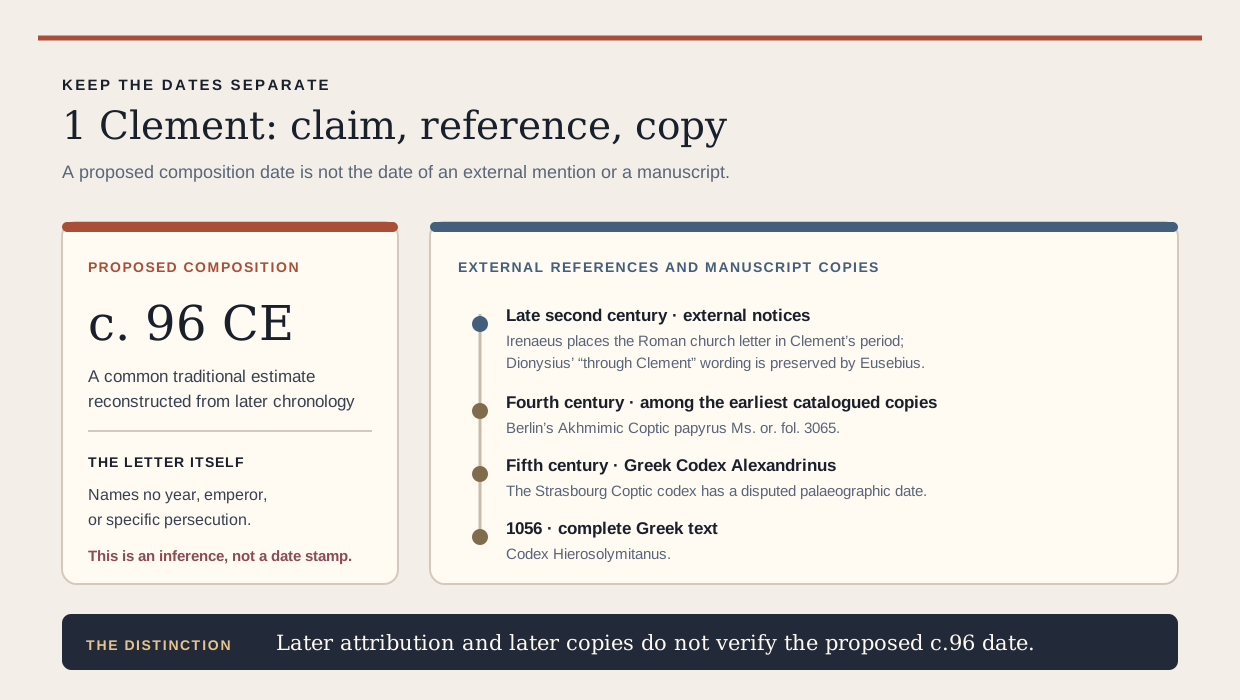
Many standard accounts place the composition near the end of the first century, often around 96 CE. That date is reconstructed from the opening’s reference to ‘sudden and successive’ troubles, the later succession chronology for Clement, and the assumption that the troubles refer to persecution under Domitian. The letter itself names no emperor, persecution, or year. Eusebius supplies the later sequence that connects Clement with Domitian’s reign; he does not quote a date written by the letter’s author.
The opening says the Roman congregation was delayed by calamities and then turns to a Corinthian leadership dispute. It does not identify those calamities. The Cambridge chapter on 1 Clement notes that the language does not plainly describe a persecution and that evidence for a Domitianic persecution of Christians is lacking. Erlemann likewise reviews why the traditional late-first-century date needs more caution. That removes the specific Domitian argument as a secure date marker; it does not, by itself, prove a precise later year.
Chapter 5 calls Peter and Paul examples ‘in our generation’ and describes their deaths as recent. That is the letter’s own claim about its temporal setting. Without a separately dated event or a contemporary witness, the phrase cannot independently verify the date assigned to the letter.
Chapters 40–44 are sometimes used to argue that the letter predates the destruction of the Jerusalem Temple because chapter 41 says sacrifices are offered only at Jerusalem. In context, the writer lays out scriptural rules for high priest, priests, Levites, and lay people, then compares that ordered hierarchy with the apostles’ appointment of ministers. The passage reports no dated sacrifice, names no current high priest, and says nothing about the Temple’s destruction. Its wording is a dating clue people can discuss, but it does not supply a date on its own.
What the letter says about Jesus
The text makes substantial claims, not just passing name-drops. Chapter 16 identifies ‘our Lord Jesus Christ’ with Isaiah 53’s suffering figure. Chapter 32 says Jesus descended from Abraham ‘according to the flesh.’ Chapters 42 and 44 say Jesus was sent by God, that the apostles preached his message, and that he was raised from the dead. Chapters 13 and 46 also present sayings as words of Jesus.
These passages establish what the letter’s authorial voice taught: a human Jesus connected with Jewish scripture, suffering, death, and resurrection. They do not identify a source for the sayings, name an eyewitness, give a location or calendar date for the events, or independently confirm the claims outside the Christian text. A text’s assertion that Jesus lived in recent history is evidence of that assertion; it is not, by itself, a dated record of the life it describes.
Paul is named, and a letter is claimed
Chapter 47 tells Corinth to take up ‘the epistle of the blessed Apostle Paul’ and describes an earlier dispute involving Paul, Cephas, and Apollos. The wording resembles the factions discussed in 1 Corinthians 1:10–12. Chapter 5 describes Paul’s travel, imprisonment, stoning, and death under authorities, and places him among the writer’s ‘recent’ examples.
These are claims inside 1 Clement. The text supplies no copy of the Pauline epistle, no external record of Paul’s travels or death, and no date for the events it describes. There is no evidence that the letter or its Pauline references predate Marcion; the claim that it preserves a first-century Pauline letter depends on assigning 1 Clement a first-century date, which the letter itself does not supply.
The earliest external references
Irenaeus, writing in the late second century, says that the Roman church sent a forceful letter to Corinth ‘in the time of this Clement.’ His wording connects the letter with Clement’s period; it does not say that Clement alone authored it. The passage is part of Irenaeus’ later succession argument, not a first-century document.
Eusebius, writing in the fourth century, preserves a statement he attributes to Dionysius of Corinth. Dionysius says Corinth read an earlier letter ‘written to us through Clement.’ This is a later attribution preserved by Eusebius, not an authorial signature or a first-century date. Eusebius also says that Hegesippus corroborated a Corinthian dissension, but does not quote Hegesippus’ account in that passage. These notices document the later attribution and reception of the letter; they do not establish that it was written before Marcion.
The manuscript copies are later
The Berlin State Library catalogues the Akhmimic Coptic papyrus Ms. or. fol. 3065, which contains 1 Clement, as fourth century. The Strasbourg Coptic codex preserves 1 Clement 1:1–26:2; its date is disputed, with proposed dates ranging from the fourth through seventh or eighth centuries and a current artefact catalogue placing it in the first half of the fifth. Codex Alexandrinus, a fifth-century Greek Bible, preserves most of the letter but lacks a leaf containing 1 Clement 57:6–63:4. The complete Greek text is in the Codex Hierosolymitanus, copied in 1056.
These are manuscript-copy dates, not automatic composition dates. They show that the earliest physical copies identified here are centuries later than the conventional c.96 date. None is a first-century copy that verifies the proposed date or the letter’s claims about Jesus and Paul.
What this evidence establishes
1 Clement is evidence that a Christian authorial voice used Jesus traditions, interpreted Isaiah through Jesus, claimed a Pauline letter to Corinth, and argued from an apostolic past. The text is anonymous and undated. There is no evidence that it was written before Marcion: its conventional first-century date rests on internal interpretation and a later succession framework, while external references are second-century reports and the manuscripts are later copies.
The letter therefore does not establish that Jesus or Paul existed in the first century, nor that the Pauline letters it names predate Marcion. Its historical value is as evidence for the beliefs, scriptural interpretation, and community disputes represented by the text when it enters the documentary record.
Source and transmission audit
What dates the claim—and what dates the copy
| Date or proposal | Source | What it says or does | What it cannot establish |
|---|---|---|---|
| c. 96 CE (conventional reconstruction) | 1 Clement 1.1; Eusebius, Church History 3.15–17 | The opening mentions unnamed calamities; Eusebius later places Clement within Domitian’s reign and discusses a persecution in the next chapter. | The letter gives no year, emperor, or named persecution. The c.96 date is inferred from these clues and Eusebius’ later chronology. |
| Undated internal claim | 1 Clement 5.1–7 | Peter and Paul are called recent examples, ‘in our generation’; the letter says Paul was stoned and died under authorities. | The wording is the authorial voice’s own dating claim, not an independently dated report. |
| Temple-order passage | 1 Clement 40–44 | The writer describes Jerusalem sacrifices and uses ordered priestly roles as a scriptural analogy for Christian ministers. | No service, high priest, or year is identified; the passage does not explicitly date itself before 70 CE. |
| Late second century, preserved in later works | Irenaeus, Against Heresies 3.3.3; Dionysius and Hegesippus as quoted in Eusebius | Irenaeus associates the Roman church letter with Clement’s period; Dionysius refers to a prior letter sent ‘through Clement’; Eusebius says Hegesippus corroborated a Corinthian dissension. | These notices support a later association with Clement and a report of Corinthian conflict. Hegesippus’ passage is not quoted there, and none supplies a signed first-century copy or date. |
| Fourth century · physical copy | Berlin State Library, Ms. or. fol. 3065 | The library catalogues its Akhmimic Coptic papyrus of 1 Clement as fourth century. | This dates the copy, not the original composition. |
| Fourth century · retrospective account | Eusebius, Church History 3.15–17 and 4.23 | Eusebius assigns the letter to Clement, gives a succession chronology, and quotes Dionysius’ reference to a letter sent ‘through Clement.’ | Eusebius is a later historical source, not a manuscript copy of 1 Clement; the chronology and attribution are not dates written in the letter. |
| Fifth century; date debated for Strasbourg Coptic codex | Codex Alexandrinus; Strasbourg P.Copt. 362–385 | Alexandrinus contains most of the Greek letter; the Strasbourg codex preserves Coptic 1 Clement 1:1–26:2. Palaeographic estimates for the Coptic codex vary. | Neither manuscript is a first-century copy; Alexandrinus also lacks one leaf of 1 Clement. |
| 1056 CE | Codex Hierosolymitanus | This manuscript preserves the complete Greek text of 1 Clement. | A complete medieval copy establishes the text’s later transmission, not a first-century composition date. |
| Site chronology: after the Marcion-era documentary anchor | Marcion-era record; later 1 Clement references and copies | The text’s external references fall in the late second century, with identified physical copies from the fourth century onward. | No external reference or dated manuscript cited here independently places 1 Clement before c.144 CE. |
The case
1 Clement is evidence for what its authorial voice claimed about Jesus and Paul. The text is anonymous and gives no date. There is no evidence that it predates Marcion: the conventional c. 96 CE date is reconstructed from internal clues and later chronology, not supplied by a contemporary dated record.
Conclusion
The letter asserts a human Jesus, a risen Jesus, and a Pauline letter to Corinth. Its anonymous, undated text and later external record do not independently establish that those events or writings belong to the first century.