Celsus' second-century polemic is quoted by Origen; Hierocles' later comparison of Apollonius and Jesus is described by Eusebius. Neither critic's original work survives for direct comparison with the Christian rebuttal.
Two works, one line of transmission
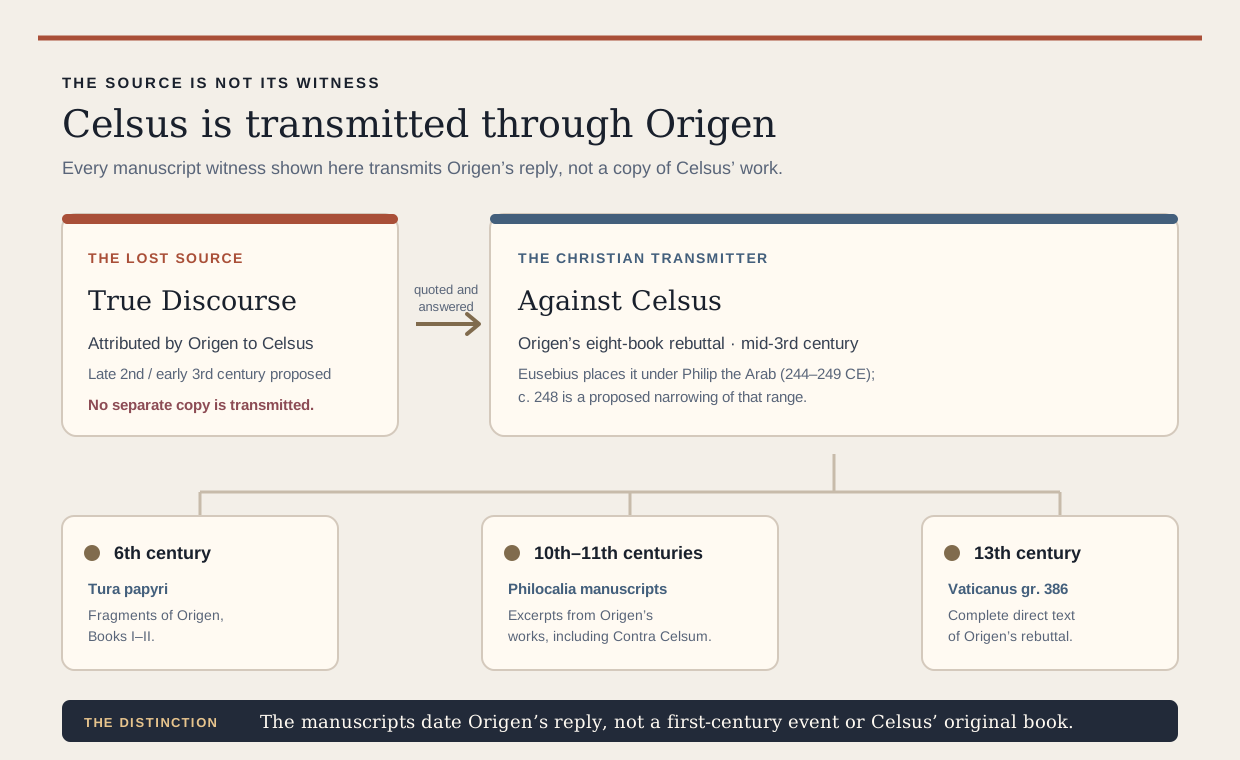
Origen identifies his opponent's title as the True Discourse (often translated True Word or True Doctrine) and says that Ambrosius sent him the treatise to answer. The original work attributed to Celsus has no separately transmitted copy. Its words are known through Origen's Against Celsus, a rebuttal written in the mid-third century.
Origen explains in his preface that he changed his original plan while writing and shifted from a short survey to a closer response. His account is a polemical reply, not a transcript or neutral edition of Celsus. The quotations are valuable evidence for the arguments Origen attributes to his opponent, but the reader encounters them inside Origen's selection and response.
What the attack says about Jesus
Origen reports Celsus' claim that Jesus was born outside marriage, worked in Egypt, learned extraordinary powers there, and returned to use them. In the passage about the mother and the soldier Panthera, Origen introduces a Jewish speaker whom he calls Celsus' Jew. These are hostile claims, not corroboration of the Gospel birth stories or proof that the accusations happened.
The passage does make a real historical point: the author Origen calls Celsus did not treat Jesus as only an abstract heavenly being. The attack depicts him as a human figure with a mother, a social setting, and activities. That is evidence for the form of the polemic and for a later belief about Jesus. It does not establish that the details came from anyone who knew a first-century person.
Celsus' Jewish speaker is not a second source
Celsus' work presents a Jewish opponent speaking to Jesus and to Jewish followers of Jesus. The speaker is not named, no document by that speaker is quoted, and Origen provides no chain of custody for the words. The text available through Origen gives us Celsus' literary presentation of a Jewish argument, not a separate Jewish document or an identifiable witness.
Origen’s Celsus presents the speech as the words of an unnamed Jewish opponent, but neither author identifies an individual source or gives a chain for the claims. The speech is therefore part of Celsus’ polemic as transmitted by Origen; it supplies no independently documented Jewish witness and no information dated to Jesus’ lifetime.
A hostile retelling is not independent corroboration
The Egyptian episode shows how the argument works. Celsus' attack engages the Christian story that Jesus was taken to Egypt as an infant, then recasts Egypt as the place where he worked for hire and learned magic. The Panthera accusation similarly counters the Christian claim of a miraculous conception with an ordinary, discrediting explanation. The texts and the reply show a dispute over claims already circulating about Jesus.
Celsus' non-Christian identity matters: this is not a Christian author repeating a confession of faith. But it does not make every biographical assertion independent. In the passages available to us, Celsus names no eyewitness, archive, official record, or source outside the Christian-Jewish controversy. The argument is an adversarial reinterpretation of Jesus traditions. That is evidence that the traditions were being contested; it is not an independently sourced report of the events they describe.
The proposed date is not a documented year
The date often given as about 178 CE is an older, more precise proposal than the evidence can secure. Only a few vague references in Origen's quotation bear on when Celsus wrote. Origen says Celsus had been dead 'for a long time'; other clues refer to persecution and rulers without naming a securely identifiable year. Recent discussions place the work broadly in the last third of the second century or possibly the beginning of the third.
Origen's rebuttal is later. Eusebius places its eight books during the reign of Philip the Arab, 244–249 CE; Henry Chadwick argues for about 248 based partly on internal clues. These are dating reconstructions for Origen's reply, not dates written into Celsus' original work.
The manuscripts preserve Origen, not Celsus
The physical witnesses also belong to Origen's text. Sixth-century papyri from Tura preserve parts of the first two books of Against Celsus. The tenth- and eleventh-century manuscripts of the Philocalia preserve excerpts from Origen. The complete direct manuscript is Vaticanus graecus 386, dated to the thirteenth century; the other complete manuscripts descend from it.
The sixth-century Tura copy is important, but it is not a manuscript of Celsus' True Discourse. It confirms a line of transmission for Origen's rebuttal. No copy of Celsus' work independent of Origen is available for comparison, so the wording and selection of every Celsian fragment reach us through a Christian transmitter.
What the testimony establishes
If Origen's attribution is accepted, Celsus is evidence for a non-Christian polemic that represented Jesus as a person and attacked Christian claims about his birth, deeds, and status. The text identifies no source outside the late-second-century controversy; it is not testimony from Jesus' lifetime.
The earliest proposed date for Celsus' attack is later than the c. 144 CE documentary anchor. His work cannot independently verify a first-century Jesus or date the stories it criticizes to the period they describe. It documents the controversy over Jesus traditions in the late second or early third century and the way a critic turned those traditions against Christianity.
Hierocles and Apollonius
Hierocles' comparison belongs to a different period and a separate transmission chain from Celsus' polemic. The following sections concern Hierocles as Eusebius represents him; they do not extend Celsus' argument or provide a second witness to the events described in the Gospels.
Hierocles: A polemic known through its rebuttal
Eusebius wrote Against Hierocles to answer comparisons between Apollonius and Jesus. Hierocles' pamphlet is lost; Eusebius is the source for its argument.
Eusebius says Hierocles contrasted Apollonius' biographers with the Christian apostles and challenged miracle claims. He does not report Hierocles denying Jesus existed.
Hierocles: What this source establishes
The episode records a late-antique dispute over miracle stories and Christian narrative credibility. It is neither a first-century account nor a denial of Jesus' existence.
Source and transmission audit
Two critics, two rebuttal chains
| Date or witness | Source | What it says or does | What it cannot establish |
|---|---|---|---|
| Late second century or early third century · proposed composition | Celsus' True Discourse, quoted in Origen, Against Celsus | Recent source-critical discussion places the work broadly in the last third of the second century or possibly the beginning of the third. Origen says Celsus had been dead for a long time when he replied. | The work supplies no calendar date. The traditional c.178 date is not fixed by a contemporary manuscript or an unambiguous internal date. |
| 244–249 CE · Origen's rebuttal | Eusebius, Church History 6.36.1–2 | Eusebius places Origen's eight books against Celsus during Philip the Arab's reign; internal evidence is commonly used to narrow this to about 248. | This dates Origen's rebuttal, not Celsus' work or Jesus' life. |
| Undated literary speech | Against Celsus 1.28–39; 2.1–79 | Origen quotes an attack voiced by a Jewish opponent and reports claims about Jesus' birth, Egypt, and alleged magic. | The speaker is unnamed; no independent Jewish document, witness, or source is identified. Whether the speech incorporates authentic Jewish material is debated. |
| Sixth century · partial manuscript of Origen | Tura papyri | Fragments contain parts of the first two books of Against Celsus. | This is a copy of Origen's response and belongs to the same textual line as the later Vatican manuscript; it is not a copy of Celsus. |
| Tenth and eleventh centuries · excerpts | Manuscripts of the Philocalia | The anthology transmits extracts from Origen, including material from Against Celsus. | The fourth-century compilation date is not the date of these extant manuscript copies; they transmit excerpts of Origen, not an independent copy of Celsus. |
| Thirteenth century · complete direct manuscript | Vaticanus graecus 386 | The manuscript preserves the complete Greek text of Against Celsus and is the basis of the direct manuscript tradition described by Chadwick. | It dates a copy of Origen's rebuttal. Other complete copies descend from this witness; it does not supply a separate manuscript of Celsus. |
| Late second or early third century · after c.144 CE | Celsus fragments in Origen; proposed dates for Celsus | Every current proposed date places Celsus' polemic after the Marcion-era documentary reference dated to c.144 CE. | This later polemic documents later beliefs and disputes, not a contemporary account of the events it alleges. |
The case
These accounts document later disputes over Christian claims and miracle narratives. Origen and Eusebius are the transmitters, so each quotation must be read in the framing and argument of its rebuttal. Neither text supplies a contemporary account of Jesus or independent first-century testimony.
Conclusion
Celsus and Hierocles show that Christian writers reported later criticism of their narratives. Origen and Eusebius transmit those criticisms through their rebuttals; neither account supplies a contemporary record or independent first-century evidence for Jesus.