In The Passing of Peregrinus 11, Lucian describes Christians worshipping an unnamed man executed in Palestine who introduced their cult. The context identifies him as their revered founder. Connecting this figure with Jesus relies on comparison with Christian texts; Lucian gives neither the personal name Jesus nor the title Christ for the man. He names no source for the earlier execution claim.
Christian context points to an unnamed founder
In §11 Lucian says Peregrinus learned Christian teaching in Palestine and became a leader among Christians. He then describes the community's reverence for an unnamed man whom they still worship, said to have been executed in Palestine for introducing their cult. Section 13 returns to the same founder as the Christians' first lawgiver and calls him a crucified sophist.
The Christian setting identifies the figure's role as the movement's revered founder. Connecting that figure with the Jesus named in Christian texts is an inference from the context and description; Lucian gives neither the personal name Jesus nor the title Christ for this man. The passage does not supply his personal name.
The Greek wording and the execution claim
The key Greek participle is ἀνασκολοπισθέντα. The LSJ lexicon gives the basic sense as fixing someone on a pole or stake, or impaling; standard English translations render the phrase as ‘crucified in Palestine.’ The translation is understandable, but the Greek word itself does not specify the mechanics of the execution.
There is a separate textual problem in §11: the transition from Lucian's description of Peregrinus as a Christian ‘protector’ to the clause about the unnamed figure Christians still worship is difficult in Greek. Christian Lacombrade surveys proposed repairs and calls the transmitted text corrupt; Luca Beltramini likewise notes serious textual problems in the passage from ἐπεγράφοντο onward. The standard rendering is an interpretation of a difficult text, so its exact syntax should not be treated as secure. Section 13 again describes Christians worshipping a ‘crucified sophist,’ but that is part of the same satirical work, not independent corroboration.
On the conventional reading, Lucian connects the Christians' revered founder with an execution in Palestine and the introduction of their cult. He supplies no date, governor, trial, named witness, or record, and the text does not show how he learned the claim. The Christian context supports identifying the figure as the movement's founder; it does not supply a personal name or an independent account of the alleged event.
Lucian's eyewitness claim concerns Peregrinus
The work opens as a letter from Lucian to Cronius and is framed as a satirical account of Peregrinus. In §§34–38 the narrator says he attended the Olympic games and saw Peregrinus' self-immolation. That first-person claim concerns the Cynic's death in the second century.
The Christian episode appears earlier in the narrative as Peregrinus' past. Lucian never says he witnessed that period in Palestine, interviewed a Christian who knew the founder, or consulted an earlier record. An eyewitness claim about Peregrinus' death cannot be transferred to the separate account of the Christian founder.
Satire records Lucian's portrayal, not a neutral deposition
Lucian's target is Peregrinus: the satire presents him as a fame-seeking performer who turns his contact with different communities into a route to status. The Christian episode is part of that characterization. Lucian's ridicule does not make every detail fictional, but it does mean the passage should be read as a crafted attack rather than a neutral biographical report.
The text is direct evidence for what Lucian chose to say about Christians and Peregrinus. Because it gives no source for the earlier founder story, it cannot independently verify that story's first-century events.
Why the passage is cited—and what it establishes
The strongest case for using Lucian is that a non-Christian author describes Christians worshipping a founder associated with an execution in Palestine. On the conventional reading of a textually difficult sentence, Lucian connects that figure with the introduction of the cult; §13 calls the object of Christian worship a ‘crucified sophist.’ The founder is not named. Identifying him with the Jesus named in Christian writings is an inference from the Christian setting and the passage's description, not a name Lucian supplies.
Lucian reports a second-century account of the community's founder and identifies no independent line of information behind it. His outsider status makes the text evidence for what Christians were said to believe by Lucian's time; it does not turn that belief into independent confirmation of events more than a century earlier. The text does not move the documentary evidence earlier than the Marcion-era record around 144 CE used in this site's chronology.
Lucian's other references to Christians
In Alexander the False Prophet 25, Lucian says Alexander portrayed Christians and atheists in Pontus as abusive opponents and urged that they be driven away with stones. In §38, Lucian describes an initiation proclamation excluding Christians and Epicureans; Alexander calls for the Christians' expulsion, and the crowd responds by shouting against the Epicureans. These passages place Christian groups in Lucian's second-century setting and depict conflict around Alexander's cult.
Neither passage names Jesus or describes his life. They add evidence about Christian groups and their conflict with Alexander's movement, not an independent account of the alleged founder.
Gellius independently mentions Peregrinus
Aulus Gellius, in Attic Nights 8.3, says that he personally heard a philosopher named Peregrinus rebuke a young Roman. This separate account independently reports Peregrinus as a public philosopher.
Gellius says nothing about a Christian conversion, a Palestinian imprisonment, or Jesus. His account cannot corroborate Lucian's story about Peregrinus' Christian phase, much less the founder's alleged execution. It helps separate the person Gellius encountered from the Christian claims embedded in Lucian's satire.
Composition date and manuscript witnesses
Lucian's narrative places Peregrinus' immolation at the fourth Olympic games he says he attended. That event is conventionally identified with the games of 165 CE, which makes the work a second-century report written after the event. The text gives no calendar year for Peregrinus' earlier time among Christians, and it does not date the founder's execution.
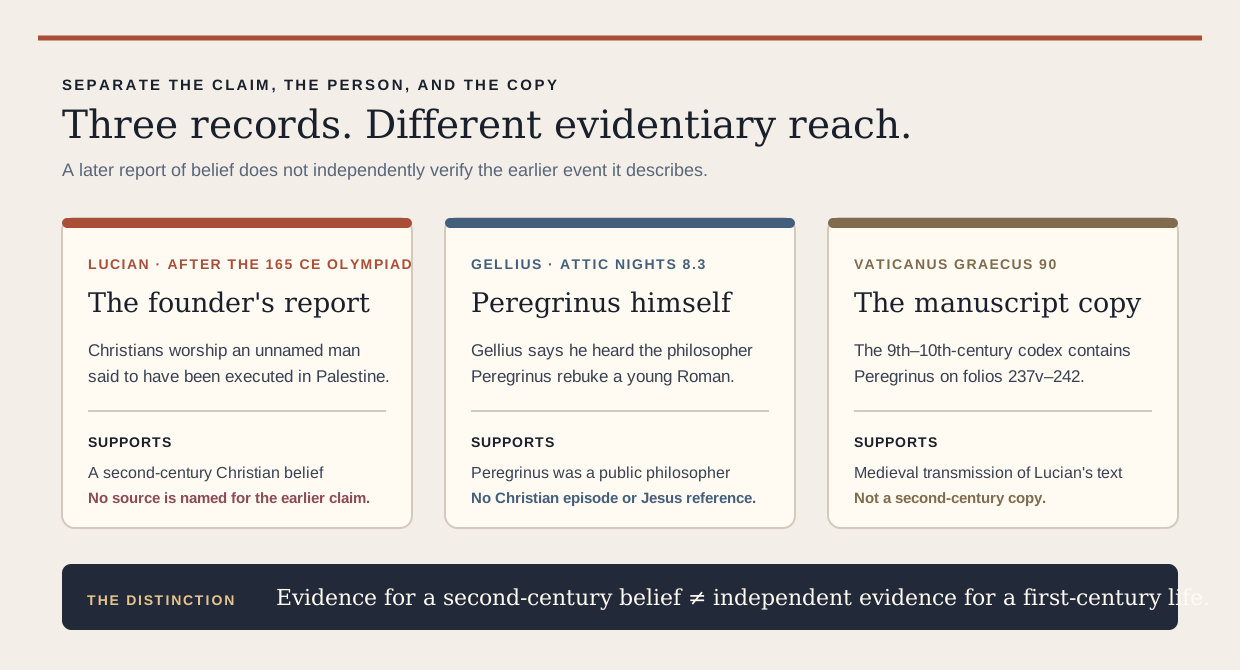
The earliest manuscript witness located in the catalogues reviewed here is Vaticanus graecus 90 (Γ), dated to the 9th–10th century; Pinakes lists The Passing of Peregrinus on folios 237v–242. Vaticanus Palatinus graecus 73, dated to the 13th century, preserves the complete work on folios 78v–87r. These manuscripts attest medieval transmission; neither is a contemporary copy of Lucian's text. The gap between the proposed second-century composition and the manuscript witnesses limits what the manuscript record itself can date.
Source and transmission audit
What Lucian, Gellius, and the manuscripts attest
| Text or witness | Source | What it says or does | What it cannot establish |
|---|---|---|---|
| Second century; usually placed around the 165 CE Olympic games | Lucian, The Passing of Peregrinus 11–16 | Describes Christians worshipping an unnamed founder said to have been executed in Palestine; the narration also calls the founder a lawgiver and refers to him again in §13. | Attests a second-century representation of Christian belief. Lucian gives no source, named witness, or date for the earlier events. |
| Second century; narrated as a recent event | Lucian, The Passing of Peregrinus 34–38 | The narrator says he attended Peregrinus' self-immolation at the Olympic games and describes the event in detail. | The claimed eyewitness scene concerns Peregrinus' death, not the earlier Christian episode or Jesus' execution. |
| Second century | Aulus Gellius, Attic Nights 8.3 | Gellius says that he heard the philosopher Peregrinus rebuke a young Roman in person. | Supports Peregrinus' existence as a philosopher; it says nothing about Christians, Jesus, or the founder described by Lucian. |
| Second century | Lucian, Alexander the False Prophet 25, 38 | Lucian says Alexander portrayed Christians and atheists in Pontus as abusive opponents, urged that they be driven away with stones, and excluded Christians from his mysteries. | Documents Lucian's report about Christian groups and their conflict with Alexander's cult; it provides no information about Jesus' life or execution. |
| 9th–10th century | Vaticanus graecus 90 (Γ), fols. 237v–242 | Pinakes lists The Passing of Peregrinus in this Lucian codex, the earliest known manuscript witness reviewed here. | This manuscript is many centuries later than Lucian's reported events; it witnesses the text's medieval transmission, not an eyewitness account. |
| 13th century | Vaticanus Palatinus graecus 73, fols. 78v–87r | The Heidelberg catalogue identifies the complete Peregrini obitus in this codex. | A further medieval copy, not a second-century manuscript or an eyewitness record. |
The case
Lucian is a non-Christian witness to a second-century Christian belief: its adherents worshipped an executed founder associated with Palestine. His satire reports that belief, but gives no contemporary record, named informant, or first-hand account of the founder's alleged life or execution.
Conclusion
Lucian shows that by the mid-second century Christians were described as worshipping an executed founder associated with Palestine. His text does not independently establish that this founder lived or was executed in the first century.